

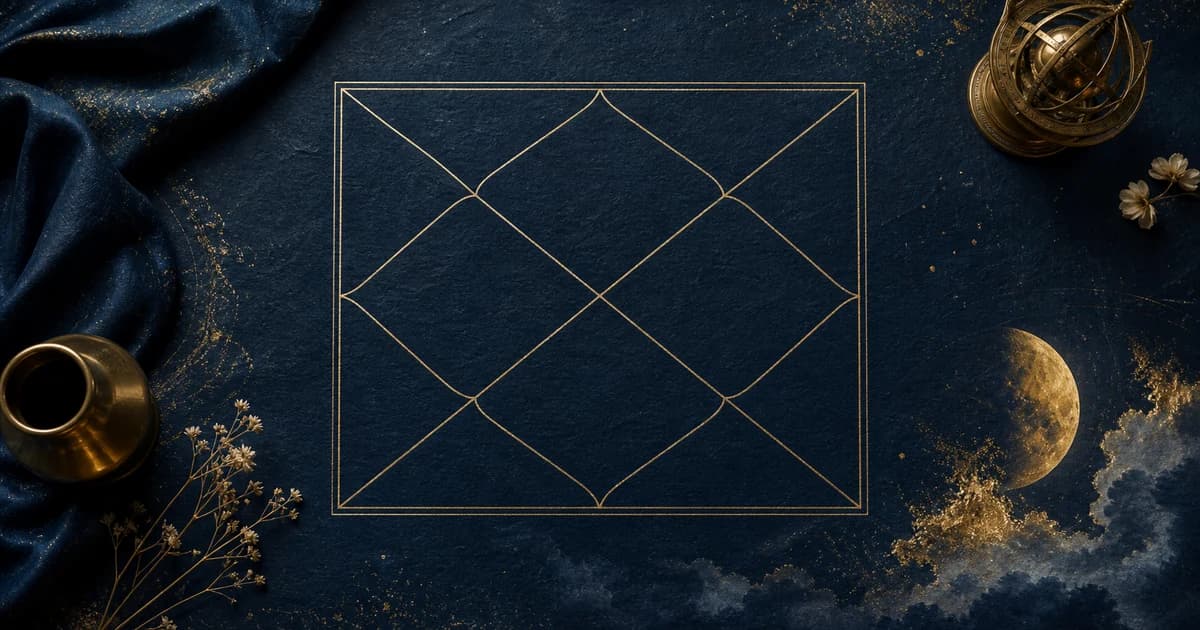
Vargas and the Navamsa chart
Sixteen charts from one birth moment, and the arithmetic problem that creates.
4 min read · Published 22 August 2026
Before the detail
Vargas are divisional charts, produced by subdividing each 30-degree sign into equal parts and mapping those parts onto a new chart. The Navamsa or D-9 divides each sign into nine parts of 3°20' and is by far the most used, consulted for marriage and for the underlying strength of planets. Sixteen standard vargas exist, each addressing a different area of life, and each is derived from the same birth moment rather than from new information.
How a divisional chart is made
Take the Navamsa. Each 30-degree sign divides into nine parts of 3°20' each. A planet's position within its sign determines which of those nine parts it falls in, and each part maps to a sign in the new chart by a fixed rule.
So a planet at 5° of a sign falls in the second navamsa; one at 25° falls in the eighth. Both are in the same sign in the main chart and in different signs in the D-9.
This is why divisional charts are so sensitive to birth time. A small error in the birth moment moves planets slightly in the main chart and can move them an entire sign in the D-9, and further still in higher divisions.
One divisional chart is a tool. Sixteen is a way of never being wrong, and I'd stop at the Navamsa.
The main vargas
| Chart | Divides each sign into | Traditionally read for |
|---|---|---|
| D-1 Rashi | 1 · the main chart | Everything; the basis of all the rest |
| D-2 Hora | 2 | Wealth |
| D-3 Drekkana | 3 | Siblings |
| D-4 Chaturthamsa | 4 | Property and fortune |
| D-7 Saptamsa | 7 | Children |
| D-9 Navamsa | 9 | Marriage, and underlying planetary strength |
| D-10 Dasamsa | 10 | Career and public standing |
| D-12 Dwadasamsa | 12 | Parents |
| D-16 Shodasamsa | 16 | Vehicles, comforts |
| D-20 Vimsamsa | 20 | Spiritual practice |
| D-24 Chaturvimsamsa | 24 | Education and learning |
| D-30 Trimsamsa | 30 | Misfortune and difficulty |
| D-60 Shashtiamsa | 60 | Everything, at the finest resolution |
Sixteen vargas are standard, and the list above covers the ones most commonly used. Practitioners vary in how many they consult; many work primarily with D-1, D-9 and D-10.
The combinatorial problem
Sixteen divisional charts, each with nine planets across twelve signs and twelve houses, generated from a single birth moment. That is a very large number of placements, and none of them contains information that wasn't already in the original chart. They're all arithmetic transformations of the same degrees.
With that many derived placements, a practitioner can find support for almost any reading. If the main chart doesn't show what is expected, a varga will. This is the same structural problem as yogas: an apparatus elaborate enough that something always fits.
It compounds with the precision issue above.
The defence, fairly stated
Practitioners would say the vargas are not independent evidence but magnification: a way of examining one area of life at higher resolution, in the same way you might read a Western chart's fifth house closely when asking about creativity.
That's a reasonable framing, and it makes the vargas a lens instead of a second opinion. Under it, a D-9 that disagrees with the D-1 isn't two conflicting readings but one reading examined at two scales.
The AsterNym Vedic calculator computes D1 and D9 and stops there. Two tested charts before thirty impressive ones: the higher vargas are extremely sensitive to birth-time precision and some have competing calculation conventions, so they are not shipped until they can be shown with the same care. D9 is withheld when the birth time does not support it.
 Mira Hale