

“It showed the math behind every number. First astrology site that treated me like an adult.”
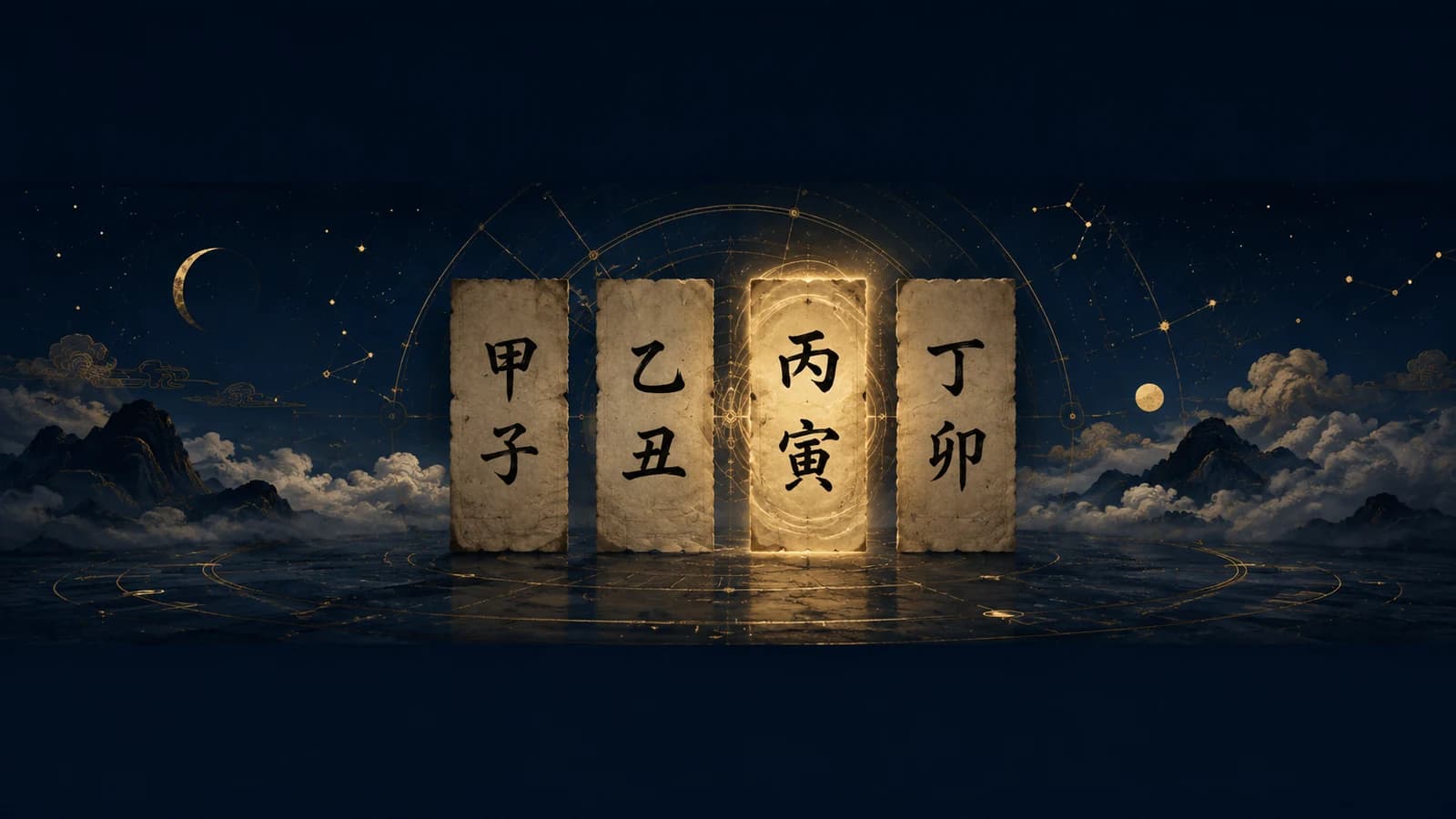
BaZi is Chinese astrology's Four Pillars. It turns your birth year, month, day and hour into eight characters and reads the balance of five elements in them.
BaZi · Four Pillars of Destiny
Your Day Master and Five Elements, read from four birth pillars
Add your birth date, and the hour if you have it, and the chart below fills in: your Day Master, the balance of the five elements, the Ten Gods and your ten-year luck pillars.
Reveal my chart · free →How to read it
Why the Day pillar leads
In BaZi, the Day Master. The Day pillar’s heavenly stem. Is the most important part of the chart. It represents your true self: every other element is read in relation to this single point. The Day pillar sets the core identity, the Month pillar shows your environment and background, the Year pillar represents your ancestors and early life, and the Hour pillar shows your later life and children.
Day pillar · you
- · The Day Stem is the core of the whole chart. The reference point everything else is judged against.
- · The Day Branch is the spouse palace: your inner heart and close relationships.
Month pillar · your world
- · Season of birth: the Month Branch establishes the season and carries special weight in judging Day Master strength.
- · Outer world: career, parents, and how you act in society.
Year pillar · your roots
- · Commonly associated with ancestry, family background and earlier life.
Hour pillar · your horizon
- · Commonly associated with later life, children, goals and what you leave behind.
This is why your AsterNym identity takes its element from the Day Master. The part of the chart that is most specifically you.
The chart in time
Your BaZi can change, and can’t
What stays the same
- The natal chart. The eight original characters: your four pillars: locked in at birth remain permanent your entire life.
- The reading of it. The eight birth characters stay fixed. Their traditional interpretation describes recurring tendencies. While how you express them can change with experience and circumstance.
What changes over time
- Luck Pillars (Da Yun). Approximately ten-year elemental phases with a traditionally calculated starting age. They do not simply flip on each birthday decade. Each phase interacts with the birth chart like changing weather.
- Annual and monthly cycles. Each passing year and month brings active elements that temporarily clash with, combine with or support your original chart: altering your current timing and opportunities.
Read your chart as the instrument and the cycles as the weather it plays in. The instrument never changes, the music does.
How this reading is constructed
The four pillars are calculated from a birth date, time and place. The ten gods come from each stem’s relationship to the Day Master together with its polarity. Strength classification, the choice of a Useful God, transformation rules and true-solar-time conventions vary between schools, so anything school-dependent is labelled as such rather than presented as settled.
- BaZi year
- Changes at the exact instant of Li Chun 立春, not at Lunar New Year.
- BaZi month
- Changes at the twelve Jie 節 solar-term boundaries, not at every one of the 24 terms.
- BaZi day
- AsterNym uses civil midnight; some lineages change the day at 23:00. A late-Zi birth is shown both ways.
- BaZi hour
- AsterNym uses recorded civil clock time. Some practitioners correct to local solar time; where that would change the hour pillar, the alternative is shown.
AsterNym BaZi method · version 1, one documented implementation of Four Pillars, with school-dependent choices labelled rather than hidden. Hidden stems weighted 60/30/10 and 70/30 as implementation weights. Not medical or financial advice. Read the complete methodology →
Reading on BaZi
The Four Pillars in longer form, where the system came from, how it is calculated, and what it will not tell you.
- Missing BaZi elements: what an absent element means
When one of the five elements is absent from your Four Pillars: what it means, what it does not, and how a reader supplies it. A missing element is a talking point, not a diagnosis.
5 min read
- The BaZi Peach Blossom star, explained
The romance-and-charm star of BaZi, found from the animal branches, and always landing on a cardinal one. Half my clients have it.
4 min read
- BaZi vs Chinese zodiac: why they're not the same thing
The animal is one of eight characters. The other seven are the system, and they turn the year on a different day.
4 min read
- Why BaZi needs your exact birth hour
A quarter of the chart, and often the quarter that changes the answer. I will not read without it.
5 min read
- Clashes, combinations and harms between branches
Six clashes, six combinations, four trines, and the arithmetic that means almost everyone has some. Count only the ones that touch the day pillar.
11 min read
- Day Master: the single most important element in your chart
One of ten characters, and every other thing in your chart is described by what it does to it. Start here or don't start.
4 min read
- Luck Pillars: how BaZi handles timing
Ten-year periods with their own characters, and the timing structure Western astrology has no equivalent for. I read them last, always.
5 min read
- How to read your Four Pillars chart
Eight characters in a grid, and the reading order I teach, because the order is most of the skill.
4 min read
- Heavenly Stems and Earthly Branches: the building blocks
Ten and twelve, turning together into sixty, the oldest calendar still in daily use. The hidden stems are where I earn my fee.
4 min read
- The Ten Gods explained
Five relationships, split by yin and yang, and the whole interpretive layer of BaZi. Learn the polarity rule and half the mistakes disappear.
5 min read
- Favourable God and element balance
The element a chart most needs, by one method or another, and the most disputed judgement in the whole system. Two teachers, two answers, one chart.
5 min read
- What is BaZi? The Chinese system that isn't the zodiac
Eight characters, four pillars, and about twelve times more information than the animal on your placemat. This is the system I read in Hong Kong every week.
4 min read