

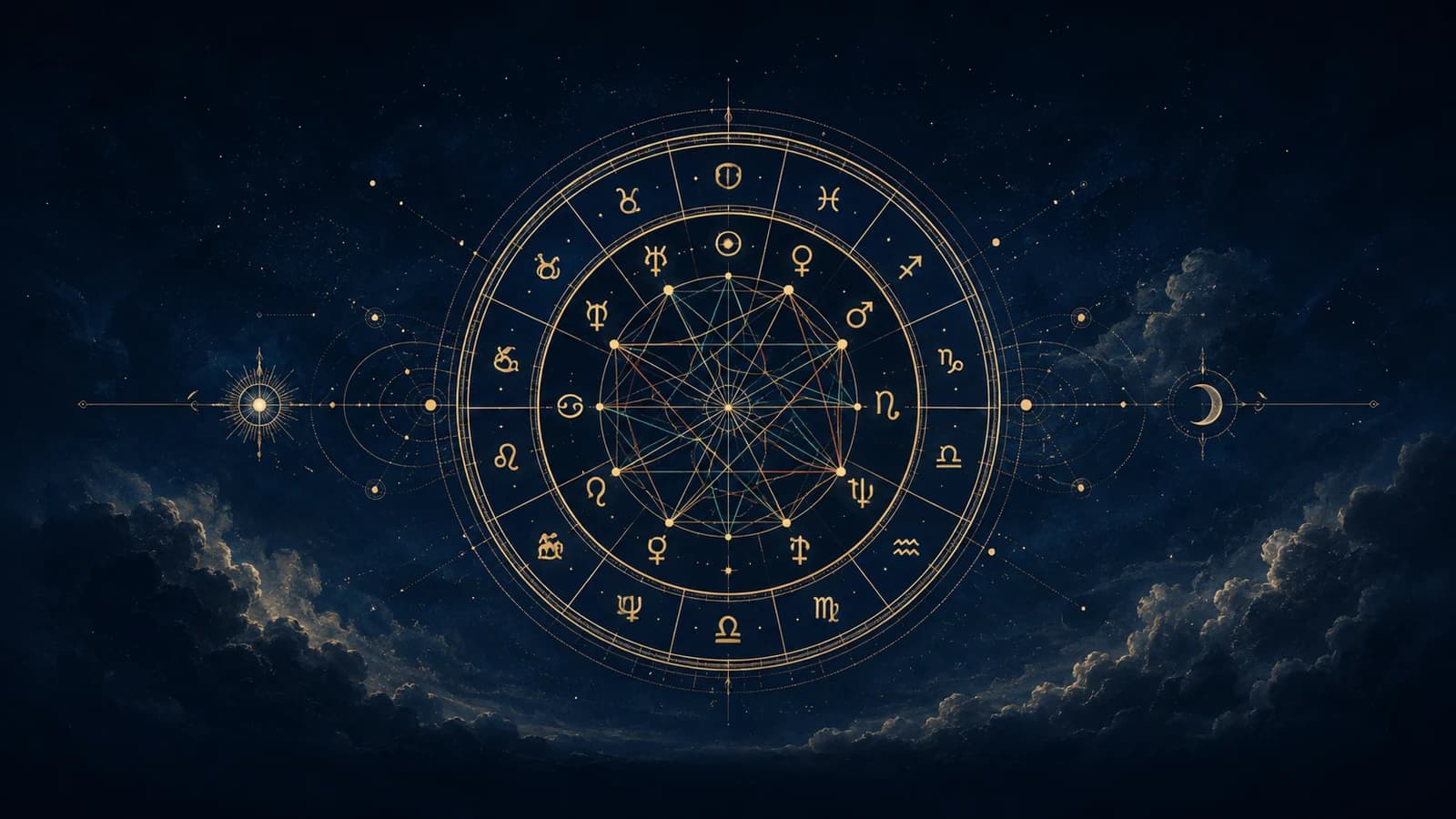
Natal chart
The sky, frozen at your first breath
The Western birth chart: where the ten chart bodies sat at the moment you were born, which houses they fell in, and the major angles between them. Your Sun sign is one line of it.
Enter your birth date, exact time and city to draw the chart of your birth moment. AsterNym places the ten chart bodies used in modern natal astrology, the Sun, Moon and Mercury through Pluto, across twelve whole-sign houses, and shows the major aspects between them.
Your chart is one birth moment away
Enter your details and the wheel below is drawn on this page: exact time and city unlock your Ascendant and the twelve houses.
How to read your chart
What each chart body carries
Astrology groups the Sun and Moon with the eight planets for interpretation, even though astronomically they are a star and a satellite. AsterNym calls the ten together the chart bodies.
- Sun, your core self: identity, vitality, what you are here to become.
- Moon, your inner life: feelings, instincts, what you need to feel safe.
- Mercury, your mind: how you think, speak, learn and connect ideas.
- Venus, your affections: how you love, what you find beautiful, what you value.
- Mars, your drive: how you act, assert, desire and fight.
- Jupiter, your growth: where you expand and what you trust.
- Saturn, your discipline: where you meet limits, duty and mastery.
- Uranus, your rebellion: where you break patterns and need freedom.
- Neptune, your dreams: imagination, longing, and where edges blur.
- Pluto, your depths: power, transformation, what refuses to stay buried.
The four angles: ASC, DSC, MC and IC
Four abbreviations sit around the edge of your wheel. They aren’t planets. They are four directions in the sky at the moment you were born, fixed by your exact time and place: where the ecliptic met the eastern horizon, where it met the western one, and the two points where it crossed your meridian. They are why a birth time matters: the planets move very little in an hour, the Moon by up to 0.6°, but these swing right around the chart.
- ASCAscendant· east, the left of the wheel
- The exact degree rising over the eastern horizon as you were born, your rising sign. Read as how you meet the world and how the world first meets you: your manner, your instincts on arrival, the face people meet before they know you. It also sets the whole house system: your rising sign becomes the first house.
- DSCDescendant· west, the right of the wheel
- The point setting in the west, exactly opposite the Ascendant. Read as what you meet in others, the qualities you notice, need, and tend to partner with, including the ones you have not yet claimed as your own.
- MCMidheaven· the upper meridian
- Medium Coeli. The degree where the ecliptic crosses your local upper meridian at the birth moment. It is not the point overhead, and under Whole Sign houses it is not the start of the 10th house. Traditionally associated with public role, reputation and direction.
- ICImum Coeli· the lower meridian
- The degree exactly opposite the Midheaven, where the ecliptic crosses the lower meridian. Traditionally associated with home, roots and private foundations.
ASC and DSC are always exactly opposite each other, as are MC and IC. Each pair is one axis seen from both ends. You may see the Ascendant written as AC and the Midheaven as Medium Coeli; they mean the same thing. Without a birth time we cannot place any of them, so an untimed chart shows no angles rather than a guess.
The twelve houses
Signs describe how a chart body acts; houses describe where in life it acts. AsterNym uses Whole Sign houses, one of the earliest attested house systems: your rising sign becomes the first house, and each following sign becomes the next house. The 10th house begins at 0° of the tenth sign from your Ascendant. Your MC is calculated separately and usually falls in the 10th Whole Sign house, though it can land anywhere from the 8th to the 12th. The further from the equator you were born the more often it leaves the 10th: near 60° north it sits outside the 9th, 10th and 11th in roughly one chart in four.
- 1
- self, body, how you arrive
- 2
- money, possessions, self-worth
- 3
- mind, siblings, the local world
- 4
- home, family, roots
- 5
- creativity, romance, play
- 6
- work, habits, health
- 7
- partnership, marriage, open rivals
- 8
- shared resources, intimacy, transformation
- 9
- belief, travel, higher learning
- 10
- career, reputation, public life
- 11
- friends, community, the future
- 12
- the inner world, rest, what is hidden
You may see the 4th and 10th houses labelled elsewhere as your mother and father, and just as often labelled the other way round. We don’t assign parents to houses; here is why the tradition disagrees with itself.
The five major aspects
Aspects are the angles planets make to each other, the lines across the middle of the wheel. They describe how your drives cooperate or collide.
- Conjunction, The two drives operate together. Their meanings blend and intensify.
- Sextile, An easy, friendly angle. The cooperation shows up once you make the first move.
- Square, A friction angle. The tension irritates, and worked with, it builds real strength.
- Trine, The easiest angle: talent so native you may not notice it is rare.
- Opposition, Magnetic opposites, a see-saw that wants balance, often lived out through other people.
Calculation settings
Planet positions are geocentric ecliptic longitudes computed with an astronomical ephemeris for your birth moment, the same engine that draws your birth sky. They do not depend on where you were born: the same UTC instant gives the same longitudes in Singapore and London. Your birthplace resolves the historical time zone and sets the local horizon, so the Ascendant, Midheaven and houses do depend on it. The positions are calculated fact; the meanings are traditional interpretation, offered for reflection.
- zodiac
- tropical
- reference_frame
- geocentric
- ephemeris
- astronomy-engine 2.1.19
- positions
- apparent (light-time and aberration applied)
- house_system
- Whole Sign
- ascendant
- exact intersection of the ecliptic with the eastern horizon
- midheaven
- intersection of the ecliptic with the upper meridian (RAMC projected onto the ecliptic)
- lunar_node
- mean node (Meeus)
- aspect_set
- conjunction, sextile, square, trine, opposition
- aspect_orb_policy_version
- western_v1
- time_conversion
- IANA time-zone database via luxon, historical rules included
- unknown_time
- planets sampled across the whole civil day; aspects classified stable, possible or impossible; no Ascendant, houses or exact Moon
Aspect orbs, policy western_v1
| Aspect | Angle | Base orb |
|---|---|---|
| conjunction | 0° | 8° |
| sextile | 60° | 5° |
| square | 90° | 7° |
| trine | 120° | 7° |
| opposition | 180° | 8° |
One table for the natal chart, the Famous pages and compatibility. No wider orb for the Sun or Moon.
Reading on chart mechanics
House systems, aspects, orbs and the parts of a chart that are contested, worked through slowly.
- Antiscia and contra-antiscia in traditional astrology
Points mirrored across the solstice axis, a real traditional technique most software ignores.
2 min read
- Asteroids in astrology: Ceres, Pallas, Juno, Vesta
Discovered in the 1800s, ignored for 170 years, then assigned meanings in the 1970s.
2 min read
- Chart shapes: bowl, bucket, locomotive, splash
Seven named distributions, and a scheme where most charts fit two of them at once.
2 min read
- Decans: the 36 subdivisions behind your sign
Thirty-six faces, two rulership schemes, and an origin older than the zodiac.
2 min read
- Essential dignities: domicile, exaltation, detriment, fall
A scoring system for how comfortably a planet sits, and the backbone of traditional judgement.
2 min read
- Angular, succedent, cadent: house strength explained
Twelve houses in three groups of four, the oldest way of judging how loudly a planet speaks.
2 min read
- Intercepted signs: when a whole sign hides in a house
A real feature of some house systems, and absent from others.
2 min read
- Out of bounds Moon: why some people feel different
A real astronomical condition, measured in declination, not longitude.
2 min read
- Part of Fortune: the point nobody talks about
The oldest of the Arabic parts, and the one most calculators compute incorrectly.
2 min read
- How to find your rising sign without a birth time
You find the time. Here's where it's written down, and what to do if it truly isn't.
10 min read
- Astrological aspects: conjunctions, squares, trines and oppositions
Placements describe the pieces. Aspects describe the arguments between them, which is where a chart stops being a list.
9 min read
- House systems compared: whole sign, Placidus and equal houses
The same birth, the same software, a different house system, and your Sun changes house. This is astrology's most consequential unresolved argument.
9 min read
- The planets in astrology: what each one represents
In astrology the planets are the active agents of a chart.
9 min read
- The 12 houses of astrology, explained in order
Signs describe how something behaves. Houses decide where in a life it happens, and one of those is personal to the minute.
9 min read
Where were your planets?
Birthday gets you the planets in their signs. Exact time and city unlock the Ascendant, the houses and the full wheel.
Draw my natal chart →