Planetary metals
Seven metals, seven planets
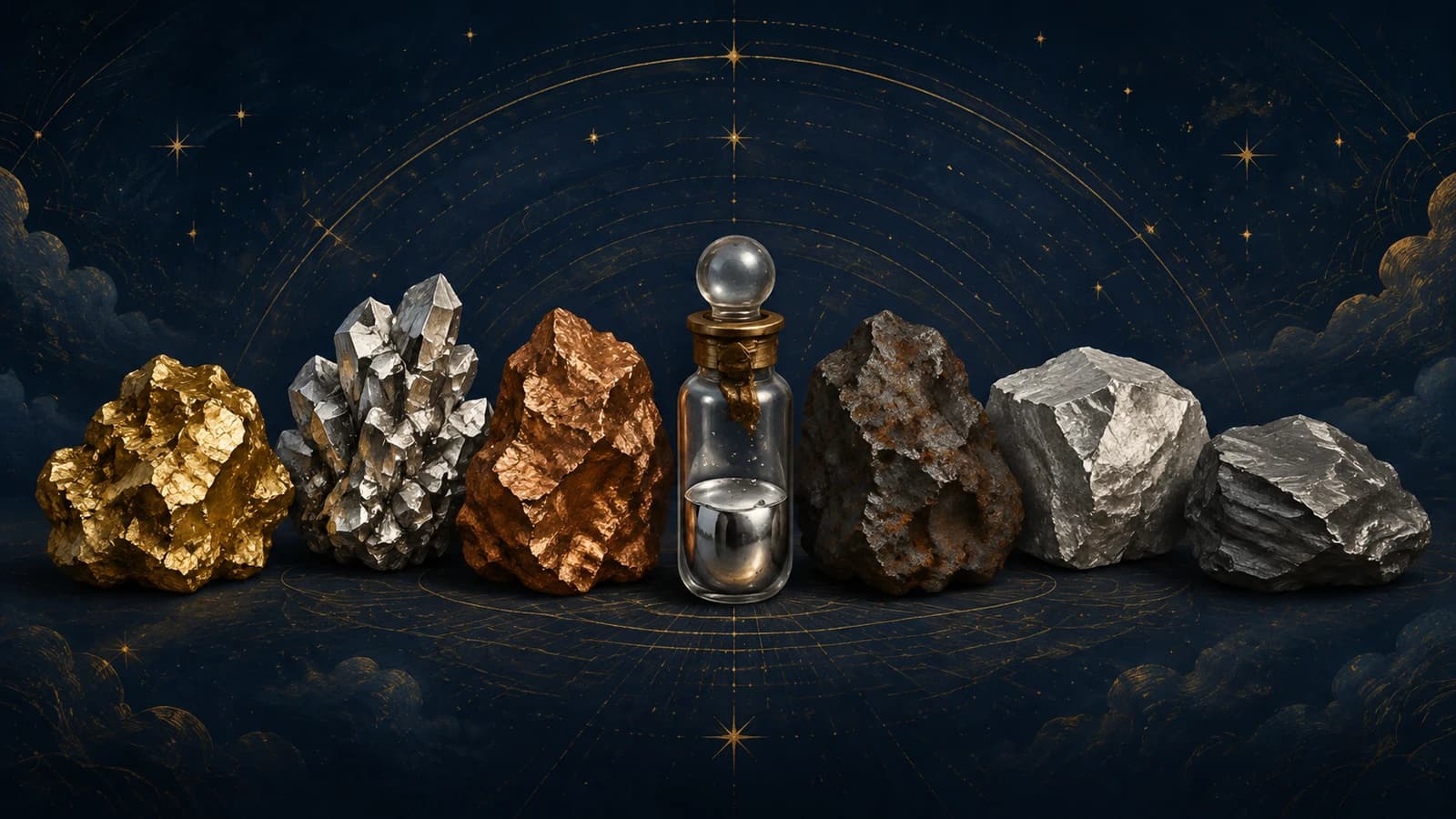
Seven metals became paired with the seven classical planets in the astrological and alchemical tradition: gold with the Sun, silver with the Moon, quicksilver with Mercury, copper with Venus, iron with Mars, tin with Jupiter and lead with Saturn. The familiar set became standard in medieval and early-modern alchemy, although earlier correspondences were not always identical.
AsterNym keeps the historical pairing separate from the modern metaphor we draw from each metal’s physical properties.
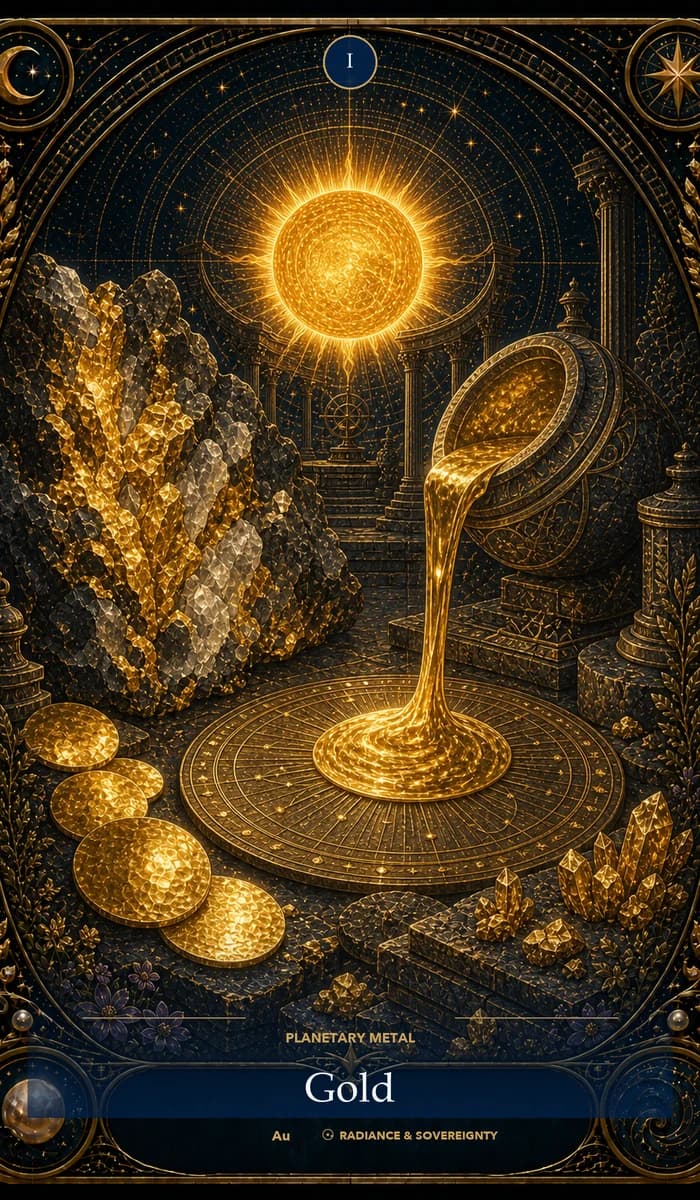
Gold Au
- Material
- Symbol Au · atomic number 79 · solid at 20 °C · density 19.3 g/cm³
- Historical correspondence · Sun
- Gold became the standard alchemical metal of the Sun and was associated with perfection, the highest stage of metallic refinement. Its brilliance, rarity and resistance to corrosion make an apt later metaphor for solar permanence and visibility.
- AsterNym reads it as
- What stays recognisably yours under pressure: visible, warm, and difficult to corrode.
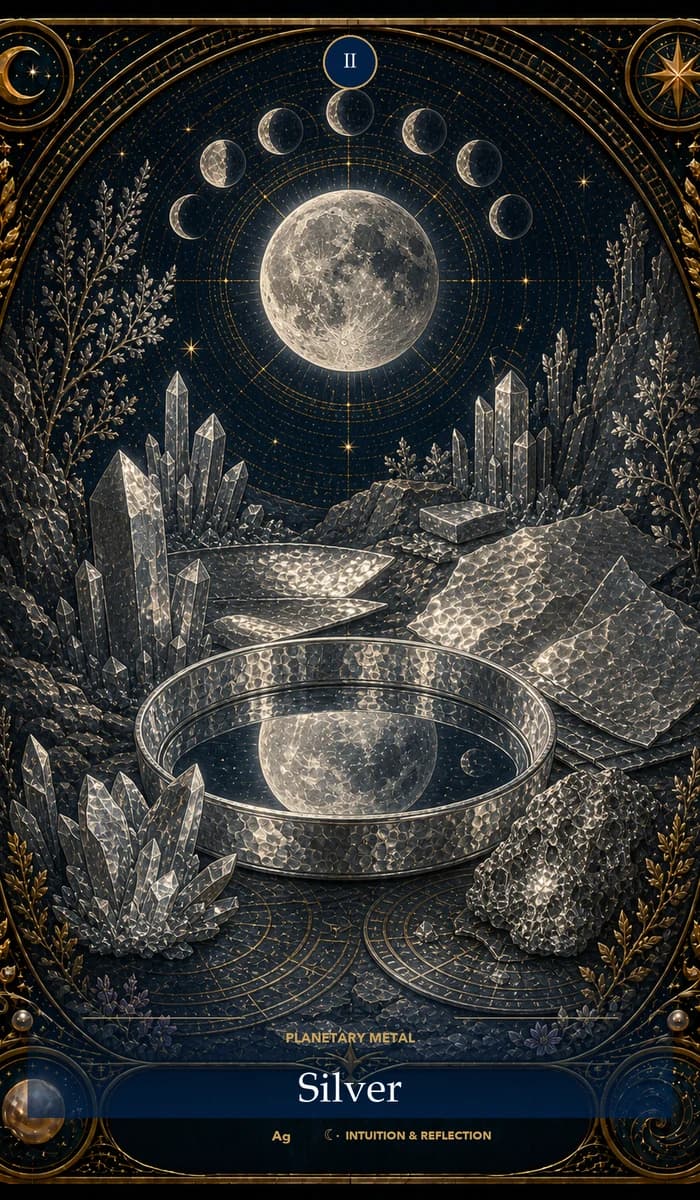
Silver Ag
- Material
- Symbol Ag · atomic number 47 · solid at 20 °C · density 10.5 g/cm³
- Historical correspondence · Moon
- Silver became the Moon's standard metal. Polished silver has exceptionally high visible-light reflectivity, which makes the correspondence easy to understand symbolically.
- AsterNym reads it as
- Receptivity: you take the shape of what you are near, and see clearly by reflected light.
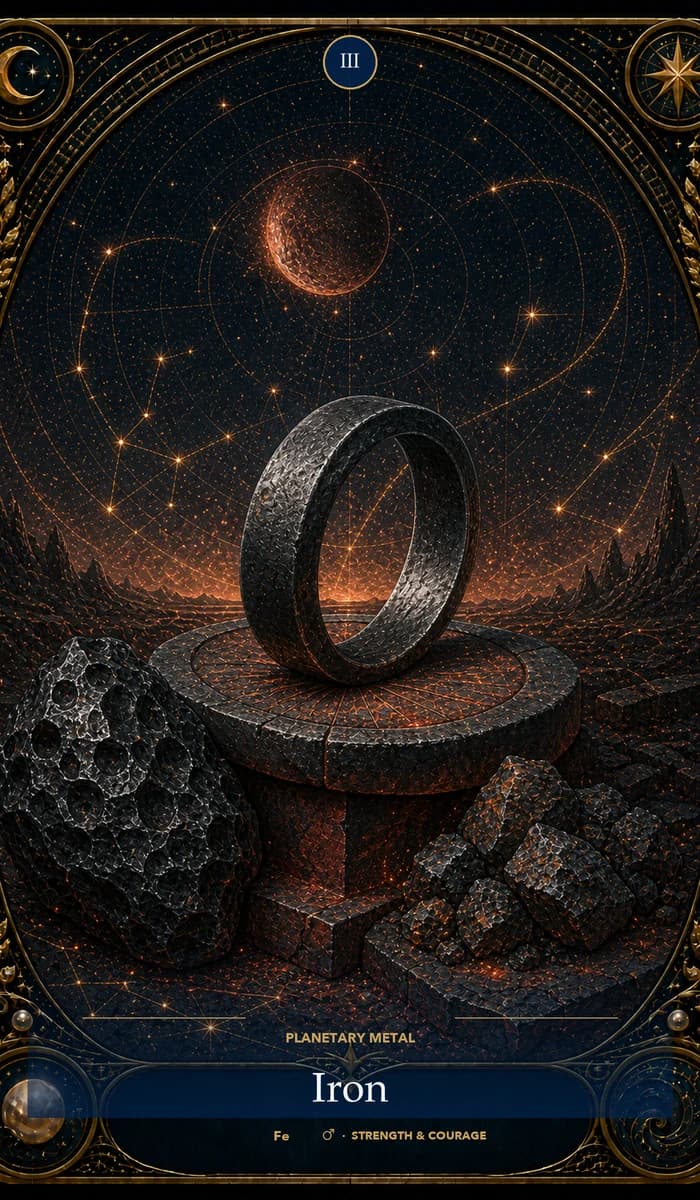
Iron Fe
- Material
- Symbol Fe · atomic number 26 · solid at 20 °C · density 7.87 g/cm³
- Historical correspondence · Mars
- Iron became associated with Mars in the standard alchemical system. Its use in weapons and tools provides an intuitive metaphor for force directed toward conflict or work.
- AsterNym reads it as
- Force with a use: strength that means something when it is pointed at work instead of at people.
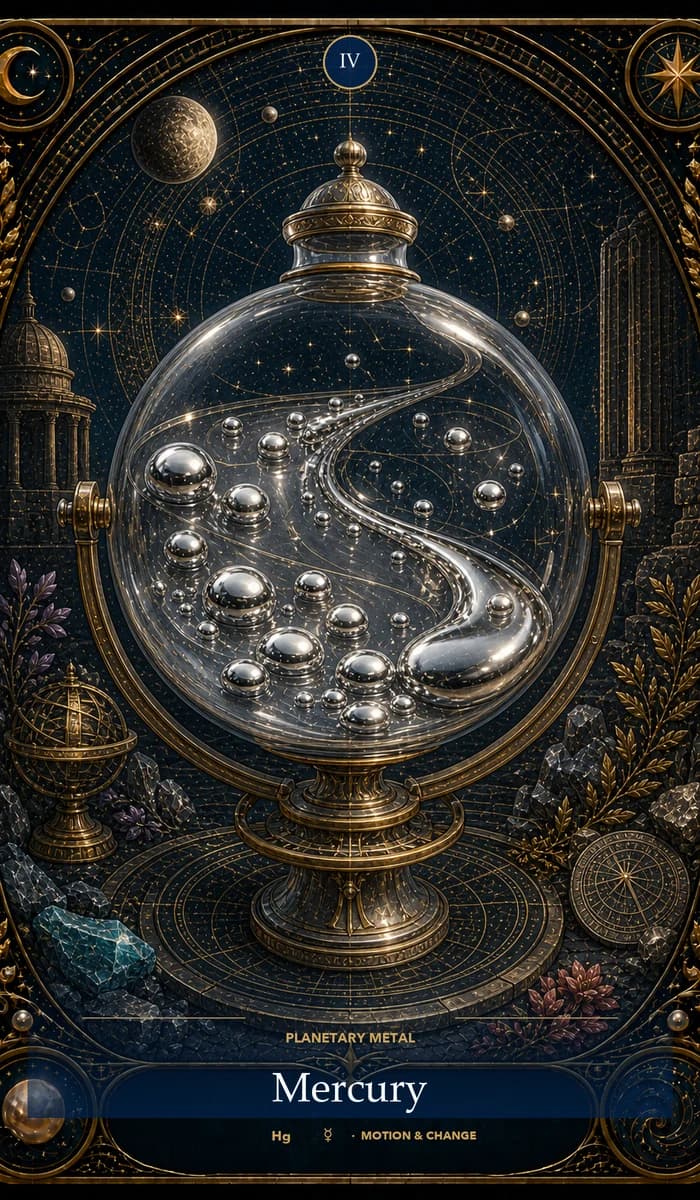
Quicksilver Hg
- Material
- Symbol Hg · atomic number 80 · liquid at 20 °C · density 13.5 g/cm³
- Historical correspondence · Mercury
- Quicksilver became Mercury's metal, and it is the only elemental metal that is liquid at ordinary room temperature. Quicksilver was known long before the modern chemical name mercury; the later name reflects its alchemical association with the planet.
- AsterNym reads it as
- Quickness: a mind that will not sit still long enough to be held.
- Safety
- Elemental mercury and many mercury compounds are toxic. The correspondence here is historical and symbolic; it is not a recommendation to handle or wear mercury.
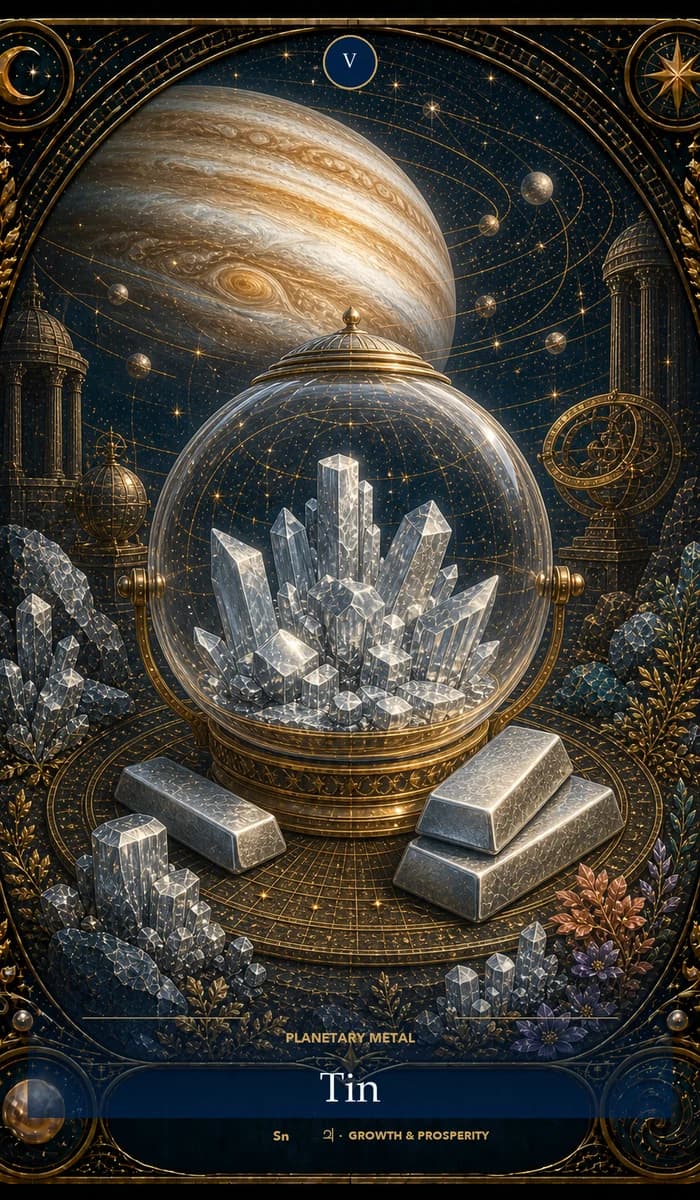
Tin Sn
- Material
- Symbol Sn · atomic number 50 · solid at 20 °C · density 7.31 g/cm³
- Historical correspondence · Jupiter
- Tin became Jupiter's standard alchemical metal. AsterNym uses its role in bronze-making, where a little tin turns copper into a far more useful alloy, as a modern metaphor for Jupiter's traditional themes of increase and expansion.
- AsterNym reads it as
- Increase: the quality that makes the things around you larger.
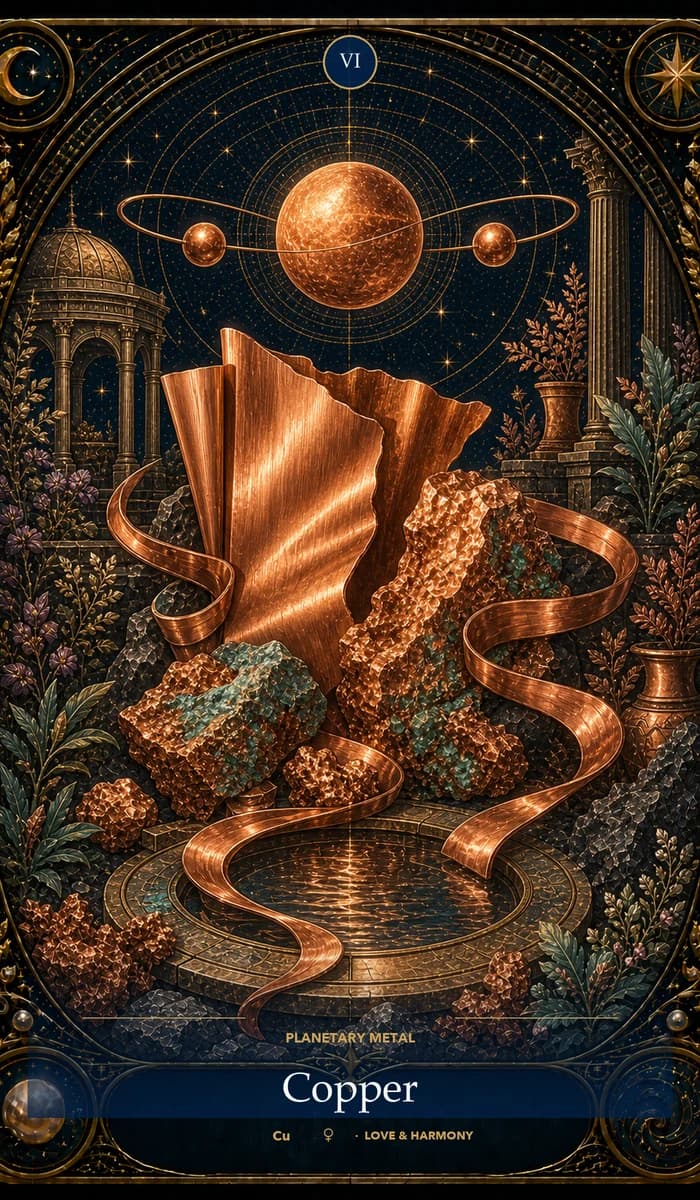
Copper Cu
- Material
- Symbol Cu · atomic number 29 · solid at 20 °C · density 8.96 g/cm³
- Historical correspondence · Venus
- Copper became Venus's alchemical metal. Cyprus was famous for copper mining, the metal's English name ultimately derives from Latin cuprum, Cyprian metal, and the island was also central to the cult of Aphrodite, the Greek counterpart of Venus. Those are three real connections; none of them is a documented reason for the pairing.
- AsterNym reads it as
- Connection: warmth that passes easily between people, as copper passes heat and current.
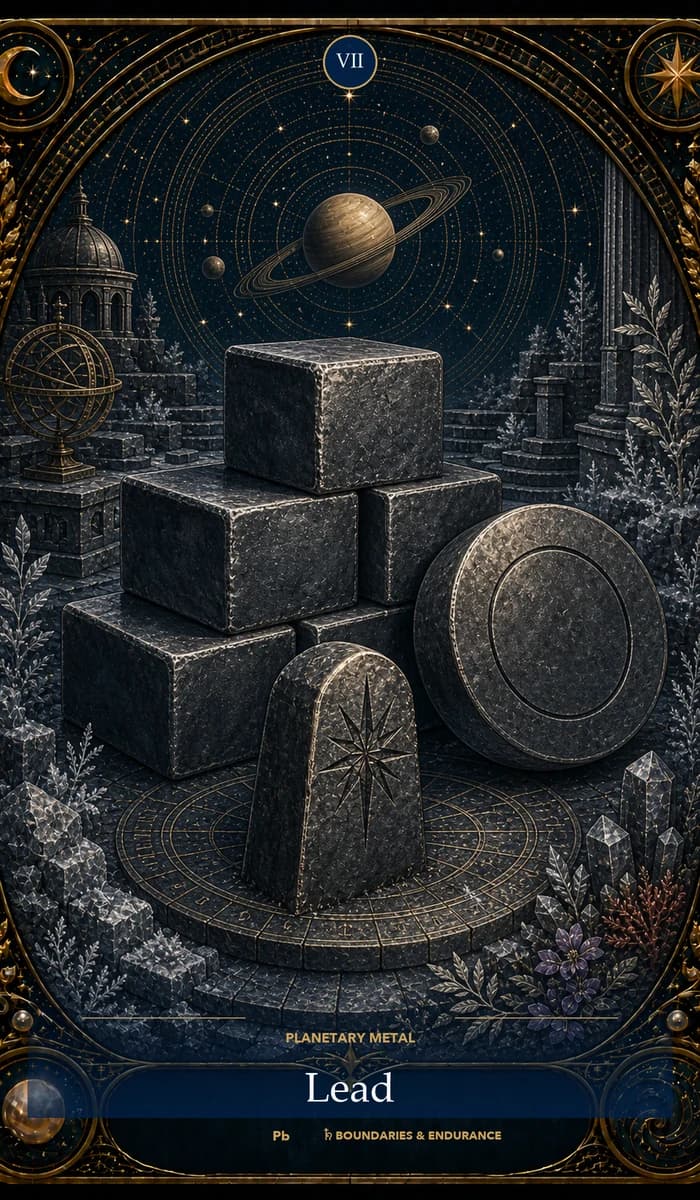
Lead Pb
- Material
- Symbol Pb · atomic number 82 · solid at 20 °C · density 11.3 g/cm³
- Historical correspondence · Saturn
- Lead became Saturn's standard metal. Its density, heaviness and durability align neatly with later Saturnian symbolism around weight, limits and endurance.
- AsterNym reads it as
- Weight and limit: what endures, and what you are willing to carry.
- Safety
- Lead is toxic. A planetary metal is a symbolic correspondence, not a recommendation to wear, ingest or handle the material.
Your AsterNym planetary metal
AsterNym derives your planetary metal from the traditional ruler of your tropical Sun sign. The planet–metal correspondence is historical; using your Sun-sign ruler to select one personal metal is AsterNym’s own synthesis. It has one practical merit: it works without a birth time. A traditional astrologer wanting one ruling planet for a person would more often take the Ascendant ruler, which needs one.
| Sun sign | Traditional ruler | Historical metal correspondence |
|---|---|---|
| Aries | Mars | Iron Fe |
| Taurus | Venus | Copper Cu |
| Gemini | Mercury | Quicksilver Hg |
| Cancer | Moon | Silver Ag |
| Leo | Sun | Gold Au |
| Virgo | Mercury | Quicksilver Hg |
| Libra | Venus | Copper Cu |
| Scorpio | Mars | Iron Fe |
| Sagittarius | Jupiter | Tin Sn |
| Capricorn | Saturn | Lead Pb |
| Aquarius | Saturn | Lead Pb |
| Pisces | Jupiter | Tin Sn |
Because AsterNym uses traditional rulerships, all twelve signs resolve to the seven classical planets, so everyone has a metal, and it is the same planet behind the planetary stone in your report.
Why isn’t uranium Uranus’s planetary metal?
Uranium was discovered in 1789, long after the seven-metal alchemical system developed, and was named after the recently discovered planet Uranus. The naming direction is modern chemistry borrowing from astronomy, not ancient astrology assigning Uranus a metal. The same holds for neptunium and plutonium, named in the 1940s.
How the correspondence travelled
- 1
Ancient metallurgy
Gold, silver, copper, iron, tin, lead and mercury are the seven metals widely known from antiquity, alongside other metallurgical substances such as antimony compounds.
- 2
Classical planetary astrology
Seven visible wanderers and lights: Sun, Moon, Mercury, Venus, Mars, Jupiter, Saturn.
- 3
Late antique and medieval natural philosophy
Metals and planets are paired in several schemes; earlier correspondences were not always identical to the later standard.
- 4
Alchemy
The standard seven metal–planet correspondences consolidate and are used throughout medieval and early-modern alchemical texts.
- 5
Early modern chemistry
Planetary glyphs continue to stand for the metals in manuscripts and early printed works.
- 6
Modern chemistry
Au · Ag · Hg · Cu · Fe · Sn · Pb: standardised element symbols replace the glyphs.
- 7
AsterNym
The historical correspondences reused as a reflective layer, with the modern metaphor labelled as ours.
In alchemical manuscripts, planetary glyphs also served as symbols for their corresponding metals. Modern chemistry later replaced these with standardised element symbols such as Au, Ag and Fe.
Find your metal
Your full report carries it alongside your three stones, your flowers and your numbers, with the derivation shown.
Safety: Planetary metals are symbolic correspondences. Some, particularly mercury and lead, are toxic and should not be used as personal objects without appropriate safety knowledge.