
Asteroids & centaurs
The small bodies: what they are, and which ones we place
Chiron, Ceres and the centaurs turn up constantly in modern astrology. They are real objects with real orbits and interesting science. AsterNym places four of them on public-figure pages from JPL data, leaves the rest out, and this page explains what each one is and where the line sits.
How we place them, and which we don’t
Every planet, house cusp and rising star on this site comes from astronomy-engine, which computes the Sun, Moon and eight planets and nothing smaller. For Chiron, Ceres, Eros and Hygiea we take heliocentric vectors from JPL Horizons, sampled from 1700 to 2100, interpolate between samples, subtract Earth’s position from the same engine as the planets, and convert to the ecliptic of date. The result is checked against Horizons to a hundredth of a degree in a test that runs before every deploy. Those four appear on public-figure pages alongside the mean Black Moon Lilith. Pallas, Juno, Vesta and the other centaurs are not placed anywhere yet, and a body we have not tested is a body we do not print.
The nine we cover
Five main-belt bodies, one dwarf planet and four asteroids, plus four centaurs from the outer Solar System. There is no canonical list of nine astrological minor bodies. We chose five prominent main-belt objects and four commonly discussed centaurs because they recur most often in modern astrology and have interesting astronomical stories of their own.
The science in each entry is observed or measured and checkable. The astrological line is modern interpretation: none of it is ancient astrology. Ceres was not discovered until 1801 and Chiron until 1977, and the interpretations entered serious astrological use mainly in the late twentieth century. Reporting how practitioners read these bodies is not the same as endorsing it.
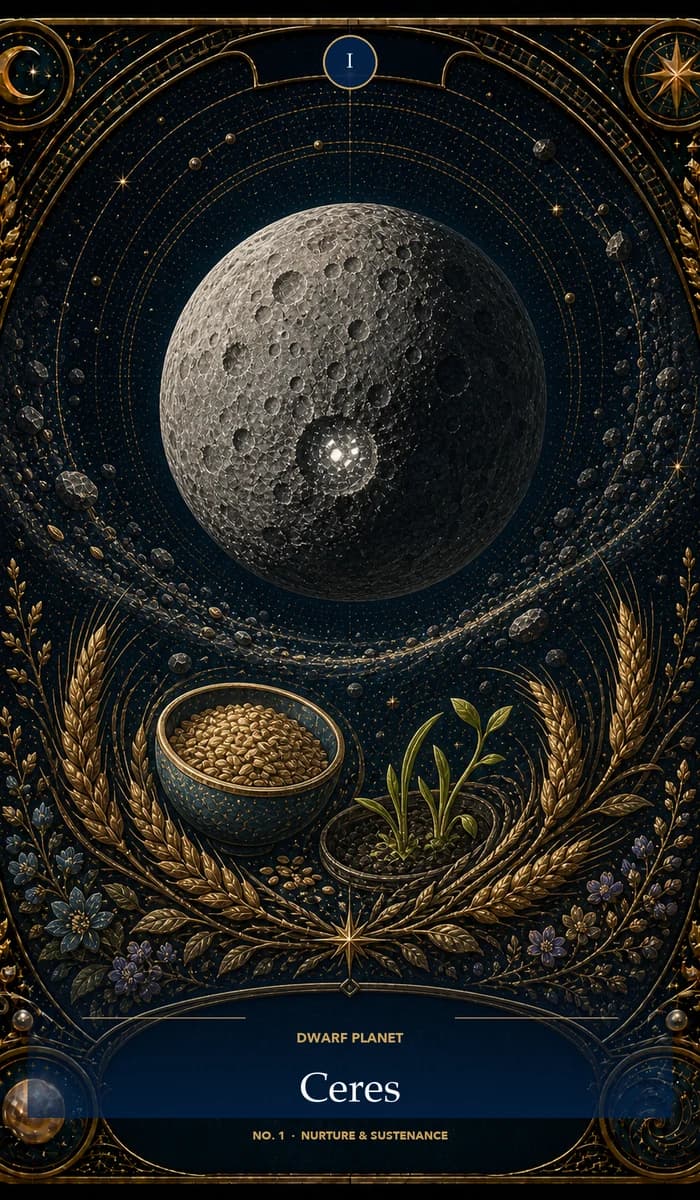
Ceres(1)
Dwarf planet · C-type
Astronomy · observed or measured: The largest object in the asteroid belt and the only dwarf planet inside Neptune's orbit, about 940 km across. It holds about a third of the belt's total mass, and models suggest it may be as much as about 25% water by mass, potentially more water in total than Earth.
Modern astrology · interpretive tradition: Astrologers who use it read Ceres as nurture and sustenance: how you feed people and how you want to be fed.
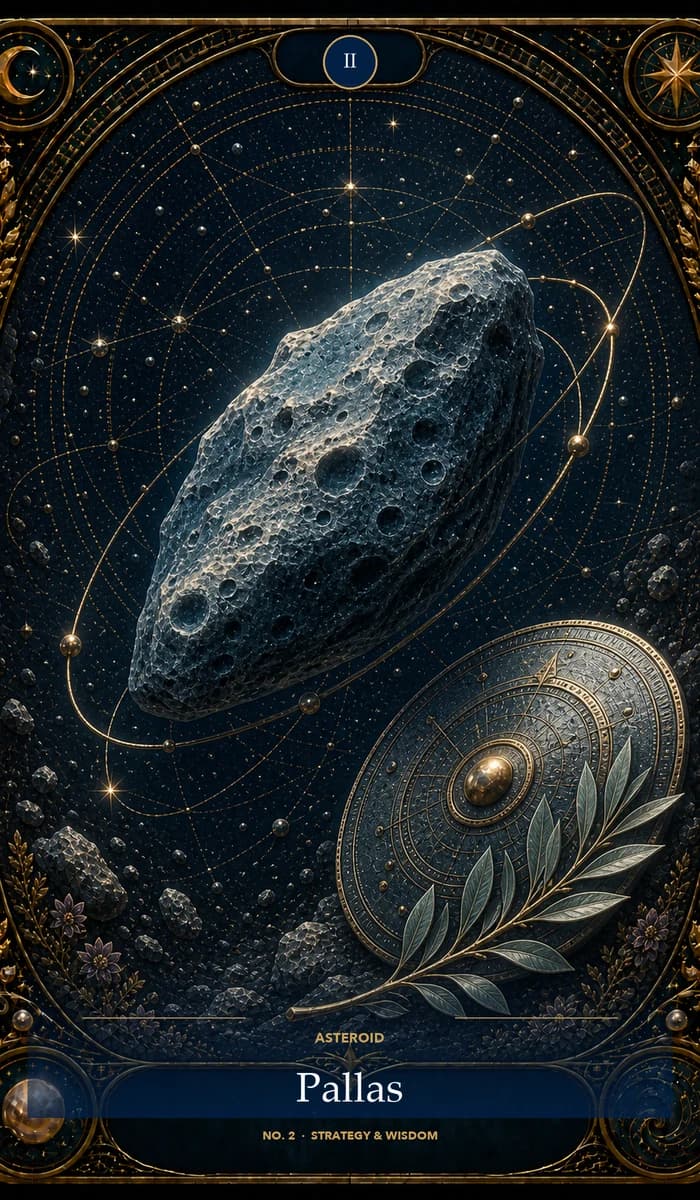
Pallas(2)
Asteroid · B-type
Astronomy · observed or measured: The third-largest asteroid, on an unusually tilted orbit that makes it expensive to reach; no spacecraft has ever visited it.
Modern astrology · interpretive tradition: Read as strategy and pattern recognition: intelligence applied to a problem rather than to a book.
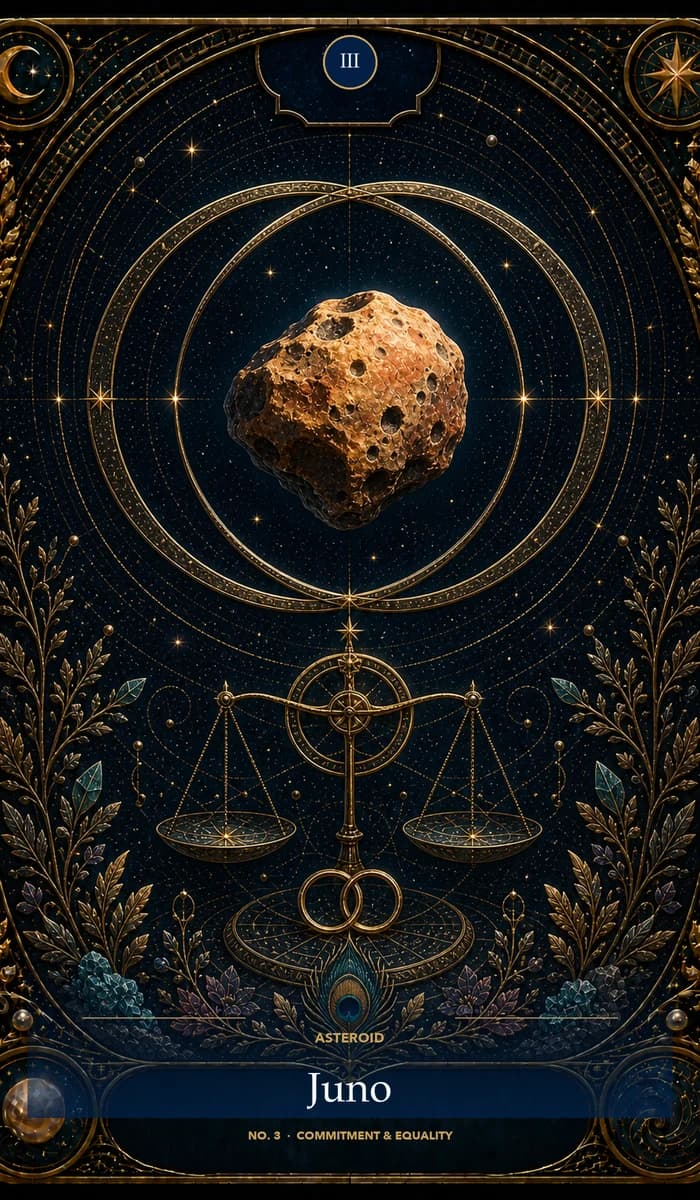
Juno(3)
Asteroid · S-type
Astronomy · observed or measured: One of the first asteroids ever found, in 1804, and briefly counted as a planet before the belt was understood.
Modern astrology · interpretive tradition: Read as commitment and fairness inside a partnership: what you need in order to stay.
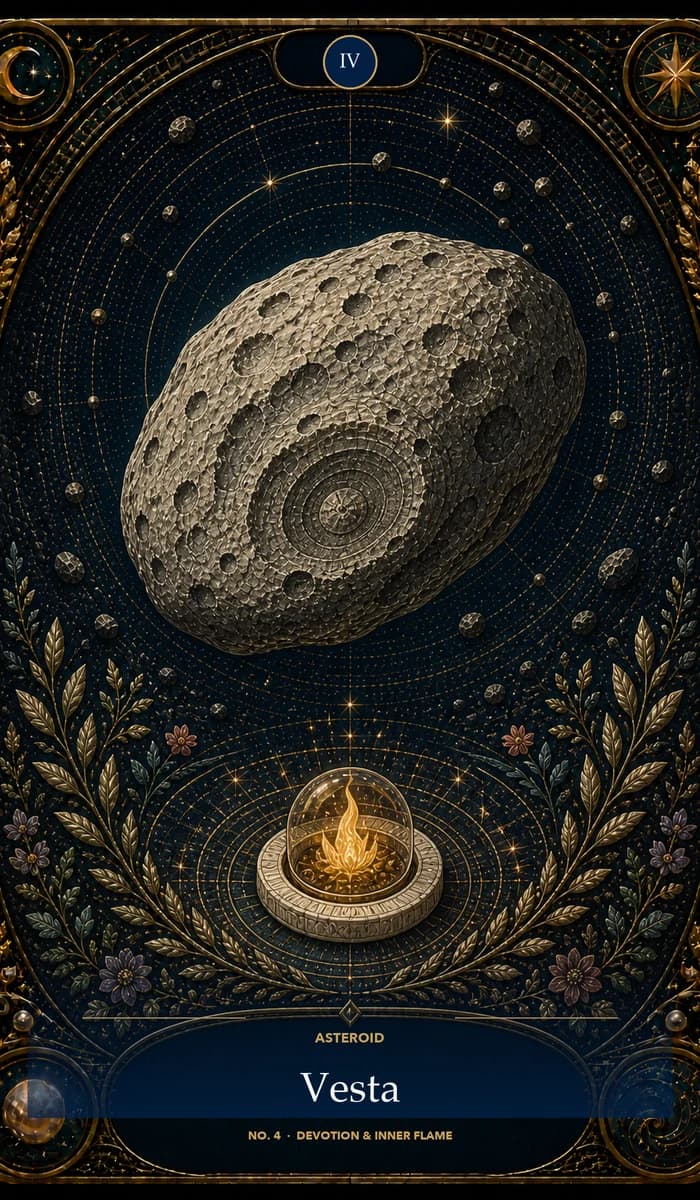
Vesta(4)
Asteroid · V-type
Astronomy · observed or measured: Bright enough to be seen with the naked eye from a dark site. NASA's Dawn spacecraft orbited it in 2011, and meteorites on Earth have been traced back to it.
Modern astrology · interpretive tradition: Read as devotion and focus. What you tend so consistently that it becomes an inner fire.
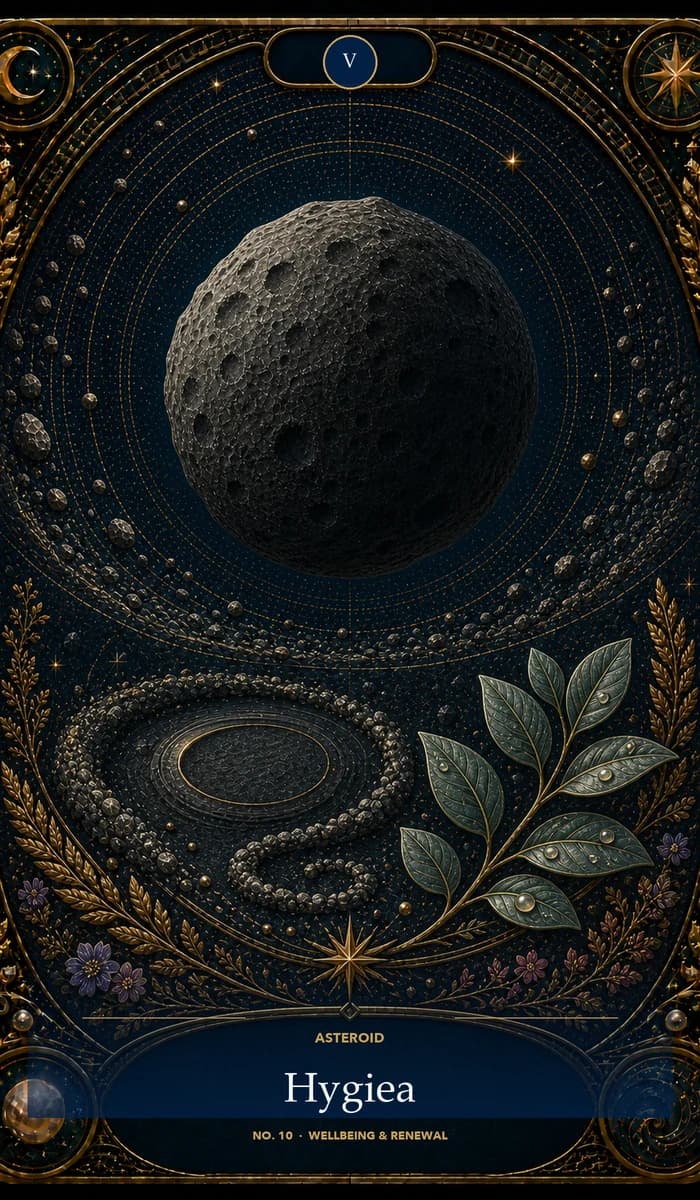
Hygiea(10)
Asteroid · C-type
Astronomy · observed or measured: The fourth-largest asteroid, and round enough that astronomers have argued it should be reclassified as a dwarf planet.
Modern astrology · interpretive tradition: Read as wellbeing and recovery, though it is used far less often than the other four.
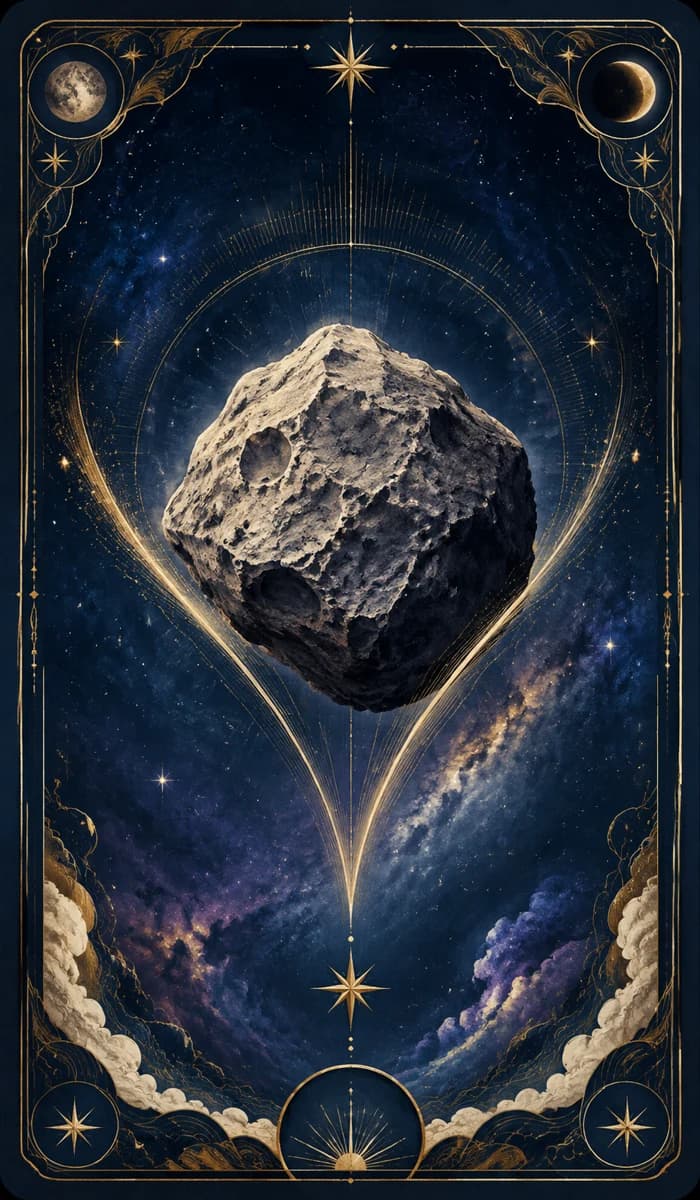
Eros(433)
Asteroid · S-type, near-Earth
Astronomy · observed or measured: The second near-Earth asteroid ever found, in 1898, and the first to be orbited and then landed on: NEAR Shoemaker touched down on it in 2001. It is about 17 km long and shaped like a peanut.
Modern astrology · interpretive tradition: Modern astrologers read Eros as desire: what draws a person, and the shape their wanting takes. It is a twentieth-century reading, and the name came first.
Black Moon Lilith
Not an object · The mean lunar apogee
Astronomy · observed or measured: Not a body at all. It is the point where the Moon's orbit is furthest from Earth, and there are two versions: the mean apogee, which AsterNym uses and most tables publish, and the osculating or true apogee, which can sit up to 30° away from it.
Modern astrology · interpretive tradition: Read in modern astrology as the part of a person that refuses to be tamed or bargained with. Note that astrologers disagree about which Lilith they mean.
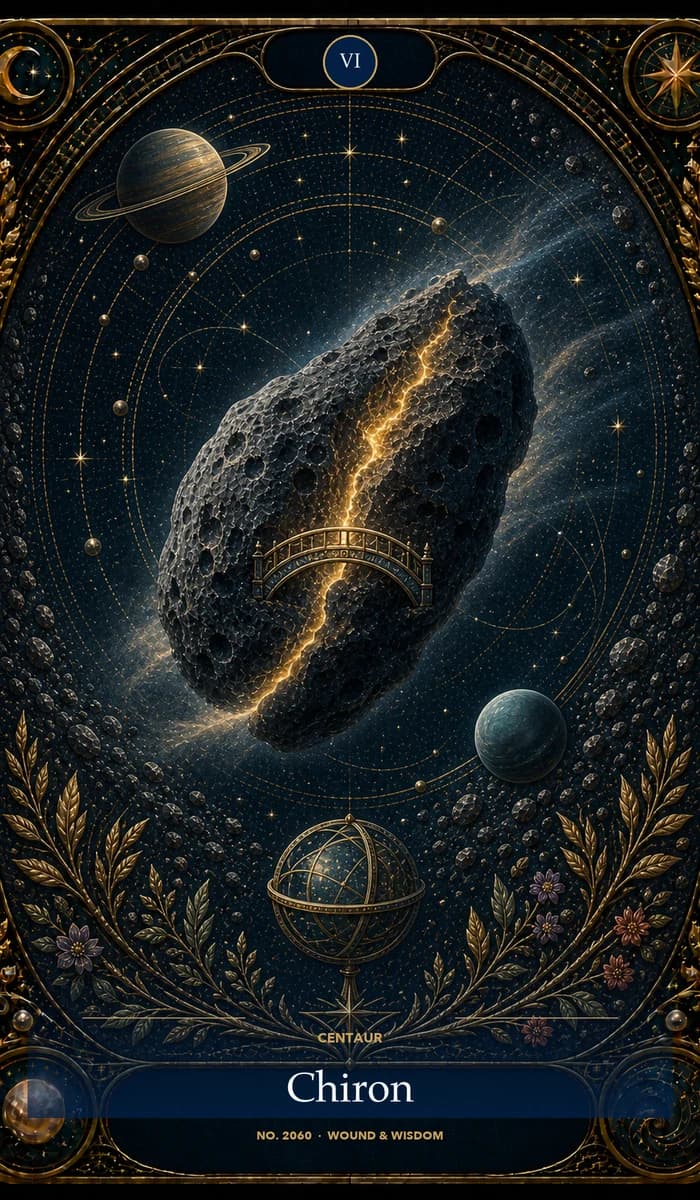
Chiron(2060)
Centaur · Centaur / comet
Astronomy · observed or measured: Discovered in 1977 and hard to put in one box: it carries both an asteroid and a comet designation, produces a cometary coma, and observations now support an evolving ring system. A 2025 occultation study identified three confined rings plus broader material around it. Its orbit between Saturn and Uranus is unstable on a million-year timescale.
Modern astrology · interpretive tradition: The most widely used of these. Modern astrologers commonly call Chiron the “wounded healer”, an archetype for vulnerability, recurring wounds and the possibility of developing insight through them. Not every painful thing becomes a gift, and the archetype does not claim it does.
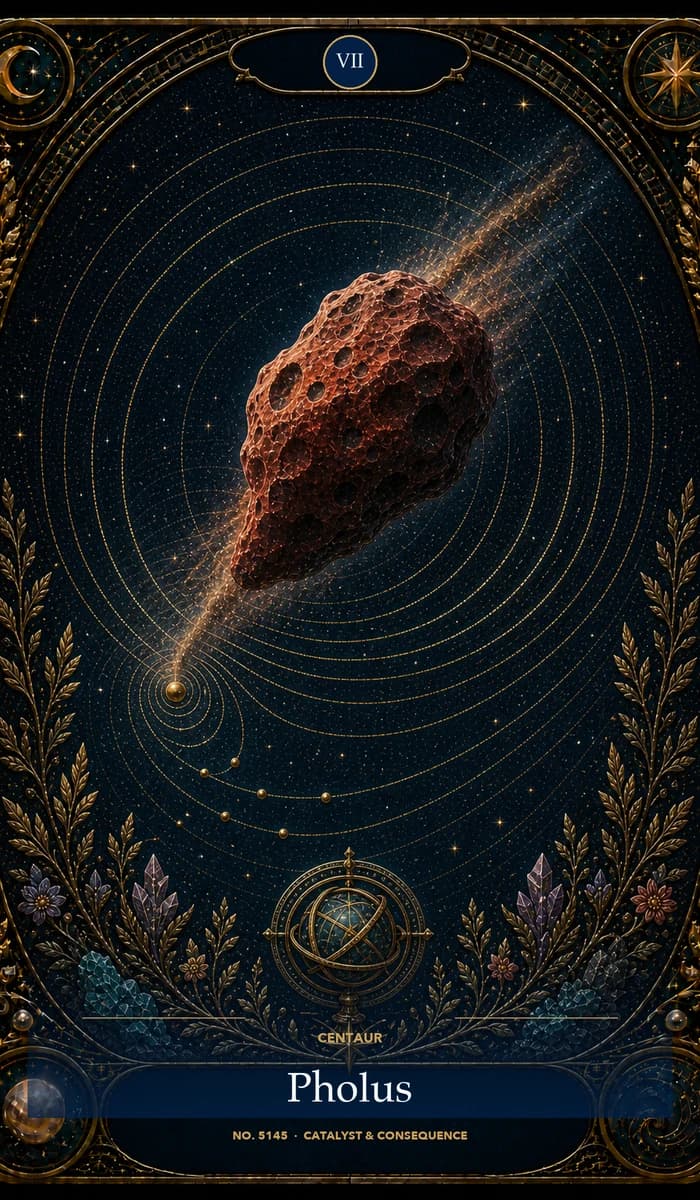
Pholus(5145)
Centaur · Red centaur
Astronomy · observed or measured: One of the reddest objects in the solar system, likely coated in organic compounds processed by radiation over billions of years.
Modern astrology · interpretive tradition: Modern astrologers often read Pholus through the phrase “small cause, big effect”, an interpretation associated with early Pholus research after its 1992 discovery. Later writers added the image of a cork or lid coming off: something small releasing a much larger chain of events.
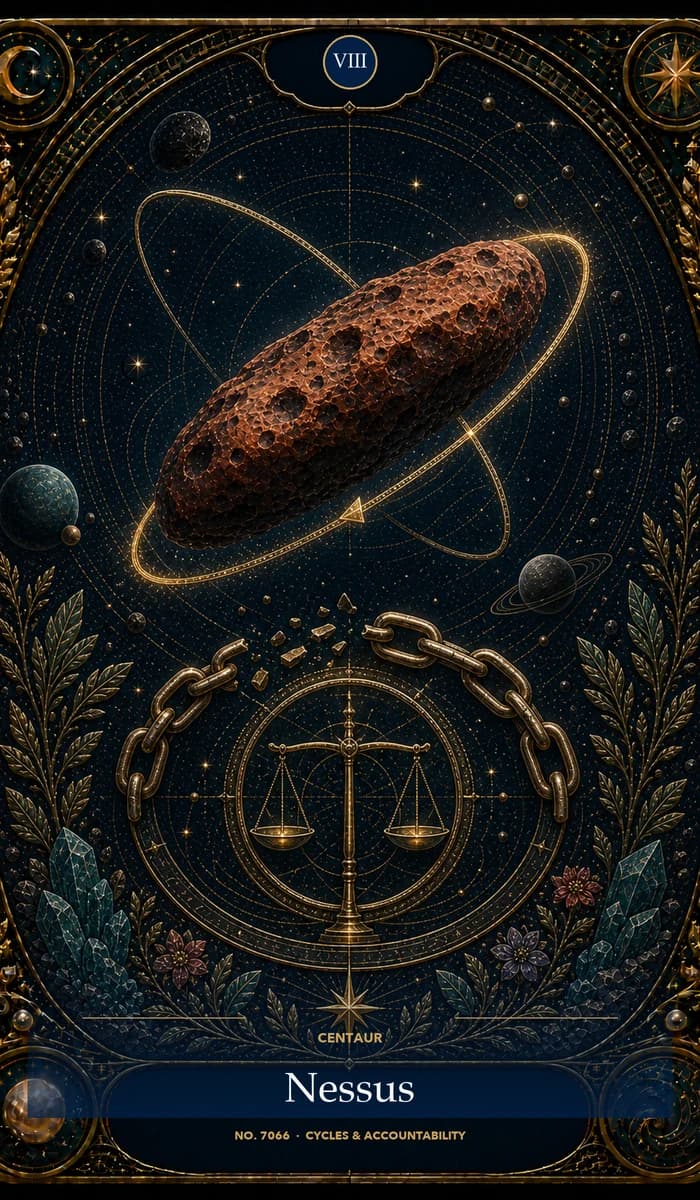
Nessus(7066)
Centaur · Centaur
Astronomy · observed or measured: Takes about 122 years to orbit the Sun, crossing from near Saturn out past Neptune.
Modern astrology · interpretive tradition: Some modern centaur astrologers associate Nessus with abuse, power, boundary violation and cycles of harm: a highly interpretive framework derived partly from the myth of Nessus, not an old astrological doctrine. AsterNym does not read a placement as evidence of abuse.
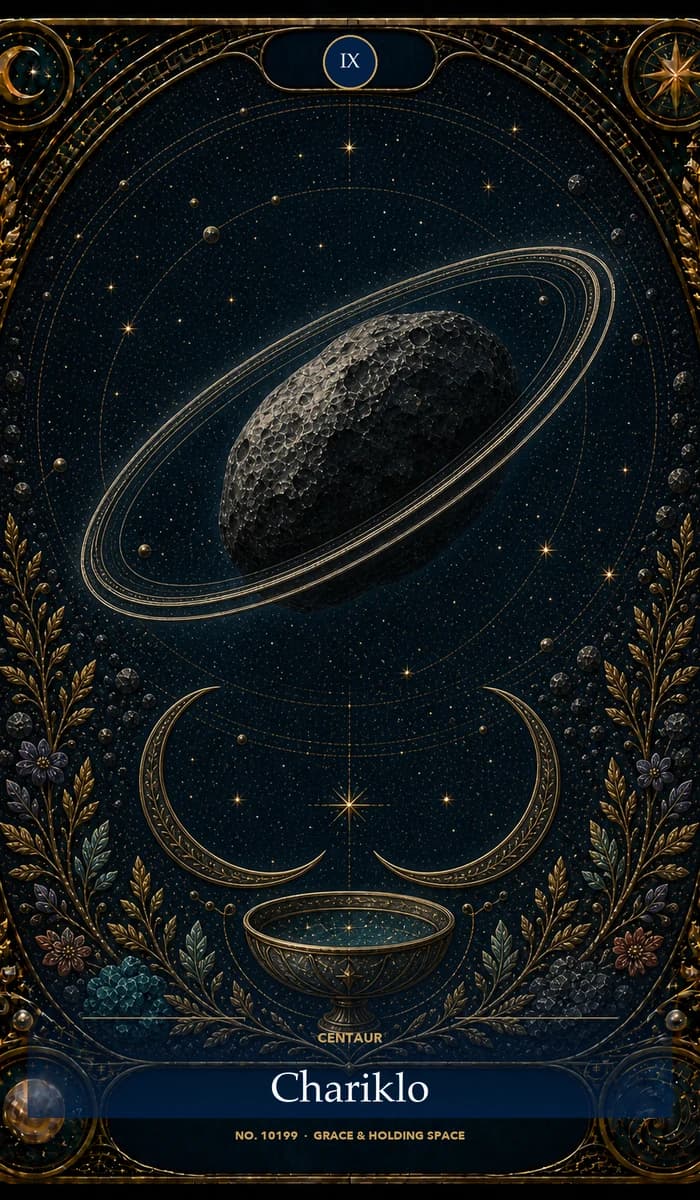
Chariklo(10199)
Centaur · Ringed centaur
Astronomy · observed or measured: The largest known centaur, and the first object smaller than a planet found to have rings: two of them, detected in a 2013 stellar occultation and announced in 2014.
Modern astrology · interpretive tradition: In contemporary centaur astrology, Chariklo has developed an archetype around holding space, witnessing and maintaining boundaries while caring for others. A current interpretation, not a centuries-old meaning.
Asteroid or centaur?
The main-belt bodies here, Ceres, Pallas, Juno, Vesta and Hygiea, orbit between Mars and Jupiter. Ceres is now classified as a dwarf planet; its history runs planet, then asteroid, then dwarf planet. They were the first minor bodies ever found, beginning with Ceres in 1801, and for a few decades each was counted as a planet before astronomers realised how many there were.
The centaurs, Chiron, Pholus, Nessus and Chariklo, orbit out among the giant planets and are dynamically short-lived: giant-planet encounters eventually push most inward, into collisions or out of the Solar System, on timescales of millions of years. None was known before 1977. Their name reflects their apparent hybrid character: centaurs can look asteroid-like, but many have cometary composition or activity.
Common questions
- Does AsterNym show my Chiron sign?
- On every public-figure page, yes: Chiron, Ceres, Eros and Hygiea are placed from JPL Horizons vectors, interpolated by AsterNym's own tested engine and checked against Horizons to a hundredth of a degree, alongside the mean Black Moon Lilith. Personal charts on /natal-chart do not show them yet; the same engine will be added there next.
- Is Chiron a planet?
- No. It is a centaur, a small icy body orbiting between Saturn and Uranus, with both an asteroid and a comet designation. It was discovered in 1977, is about 200 km across, produces a cometary coma, and observations now support an evolving ring system.
- Are asteroids real astrology?
- They are used, particularly Chiron and the four main asteroids, and there is a body of modern practice behind them. All of it is modern: the first asteroid ephemeris for astrologers appeared in 1973, the main asteroids entered serious use mainly in the late twentieth century, and Chiron and the centaurs came later still. Interpretations vary widely between astrologers and remain a minority practice.
- Which ones are placed, and which are not?
- Placed: Chiron, Ceres, Eros and Hygiea, on public-figure pages, for births between 1700 and 2100. Not placed: Pallas, Juno, Vesta, Pholus, Nessus and Chariklo. The placed bodies sit in their own layer, outside the ten-body element balance, chart ruler, aspect ranking, stellium count and rarity score, so adding them changed no existing result.
What we do calculate
Ten chart bodies, every house, every aspect, and the real sky over your birthplace, each from published astronomical data. Four minor bodies and Lilith on every public-figure page.