

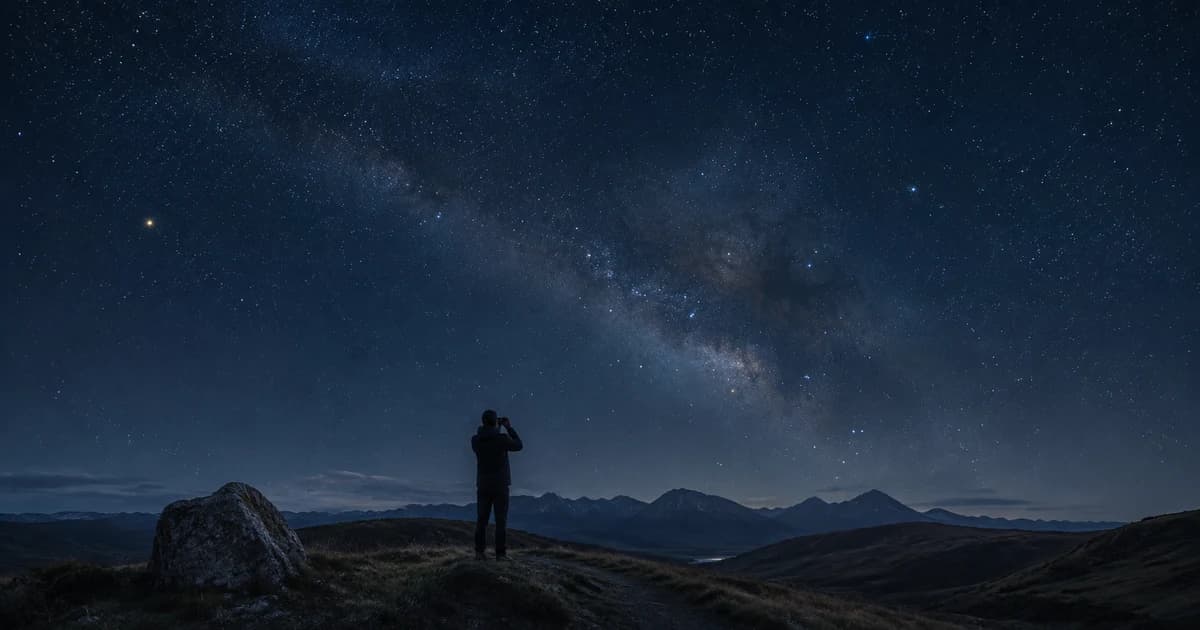
Astrophotography with just your phone
A recent phone, night mode, held dead still. The Milky Way is achievable. Saturn's rings are not.
4 min read · Published 23 August 2026
Straight to it
A recent phone in night mode, held completely still, will capture the Milky Way, constellations, bright meteors and the aurora. The essentials are a tripod or a stable surface, night mode, and the flash off. What a phone can't do without a telescope is planetary detail. Saturn's rings and Jupiter's bands need magnification no phone lens has. The one accessory to buy is a cheap tripod.
What is achievable
| Target | Phone alone? | Notes |
|---|---|---|
| The Moon | Yes | Easy, but it overexposes on auto: tap and drag exposure down |
| Constellations | Yes | A few seconds of exposure on a stable surface |
| The Milky Way | Yes, under dark skies | Night mode or 10–30 seconds manual. impressive results |
| Aurora | Yes | Phones often capture colour the eye cannot see |
| Bright meteors | Sometimes | A matter of luck: leave it running during a shower |
| Star trails | Yes | Many phones have a dedicated mode; otherwise stack many exposures |
| Planets as discs | No | Needs magnification; a phone lens cannot resolve them |
| Galaxies and nebulae | Mostly no | Andromeda is faintly possible under very dark skies |
The settings that matter
In order of impact
- Hold it absolutely still. This is more important than every other setting combined. A tripod, a wall, a bag on the ground, anything. Use the timer or voice shutter so tapping the screen doesn't shake it.
- Use night mode, or manual if your phone offers it. In manual: ISO around 800–3200, exposure 10–30 seconds, focus set manually to infinity.
- Turn off the flash. It does nothing at astronomical distances except ruin your night vision and annoy everyone nearby.
- Shoot RAW if available. It preserves far more data for later adjustment, and astrophotographs benefit enormously from processing.
- Wipe the lens. Astonishingly often the problem. A smear that's invisible in daylight turns every star into a blur.
Why night mode works so well
Modern computational photography does something a single long exposure can't. It takes many short frames, aligns them, and combines them.
That averaging kills random sensor noise and keeps the signal. Because each frame is short, stars never trail. It's the same stacking technique amateur astrophotographers have used for years, done for you in seconds.
That's why a phone can now produce a Milky Way photo that needed a dedicated camera and hours of processing a decade ago. The lens barely improved. The software did.
A phone on a tripod in night mode beats a cheap camera. Stop apologising for it.
Through a telescope
Holding a phone camera to a telescope eyepiece is called afocal photography, and it works better than it sounds, particularly on the Moon, which is bright enough to need no special handling.
Hand-holding is possible for the Moon and frustrating for anything else. Inexpensive phone-to-eyepiece adapters clamp the phone in place and make the difference between an occasional lucky shot and repeatable results.
For planets, the technique is to shoot video instead of stills, then use free stacking software to combine the sharpest frames. Atmospheric turbulence means some frames are far better than others, and stacking the best is how amateur planetary images achieve their detail.
Expectations, set fairly
A phone will give you a good wide-field Milky Way shot, a decent Moon, and an aurora photograph that may look better than what you saw.
It won't give you a nebula in colour, a planet showing detail, or anything resembling a space telescope image. Those require aperture, tracking mounts and hours of exposure.
That isn't a limitation that needs being disappointed by. The most valuable thing a phone photograph does is record that you were there, under that sky, on that night, and it does that very well.
Can you photograph the Milky Way with a phone?
Yes, on a recent phone under dark skies. Use night mode or a manual exposure of 10 to 30 seconds with the phone held completely still on a tripod or stable surface, with focus set manually to infinity.
What settings should I use for phone astrophotography?
Night mode where available, or manual with ISO around 800 to 3200 and an exposure of 10 to 30 seconds, focus at infinity, flash off, and RAW if your phone supports it. Stability matters more than any individual setting.
Why does my phone show star trails?
Because Earth is rotating during the exposure. The rough guide is 500 divided by the 35mm-equivalent focal length, around 20 seconds for a typical phone wide lens. Night modes avoid this by stacking many short frames instead of one long one.
Can I photograph planets with my phone?
Not as discs without a telescope, a phone lens can't resolve them. Held to a telescope eyepiece it can, and the best results come from shooting video and stacking the sharpest frames with free software instead of taking single stills.
 Natalie Hasselbank