

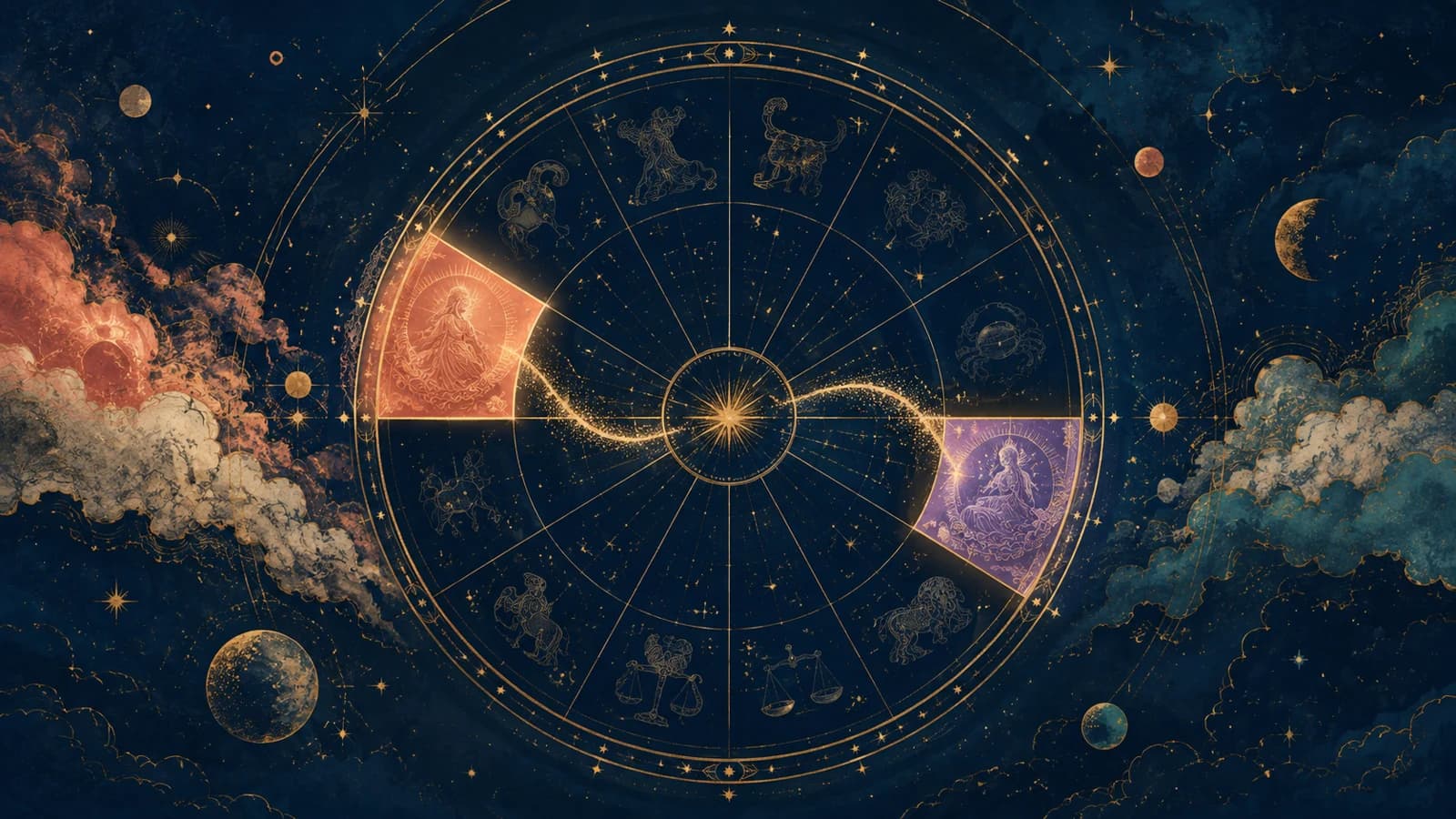
Natal chart · the 4th–10th axis
Does your chart show your parents?
Ask which house rules which parent and you will get two confident, opposite answers. That is not a gap in your research, the tradition disagrees with itself, and it is worth knowing why before you believe anything a chart tells you about your family.
The short answer
Neither assignment is settled. Modern astrology usually calls the 4th house the mother and the 10th the father; an equally serious tradition teaches the exact reverse; and the oldest surviving sources did not use the houses for this at all. What the axis does describe reliably is the difference between the foundations you were built on and the direction you face in public.
The two camps
Both of these are taught by working astrologers today, with real reasoning behind each. Neither has won.
4th = mother · 10th = father
Who teaches it
The most common modern assignment, including most popular chart software and books.
The reasoning
Pairs the Moon's associations, home, nurture, the private interior, with the 4th house, and Saturn's, structure, authority, the world outside, with the 10th.
4th = father · 10th = mother
Who teaches it
A long-standing traditional assignment, still actively taught.
The reasoning
Reads the 4th house as inheritance and lineage, historically the father's line and property, and the 10th as the visible parent who shapes standing in the world.
A third position, common in modern practice, drops the gendered version entirely: the 4th house describes whichever parent was the private, nurturing presence, and the 10th whichever one shaped your standing in the world, which may be the same person, or neither.
What the older tradition used
The house-based version is comparatively recent. Hellenistic astrology: Ptolemy’s Tetrabiblos among others, read parents from planets, not houses: the Sun and Saturn as significators of the father, the Moon and Venus of the mother, with which one took precedence depending on whether the birth was by day or by night. Whatever you make of that scheme, note what it means for the argument: the two traditions are not disagreeing about the answer to one question, they are answering different questions built on different foundations.
A note on “ancient” tables
Forum threads on this question often circulate a table of house rulers labelled “Chaldean” that assigns each house a planet in an unfamiliar order. The genuine Chaldean order is a sequence of the seven classical planets, Saturn, Jupiter, Mars, Sun, Venus, Mercury, Moon, used for planetary hours and the names of the weekdays, not for ruling houses. If you meet a table like that, treat it as one writer’s personal synthesis until it comes with a source, however old it looks.
What the axis honestly describes
Strip the parent labels away and the 4th–10th axis is one of the clearest things in a chart, because it is literally geometric: one end points at the ground beneath you at birth, the other at the highest point of the sky.
4th house · the ground beneath
Where you build from
Home, roots, family and the private base underneath a life, the part nobody applauds and everything else rests on. Read it for what makes you feel secure, and what “home” has to contain before you can settle.
10th house · the top of the sky
Where you are headed
Career, reputation, ambition and public role: what you become known for. Read it for the direction you face when people are watching, and how much of your worth you have hung on it.
They are opposite ends of one line, which is the useful part: what you build in public is held up by what you were built on, and the tension between the two, private security against public ambition, is a real question most people recognise without needing a parent attached to it.
What no chart can tell you
A birth chart records where the planets were at a moment in time. It holds no information about who raised you. It cannot tell you whether a parent loved you well, why one of them left, whether an estrangement was your fault, or what a person who has died would have said. Readings that appear to do this are describing a symbol and letting you supply the person.
That matters more here than almost anywhere else in astrology, because families are not a tidy dataset. People are adopted, raised by grandparents, brought up by two mothers or one exhausted parent doing both jobs, or by someone they have since had to walk away from. A system that insists your 10th house is your father has nothing useful to say to a person who never had one, and no business telling anyone what their mother was like.
If a placement description rings true about your family, that is worth sitting with as a description of your experience, which you already had before the chart. It is not evidence about the other person, and it is not a verdict you owe them.
What AsterNym does
We do not assign parents to houses. Your natal chart reads the 4th house as home, family and roots and the 10th as career, reputation and public life, and stops there. Where a convention is contested, we would rather show you the argument than pick a side and present it as the answer, the same reason we label our house system on every chart and disclose the late-hour convention on our Chinese charts.
Reading about your own foundations is useful. Reading a verdict about your mother is not something we are willing to sell you.
Common questions
- Is the 4th house the mother or the father?
- There is no consensus. Modern astrology most often assigns the 4th house to the mother and the 10th to the father, but a substantial tradition teaches the reverse, and Hellenistic astrology used planets rather than houses for parents entirely. Any source stating one assignment as settled fact is overstating the tradition.
- What does the 4th house mean?
- The 4th house sits at the bottom of the chart, the part of the sky beneath the horizon at your birth. It is read as your foundations: home, roots, private life, and the base you build from. The part of you the public does not see.
- What does the 10th house mean?
- The 10th house sits at the top of the chart, the highest point the sky reached at your birth. It is read as your public direction: career, reputation, ambition and what you become known for.
- Can a birth chart tell me about my mother or father?
- No. A birth chart is a map of planetary positions at a moment in time. It contains no information about who raised you, and it cannot diagnose a parent, explain an estrangement or describe a family you have not described yourself.
- Does AsterNym assign parents to houses?
- No. AsterNym reads the 4th house as home, family and roots, and the 10th as career, reputation and public life. We do not label either house as a specific parent, because the tradition does not agree on it and because the claim is about people who never consented to being read.
See your own 4th and 10th houses
Your birth time places the axis. The chart shows which signs sit at the base and the peak of your sky, and which planets, if any, you carry there.