
“My grandmother reads Saju and I never understood it. AsterNym explained my four pillars in English and I finally get what she meant.”
사주 · Saju
Saju calculator: your Korean Four Pillars
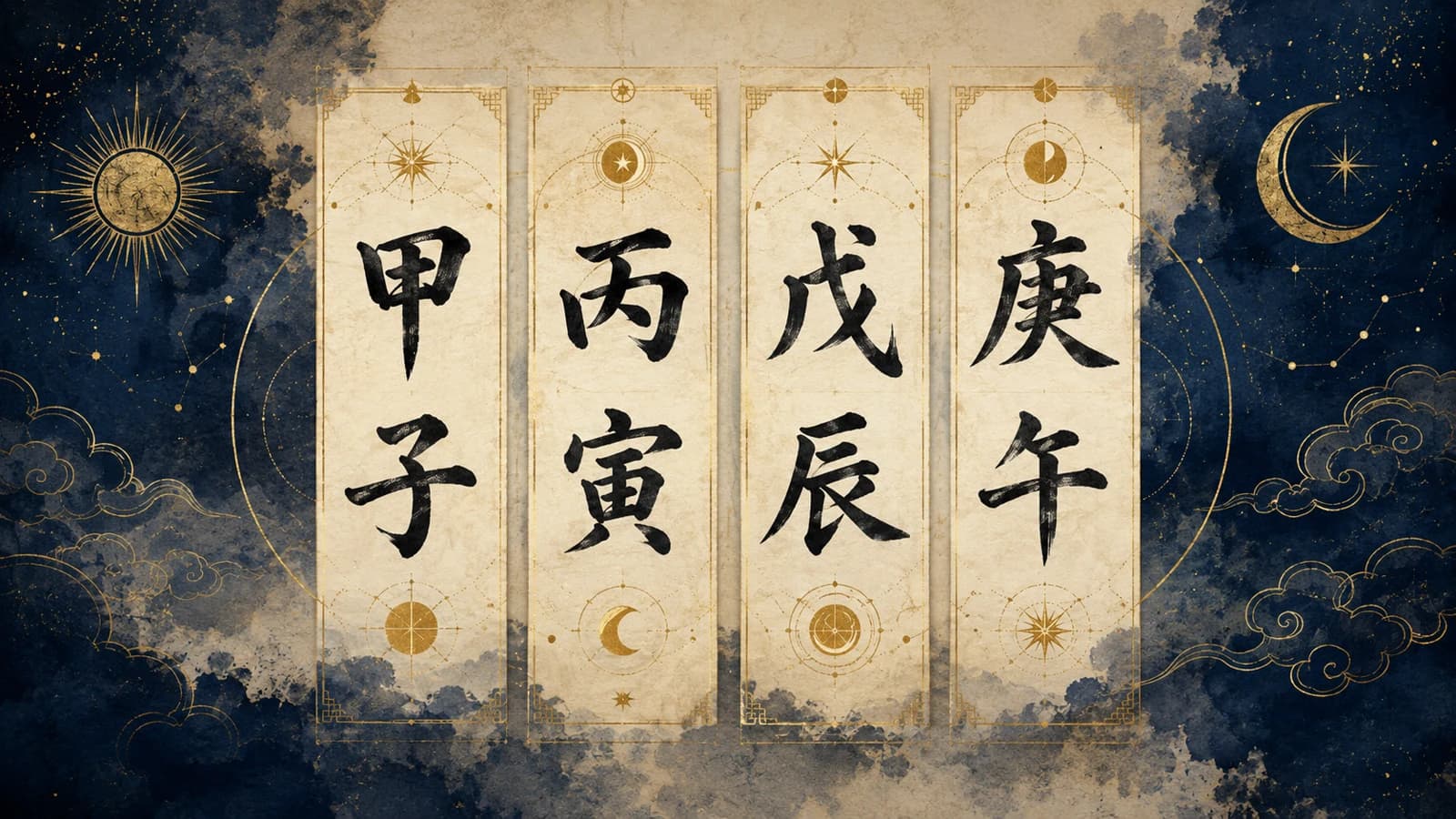
Saju (사주) is the Korean Four Pillars of Destiny: your birth moment read as four pairs of heavenly stems and earthly branches, centred on your Ilgan (일간), the day master. It is the same system as Chinese BaZi, read in Korean terms, so this calculator runs on the same engine.
Without a birth time the hour pillar (시주) is left out, the other three pillars still stand.
What is Saju?
Saju (사주) means “four pillars.” Your birth year, month, day and hour each become a pillar, a pair of one heavenly stem (천간) and one earthly branch (지지). Together the four pillars hold eight characters, so the full reading is called Saju Palja (사주팔자), the “four pillars, eight characters.”
The heart of a Saju is the Ilgan (일간), the day stem, which stands for your core self. Every other element is read in relation to it, and the balance of the five elements, the Ohaeng (오행): Wood, Fire, Earth, Metal, Water, shapes the whole interpretation.
Saju, BaZi, one system, two names
Saju and Chinese BaZi (八字) are not two competing systems. They are the same Four Pillars, the same sexagenary cycle of ten stems and twelve branches, the same day master, the same five elements: read in Korean rather than Chinese terms. The calculation is identical, so AsterNym computes both on one engine.
AsterNym explores these as cultural and metaphysical traditions, not scientific predictions.
What Korean practice does differently
The chart is the same object. Saju means four pillars, the calculation uses the same sexagenary cycle and the same solar terms as BaZi, and a chart cast in Seoul and one cast in Taipei from the same birth moment will match stem for stem.
The difference is in what gets emphasised and what the reading is for. Korean practice leans hard on 용신, the balancing element the chart most needs, and a great deal of the consultation is spent identifying it and then advising around it. It is also consulted at specific junctures rather than continuously: 궁합, compatibility between two charts, is still routinely checked before a marriage, and saju is consulted over business timing and naming in a way that has stayed mainstream rather than becoming a niche interest.
There is a practical consequence for anybody reading both. Korean and Chinese sources will give you the same eight characters and then different advice, because they are answering different questions with them. If two readings disagree, check whether they disagree about the chart or about what to do with it. Usually it is the second.