A dedicated star
Procyon
yellow-white · Canis Minor · α CMi · eighth-brightest star in the night sky
Dedicated to
Julien Laurent
by Sophie Laurent · August 14, 2026
“Pour ton nouveau départ à Montréal. Que Procyon te rappelle que chaque changement ouvre la porte à de nouvelles possibilités.”

This dedication
- Dedicated to
- Julien Laurent
- Dedicated by
- Sophie Laurent
- Recorded
- August 14, 2026
- Held until
- August 14, 2027
When this dedication ends, Procyon becomes available again. Want it? Put the date in your calendar.
Procyon at a glance
- Constellation
- Canis Minor
- Other name
- α CMi
- Catalogue number
- HIP 37279
- Distance
- ≈ 11.5 light-years
- Brightness
- Magnitude 0.34 naked-eye
- Rank
- eighth-brightest star in the night sky
- Star type
- F5 IV-V
- Colour
- yellow-white
- Best seen from
- Almost everywhere on Earth
- Right ascension
- 07h 39m 18s
- Declination
- +05° 13′ 30″
J2000 catalogue coordinates that can be independently cross-checked against astronomical databases. A planetarium app showing coordinates of date will differ slightly, because proper motion and precession move a star’s apparent position over time.
What kind of star is Procyon?
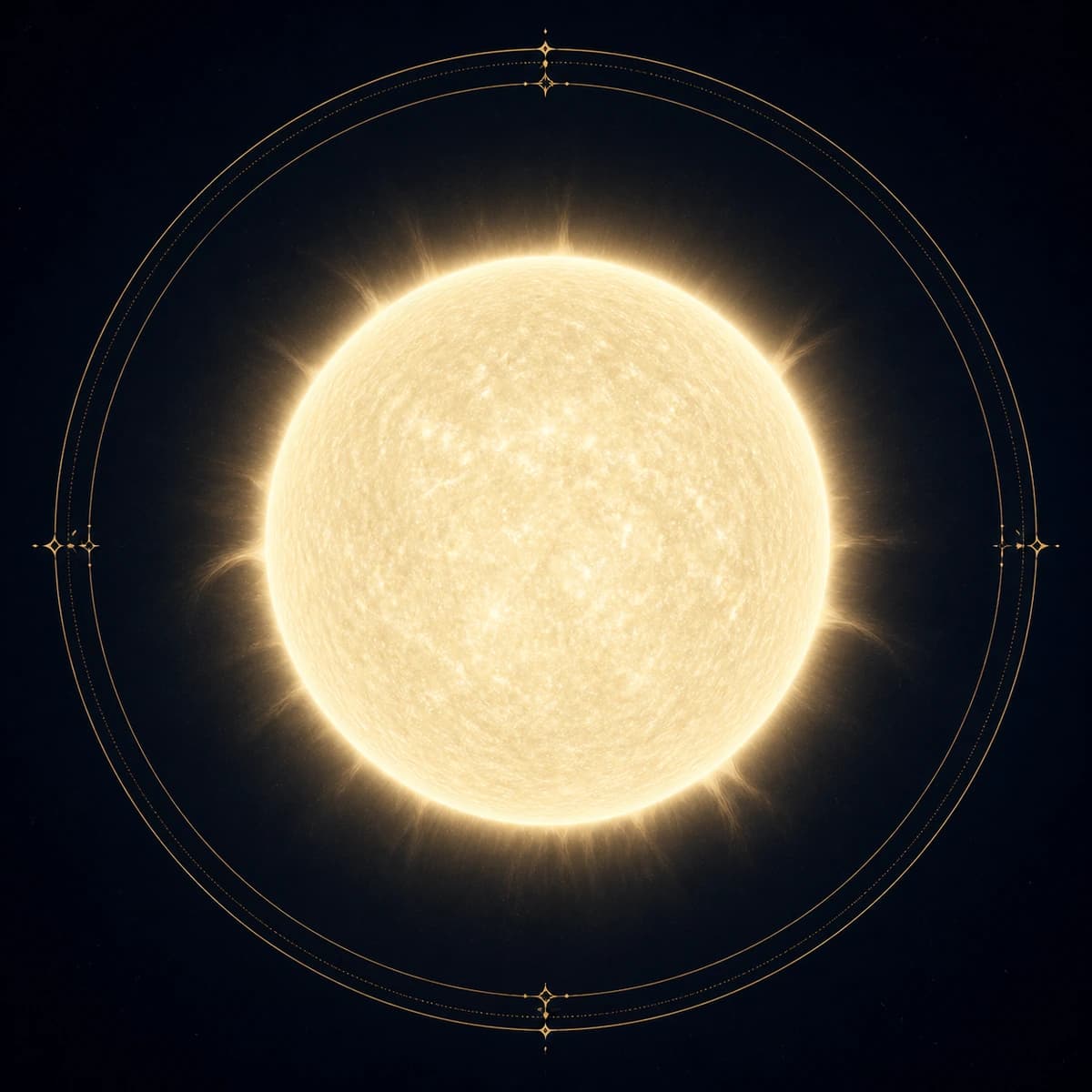
Procyon is a yellow-white subgiant. Its surface runs about 6,000 to 7,500°C, a shade hotter than the Sun. Colour in a star is a temperature reading rather than a decoration: the hot ones are blue and the cool ones red, the opposite way round to a kitchen tap.
A little brighter and a little shorter-lived than the Sun, and near the edge of the range where a planet could plausibly hold liquid water for long enough to matter.
A star of this class gets two to four thousand million years.
It is a subgiant, caught in the short crossing between an ordinary life and a giant one. Its core has run out of hydrogen but its outer layers have not finished expanding, and astronomically this stage passes quickly.
Procyon is one of the fastest-moving stars in the sky. It shifts about 126 arcseconds every century, which sounds tiny and is not: over a human lifetime it visibly changes position against the stars behind it. The constellations are not fixed, they are just slow, and this one is in a hurry.
The light you are looking at is old
Light travels fast but not instantly, so what reaches your eye from Procyon tonight set out in 2015. That is inside a single lifetime. Someone alive now was already alive when this particular light left.
Distance is also the honest limit of what a star can be to you. It is a real object, unimaginably large, and it does not know you exist. What it can be is a fixed point you agreed to attach a meaning to, which is the oldest use people have ever had for the sky.
It is also one of the brighter stars in the sky, which is why it carries a proper name at all rather than a catalogue number.
What does the name Procyon mean?
The name Procyon comes from the Ancient Greek Προκύων, meaning "before the dog", since it precedes the "Dog Star" Sirius as it travels across the sky due to Earth's rotation'.
Rarer names are the Latin translation of Procyon, Antecanis, and the Arabic-derived names Al Shira and Elgomaisa.
Name origin from English Wikipedia. AsterNym does not invent an etymology where none is recorded, and most stars in this catalogue have none: they carry modern names, or a catalogue designation and nothing older.
Where can you see Procyon?
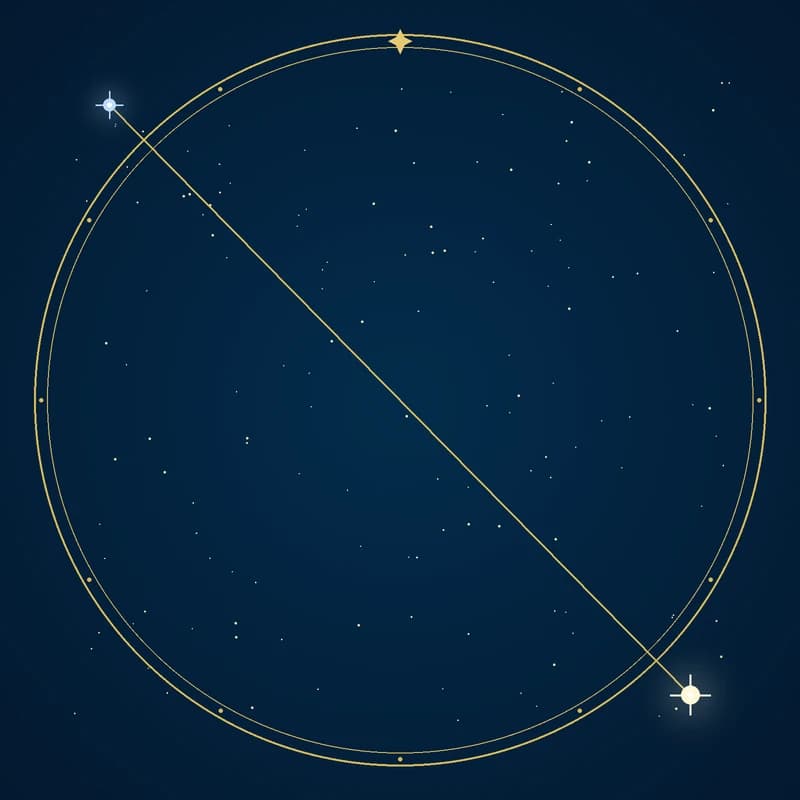
It sits 5° north of the celestial equator, so it clears the horizon everywhere short of latitude 85°S, in practice, every inhabited latitude on Earth. It passes directly overhead at latitude 5°N. It stands highest at midnight in January, so January and February evenings are the best time to look. At magnitude 0.34 it is bright enough to hold its own over city lights.
Procyon belongs to Canis Minor, where it is the brightest star.
What does Procyon mean in astrology?
"Before the dog". It rises just ahead of Sirius. Behenian, nature of Mercury and Mars: sudden opportunity and quick success, with the classical caution that what rises fast must be secured or it fades as fast.
Projected onto the zodiac the way fixed-star astrology reads any star, Procyon stands at 25° Cancer at the J2000 epoch, and the Sun passes that degree around 15 July in the years around 2000. Fixed-star longitude shifts slowly against the tropical zodiac because of precession, about one degree every seventy-two years, so a natal conjunction must be calculated for the birth year rather than read off this J2000 value or a calendar date.
Traditional interpretations, not facts or predictions. The position and dates are computed.
Frequently asked questions about Procyon
- What does Procyon mean in astrology?
- "Before the dog". It rises just ahead of Sirius. Behenian, nature of Mercury and Mars: sudden opportunity and quick success, with the classical caution that what rises fast must be secured or it fades as fast. Projected onto the zodiac, Procyon stands at 25° Cancer, and the Sun passes that degree each year around 15 July.
- Is Procyon the brightest star?
- Procyon is the eighth-brightest star in the night sky as seen from Earth. Sirius is the brightest.
- How far away is Procyon?
- Procyon is approximately 11.5 light-years from Earth. The light reaching us tonight began its journey around 12 years ago.
- Which constellation contains Procyon?
- Procyon is the brightest star in Canis Minor.
- Can everyone see Procyon?
- It sits 5° north of the celestial equator, so it clears the horizon everywhere short of latitude 85°S, in practice, every inhabited latitude on Earth. It passes directly overhead at latitude 5°N. It stands highest at midnight in January, so January and February evenings are the best time to look. At magnitude 0.34 it is bright enough to hold its own over city lights.
- Is dedicating Procyon an official astronomical renaming?
- No. Procyon keeps its internationally recognised astronomical name. An AsterNym dedication records your personal name and message in the AsterNym registry without changing the star's scientific identity.
Explore nearby stars