The AsterNym star registry
Rasalhague
Rasalhague: the white star of Ophiuchus
white · Ophiuchus · α Oph
Rasalhague is a white star, burning hotter than our own Sun in the constellation Ophiuchus, one of the stars with a proper name recognised in the IAU Catalog of Star Names. At magnitude 2.08 it is visible to the naked eye under a dark sky.
Most stars in the sky are anonymous points of light. Rasalhague is not. Some IAU-recognised names are ancient; others were adopted by the IAU only recently. Either way, the star already has a scientific identity, and a dedication attaches a human story to it.
Real star · Personal dedication · Recorded in the AsterNym registry
See what a dedicated page looks like: preview
Rasalhague at a glance
- Constellation
- Ophiuchus
- Other name
- α Oph
- Catalogue number
- HIP 86032
- Distance
- ≈ 49 light-years
- Brightness
- Magnitude 2.08 naked-eye
- Star type
- A5 III
- Colour
- white
- Best seen from
- Almost everywhere on Earth
- Right ascension
- 17h 34m 56s
- Declination
- +12° 33′ 36″
J2000 catalogue coordinates that can be independently cross-checked against astronomical databases. A planetarium app showing coordinates of date will differ slightly, because proper motion and precession move a star’s apparent position over time.
What kind of star is Rasalhague?
Rasalhague is a white giant. Its surface runs around 7,500 to 10,000°C, hot enough to look white or blue-white to the eye. Colour in a star is a temperature reading rather than a decoration: the hot ones are blue and the cool ones red, the opposite way round to a kitchen tap.
Its colour is not the whole story. A white star still in the steady part of its life would burn for about a thousand million years. This one is past that stage, and it is cool at the surface because it has swollen outward, not because it was born this way.
It is a giant, which is what a star becomes when it exhausts the hydrogen in its core. It has swollen outward and cooled at the surface, and it is now brighter than it ever was as a young star. The Sun will do this too, in about five thousand million years.
The light you are looking at is old
The light you can see from Rasalhague left in 1977, which puts it roughly a lifetime ago. Nobody has invented anything since then that the light knows about; it has simply been travelling.
That delay is the part people find hardest and like most. A star is the one thing you can give someone that was already old before either of you was born and will outlast anything else you could have chosen.
It is comfortably visible without equipment on a decent night.
What does the name Rasalhague mean?
It is also known by the traditional name Rasalhague, from the Arabic رأس الحواء raʼs al-ḥawwāʼ "the head of the serpent collector".
Name origin from English Wikipedia. AsterNym does not invent an etymology where none is recorded, and most stars in this catalogue have none: they carry modern names, or a catalogue designation and nothing older.
What could a Rasalhague dedication represent?
Rasalhague is especially meaningful for someone who:
- · Deserves something older than any gift shop
- · Marks a beginning, an anniversary or a promise
- · Is remembered every time you look up
- · Has a light you want recorded somewhere permanent
Dedication idea
“For the one I think of when I find Ophiuchus in the sky.”
Where can you see Rasalhague?
It sits 13° north of the celestial equator, so it clears the horizon everywhere short of latitude 77°S, in practice, every inhabited latitude on Earth. It passes directly overhead at latitude 13°N. It stands highest at midnight in June, so June and July evenings are the best time to look. At magnitude 2.08 it is an easy naked-eye star from any reasonably dark spot.
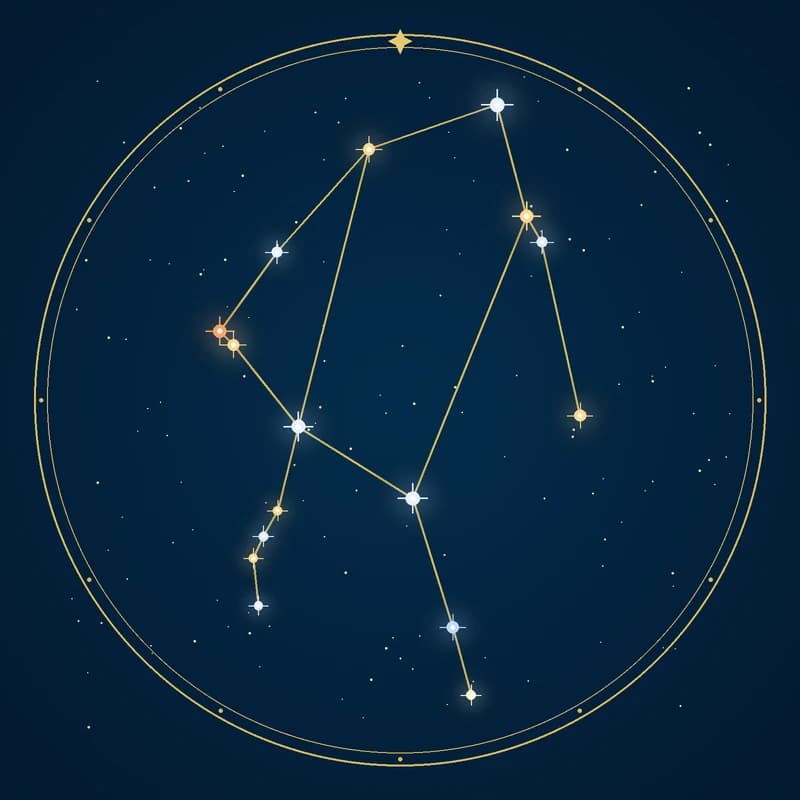
Rasalhague belongs to Ophiuchus, where it is the brightest star.
What does Rasalhague mean in astrology?
The classical fixed-star tradition: Ptolemy, the medieval Behenian lists, Robson’s 1923 compilation. Is silent on Rasalhague, and we don’t invent lore where none exists. What astrology can still read is the star’s real position, below.
Projected onto the zodiac the way fixed-star astrology reads any star, Rasalhague stands at 22° Sagittarius at the J2000 epoch, and the Sun passes that degree around 11 December in the years around 2000. Fixed-star longitude shifts slowly against the tropical zodiac because of precession, about one degree every seventy-two years, so a natal conjunction must be calculated for the birth year rather than read off this J2000 value or a calendar date.
Traditional interpretations, not facts or predictions. The position and dates are computed.
Dedicate Rasalhague to someone who matters
A flower fades. A card is eventually put away. A star gives your message a place in the sky.
from$29.95a year
Dedicate Rasalhague →Real star · your message · a page to share

Your Rasalhague dedication includes
- Your chosen dedication name
- Your personal message
- Rasalhague's real astronomical coordinates
- A shareable dedication page
- Its location on the AsterNym Galaxy Map
- An optional printable certificate and gift presentation
Rasalhague keeps its established astronomical name. Your dedication is a personal commemorative record within the AsterNym registry.
Frequently asked questions about Rasalhague
- What does Rasalhague mean in astrology?
- The classical fixed-star tradition has no documented meaning for Rasalhague. Projected onto the zodiac, Rasalhague stands at 22° Sagittarius, and the Sun passes that degree each year around 11 December.
- Is Rasalhague the brightest star?
- Rasalhague shines at magnitude 2.08 · visible to the naked eye on a clear night, one of the few thousand stars with an officially recognised name.
- How far away is Rasalhague?
- Rasalhague is approximately 49 light-years from Earth. The light reaching us tonight began its journey around 49 years ago.
- Which constellation contains Rasalhague?
- Rasalhague is the brightest star in Ophiuchus.
- Can everyone see Rasalhague?
- It sits 13° north of the celestial equator, so it clears the horizon everywhere short of latitude 77°S, in practice, every inhabited latitude on Earth. It passes directly overhead at latitude 13°N. It stands highest at midnight in June, so June and July evenings are the best time to look. At magnitude 2.08 it is an easy naked-eye star from any reasonably dark spot.
- Is dedicating Rasalhague an official astronomical renaming?
- No. Rasalhague keeps its internationally recognised astronomical name. An AsterNym dedication records your personal name and message in the AsterNym registry without changing the star's scientific identity.
Explore nearby stars