

Major Arcana · Deck number 12
The Hanged Man
Waits it out on purpose.
Core meaning
suspension · surrender · reframing
The card in tarot
What The Hanged Man means
In the Rider–Waite–Smith image
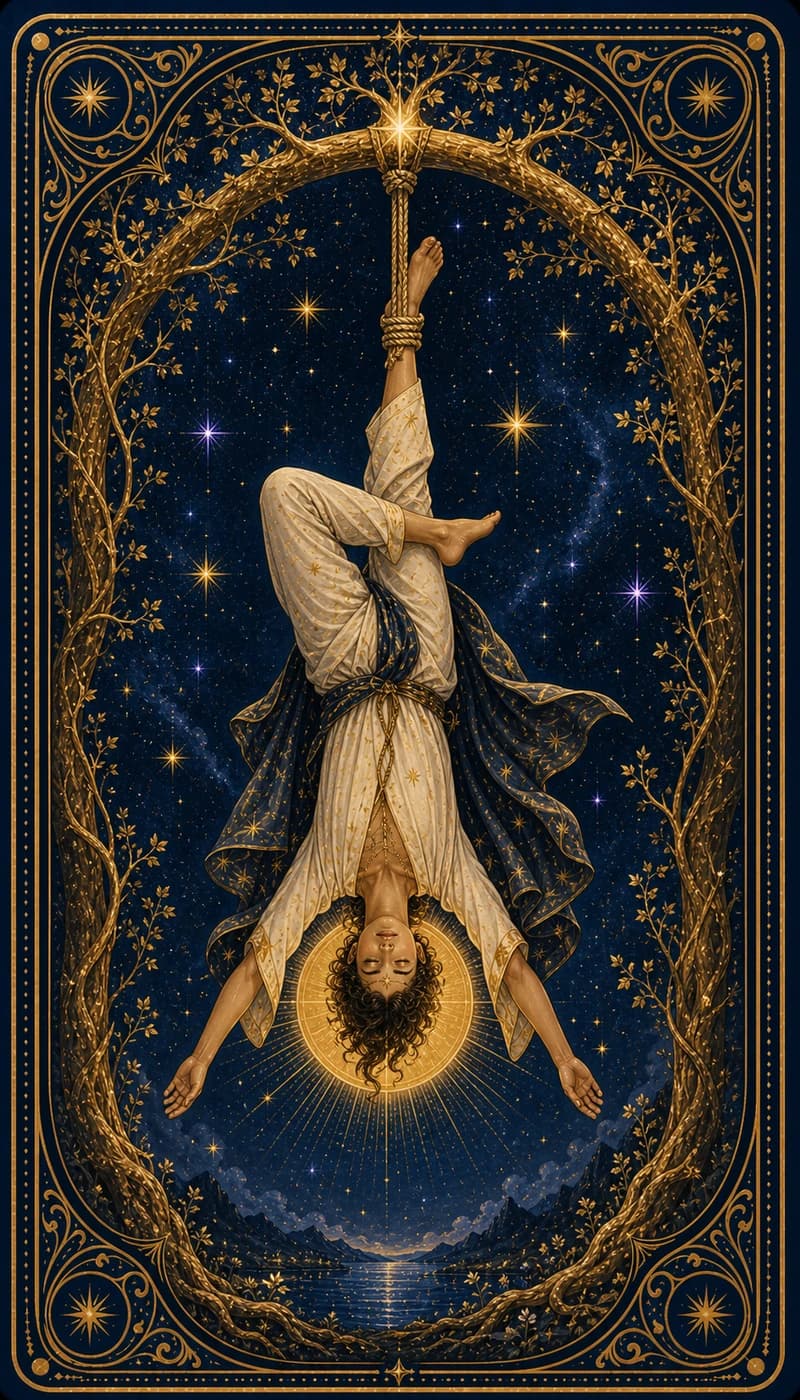
A man hangs upside down by one foot from a living tree, the other leg crossed behind, hands behind his back, a halo of light around his head.
In a reading
The Hanged Man commonly points to a pause that cannot be forced, letting go of control, or a situation that looks different from another angle.
As an AsterNym birth card
The Hanged Man as your birth card
What follows is AsterNym’s birth-card interpretation, informed by modern tarot symbolism. It is written for the reader whose birth date reduces to this card, and it is a frame for reflection, not a description of a class of people.
The archetype
The new angle · chosen suspension. The Hanged Man stops on purpose, hangs upside down, and sees what the hurrying world cannot.
Your strength is seeing from angles no one tries. Your weak spot is knowing when the pause becomes a stall.
Your strength
You can pause when everyone else is panicking, and the pause produces the insight. You understand that some problems dissolve when you stop wrestling them.
Your shadow
The sacred pause can become the permanent excuse. There is a difference between surrender and stalling, and only you know which one this is.
In relationships
You give people room to be complicated. Just make sure 'waiting to see' isn't your way of never saying what you want.
At work
You reframe stuck problems. The sideways view is your genius. Timebox it: insight has a shelf life, and so does a team's patience.
What it asks you to practise
Set a date on one thing you've been 'sitting with', and act on that date.
The question this card keeps asking
What would you see immediately if you stopped defending your current angle?
Linked birth cards
In fuller birth-card numerology, 12 reduces to 3 (The Empress), so The Hanged Man is read alongside The Empress.
Numbering and the Life Path
AsterNym uses Rider–Waite–Smith numbering, with Strength at 8 and Justice at 11. Other tarot traditions number these differently: Marseille and Thoth decks commonly place Justice or Adjustment at 8 and Strength or Lust at 11. A deck that does so is not wrong; it is following a different convention.
Your AsterNym identity is read from your Life Path, calculated separately on the numerology page, never from the tarot number. The two share a digit root because both start from the birth date, but the Life Path keeps 11, 22 and 33 at intermediate stages and the tarot method does not, so a birth card of The Fool (22) does not by itself mean a Life Path of 22.
Calculate my Life Path separately →