

Major Arcana · Deck number 5
The Hierophant
Knows the rules. Keeps them.
Core meaning
tradition · teaching · belonging
The card in tarot
What The Hierophant means
In the Rider–Waite–Smith image
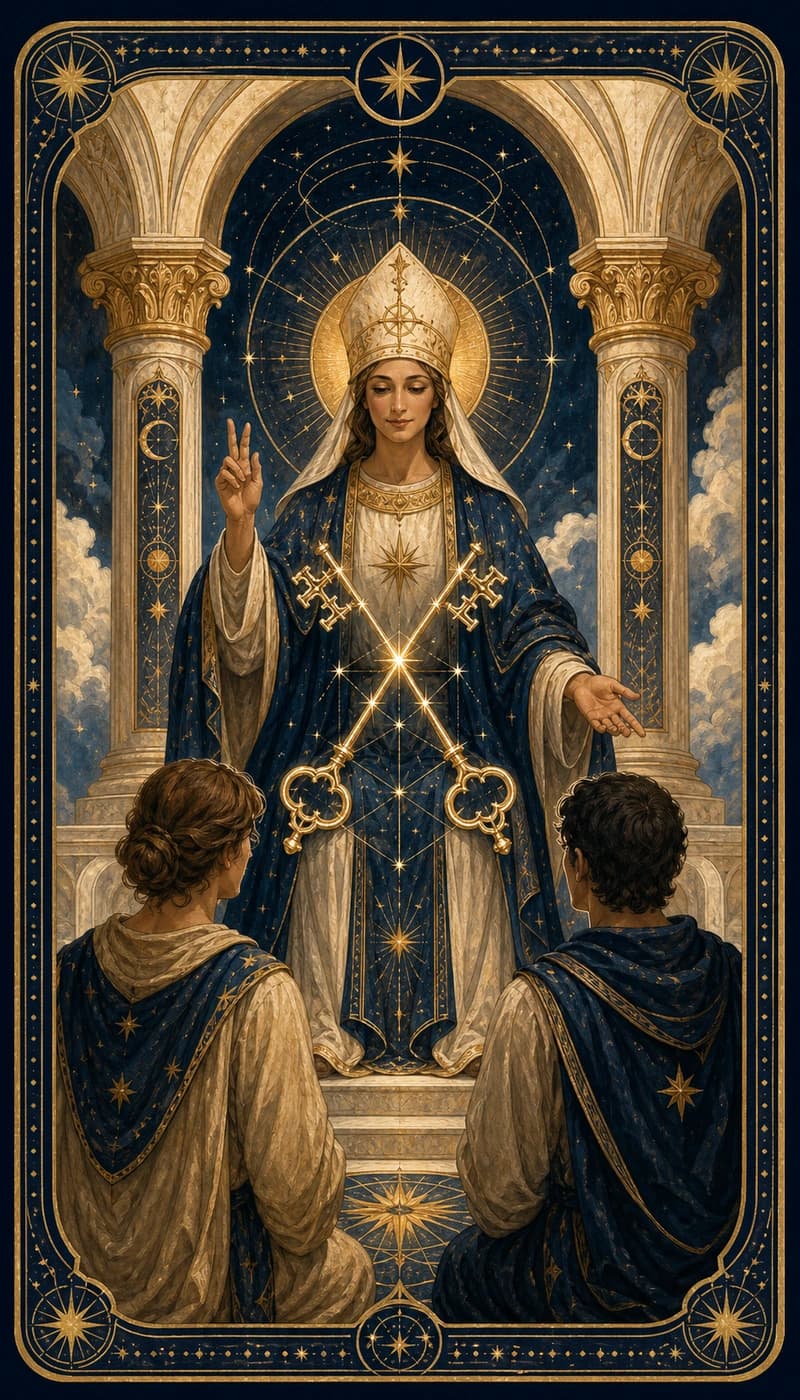
A robed figure with a triple crown raises a hand in blessing between two pillars; two acolytes kneel before him and two crossed keys lie at his feet.
In a reading
The Hierophant commonly points to established institutions, received teaching, ceremony, or conformity and its costs.
As an AsterNym birth card
The Hierophant as your birth card
What follows is AsterNym’s birth-card interpretation, informed by modern tarot symbolism. It is written for the reader whose birth date reduces to this card, and it is a frame for reflection, not a description of a class of people.
The archetype
The keeper of the thread, tradition, teaching and belonging. The Hierophant carries what a community has learned and hands it on so nobody has to start from zero.
Your strength is carrying wisdom that needs keeping. Your weak spot is questioning a rule that has stopped serving.
Your strength
You give people context and continuity. You know why the rules exist, which is rarer than knowing the rules.
Your shadow
The thread can become a leash. Defending the way it's done can quietly replace asking whether it still works.
In relationships
You take bonds seriously, rituals, anniversaries, loyalty. Leave room for the relationship to write its own tradition rather than inheriting one wholesale.
At work
You're the institutional memory and the natural mentor. Your test is sponsoring the change that makes some of your knowledge obsolete.
What it asks you to practise
Question one rule you keep: keep it if it survives, retire it honestly if it doesn't.
The question this card keeps asking
Which of your rules protects something real, and which one just protects the past?
Linked birth cards
The Hierophant is a single-digit birth card, so it stands on its own in the chain.
Cards that reduce to The Hierophant: Temperance (14).
Numbering and the Life Path
AsterNym uses Rider–Waite–Smith numbering, with Strength at 8 and Justice at 11. Other tarot traditions number these differently: Marseille and Thoth decks commonly place Justice or Adjustment at 8 and Strength or Lust at 11. A deck that does so is not wrong; it is following a different convention.
Your AsterNym identity is read from your Life Path, calculated separately on the numerology page, never from the tarot number. The two share a digit root because both start from the birth date, but the Life Path keeps 11, 22 and 33 at intermediate stages and the tarot method does not, so a birth card of The Fool (22) does not by itself mean a Life Path of 22.
Calculate my Life Path separately →