

Tử Vi: your Vietnamese Purple Star chart
Tử Vi (Tử Vi Đẩu Số) is Vietnam’s Purple Star astrology: your birth arranged into twelve cung (palaces) with the major stars placed across them, centred on the cung Mệnh, your Destiny palace.
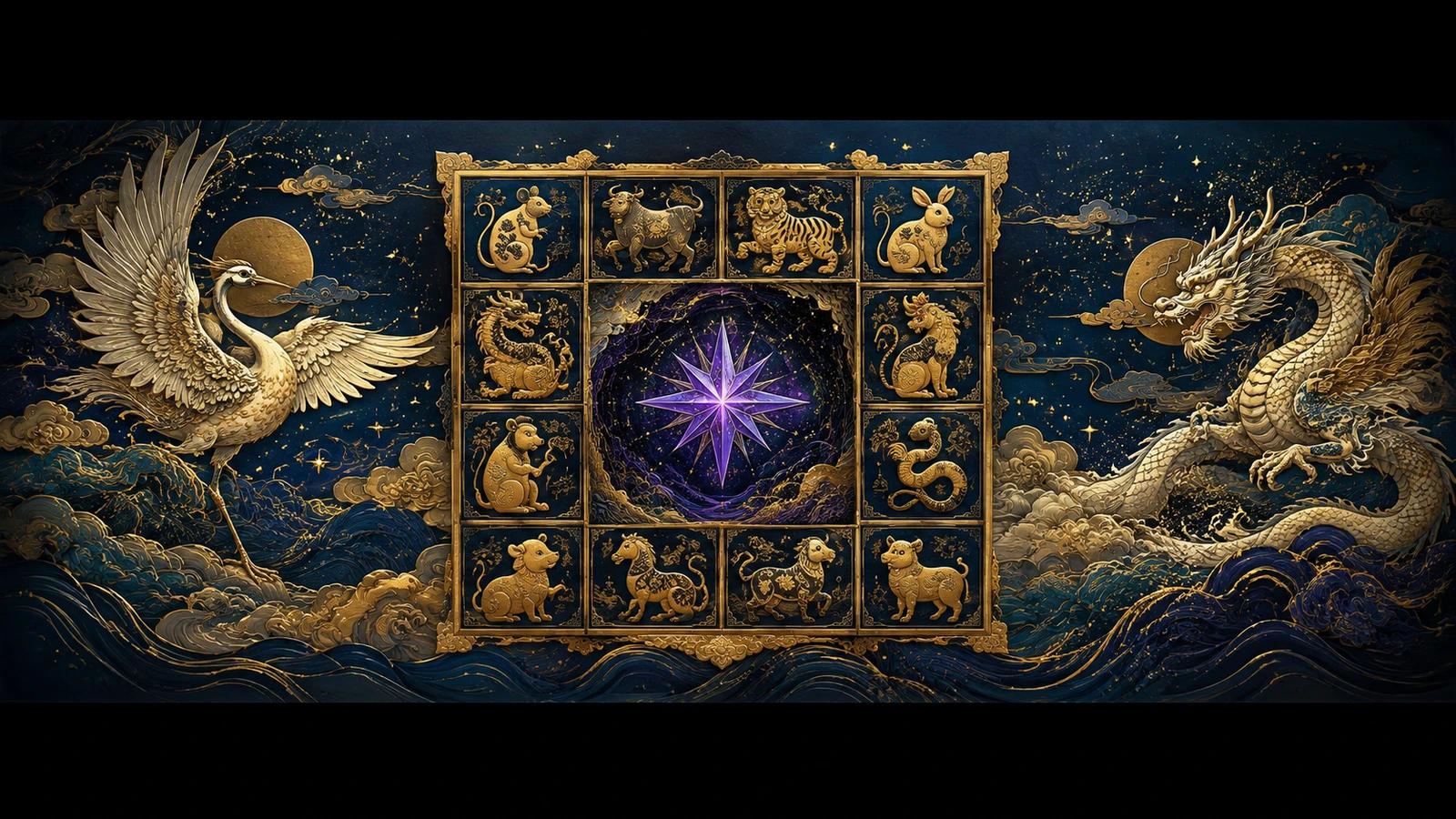
How Tử Vi works
Traditional interpretation
The structure is calculated. What it means comes from the system's own texts and practice, offered for reflection. These meanings have not been shown to predict personality or events.
Also: Calculated.
How we work it out →- Your birth date and city. Optional: your exact birth time and your sex at birth.
- Lá số Tử Vi, the Vietnamese form of Zi Wei Dou Shu, on the same engine.
What is Tử Vi?
Tử Vi Đẩu Số (紫微斗數) means the “Purple Star reckoning.” It builds a chart of twelve palaces: cung Mệnh (Destiny), cung Phụ Mẫu (Parents), Phúc Đức (Fortune), Điền Trạch (Property), Quan Lộc (Career), Nô Bộc (Friends), Thiên Di (Travel), Tật Ách (Health), Tài Bạch (Wealth), Tử Tức (Children), Phu Thê (Spouse) and Huynh Đệ (Siblings), and places dozens of stars into them.
The chart is anchored by the cung Mệnh, the Destiny palace, placed from the lunar month and the birth hour. The fourteen major stars, led by Tử Vi, the Purple Star, and the four transformations (tứ hóa) give the reading its detail.
Tử Vi, Zi Wei, one system, two names
Tử Vi Đẩu Số and Chinese Zi Wei Dou Shu are the same system: the same 紫微斗數, the same twelve palaces, the same stars and the same method of placing them. Tử Vi is the Vietnamese name and vocabulary. The calculation is identical, which is why AsterNym casts both on one engine.
The technique is shared; the calendar is not. Vietnam has computed the âm lịch on UTC+7 since 1968 while China uses UTC+8, so when a new moon falls in that one-hour window the lunar month begins a day earlier in Vietnam, and the two calendars can even put the leap month in different places. Your chart here is cast on the Vietnamese calendar, computed the way Vietnamese almanacs compute it: months opening on the new moon in Vietnam time, the eleventh month holding the winter solstice, and the leap month being the first that contains no major solar term. Tết lands on the first day of the first month, which is the check you can run yourself.
AsterNym explores these as cultural and metaphysical traditions, not scientific predictions.
How your lá số is cast
The chart reads the birth date, hour and place you saved, turns the date into a Vietnamese lunar date, and then works in a fixed order. Each step feeds the next one, so a wrong hour at the start moves everything after it.
- Cung Mệnh and cung Thân. Start at the Dần palace and count forward to your lunar birth month. Count back by your birth hour for Mệnh and forward by it for Thân. A birth after 23:00 counts as the Tý hour of the next lunar day.
- Palace stems. The stem of your birth year sets the stem of the Dần palace, and the other eleven follow round the wheel. Your year here turns at Tết, not on 1 January and not at Lập Xuân.
- Your Cục. The stem and branch of cung Mệnh give a nạp âm element, and that element is your Cục: Thủy Nhị Cục (2), Mộc Tam Cục (3), Kim Tứ Cục (4), Thổ Ngũ Cục (5) or Hỏa Lục Cục (6).
- The Tử Vi star. Your lunar day of birth and the Cục number together place Tử Vi. Thiên Phủ mirrors it across the Dần–Thân line, and the remaining twelve major stars are counted out from those two.
- Tứ hóa. Your birth-year stem picks the four stars that take Hóa Lộc, Hóa Quyền, Hóa Khoa and Hóa Kỵ.
Where to start reading
Go to cung Mệnh first and look at which major stars landed there. Vietnamese readers treat that palace as you: your temperament, how people see you when they first meet you, what you lean towards. Don’t read it on its own, though. Tam Hợp readers look at it together with the palace opposite, Thiên Di, and the two palaces that form a triangle with it.
Then find cung Thân. For a Tý or Ngọ hour birth it shares a palace with Mệnh, because counting six steps forward or back round twelve palaces lands in the same spot, and counting none does too.
After that, the four transformations, and which palaces they fell in. Hóa Lộc stands for fortune, Hóa Quyền for power, Hóa Khoa for standing and Hóa Kỵ for obstacles, so a Hóa Kỵ in Tài Bạch points at money as the area that tends to snag. The decade cycles (đại vận) begin at the age given by your Cục number, so a Thủy Nhị Cục chart opens its first decade at 2, counted in tuổi mụ, your lunar age. Their direction depends on your year’s polarity and your sex. If your saved details don’t record male or female, the chart leaves the decades out instead of guessing.
What this chart leaves out
Plenty of Tử Vi readers grade every star’s brightness in its palace, from miếu at the strong end to hãm at the weak end. The brightness tables differ from one school to the next, so this chart doesn’t grade brightness yet. Everything it does place follows the Tam Hợp school.
No birth time saved? The chart shows midday, then builds all twelve hour charts to tell you how many palaces your cung Mệnh could fall in. Treat a timeless lá số as a sketch.
The system is traditionally credited to Chen Tuan, Trần Đoàn in Vietnamese, a Daoist of the tenth century. The texts that survive are much later, in editions from the Ming dynasty onward.
Before you read your lá số
- What is Tử Vi?
- Tử Vi, or Tử Vi Đẩu Số (紫微斗數), is the Vietnamese form of Purple Star astrology. It arranges a person's birth into a chart of twelve palaces (cung), Destiny, Siblings, Spouse, Children, Wealth, Health and so on, and places dozens of stars across them, led by the Purple Star (Tử Vi) itself. It is one of the most detailed chart systems in East Asia.
- Is Tử Vi the same as Zi Wei Dou Shu?
- Yes. Tử Vi Đẩu Số and Chinese Zi Wei Dou Shu are the same system, the same 紫微斗數, the same twelve palaces and the same stars, with Tử Vi being the Vietnamese name and terminology. AsterNym computes both on one engine.
- What is the cung Mệnh?
- The cung Mệnh is the Destiny or Life palace, the most important of the twelve palaces in a Tử Vi chart. It is placed from the lunar month and the birth hour, and Vietnamese readers take the stars that fall in it as the core of your character and life. Vietnamese charts also mark the cung Thân, the Body palace.
- Do I need my birth time for Tử Vi?
- Yes, more than in almost any other system. The Life palace (cung Mệnh) and the whole arrangement of the twelve palaces are placed using your birth hour, so without an accurate time the chart cannot be cast reliably. A rough time changes which palace your stars fall into.
- What are the main stars in Tử Vi?
- The chart is led by the fourteen major stars, headed by Tử Vi (the Purple Star), along with stars such as Thiên Cơ, Thái Dương, Vũ Khúc, Thiên Đồng and Liêm Trinh, plus many minor stars. Their placement across the twelve palaces, and the four transformations (tứ hóa), drive the reading.
- Why can my Tử Vi chart differ from a Chinese Zi Wei chart for the same birth?
- The method is the same, so the difference comes from the calendar. Vietnam has computed its lunar calendar on UTC+7 since 1968 and China uses UTC+8, so when a new moon falls in that hour the Vietnamese month starts a day earlier. That changes your lunar day of birth, the lunar day places the Tử Vi star, and every major star is placed from Tử Vi, so the whole chart can shift.