The Andromeda collision: what happens in 4 billion years
Two galaxies merging, and essentially zero chance of any two stars hitting each other.
2 min read · Published 27 August 2026
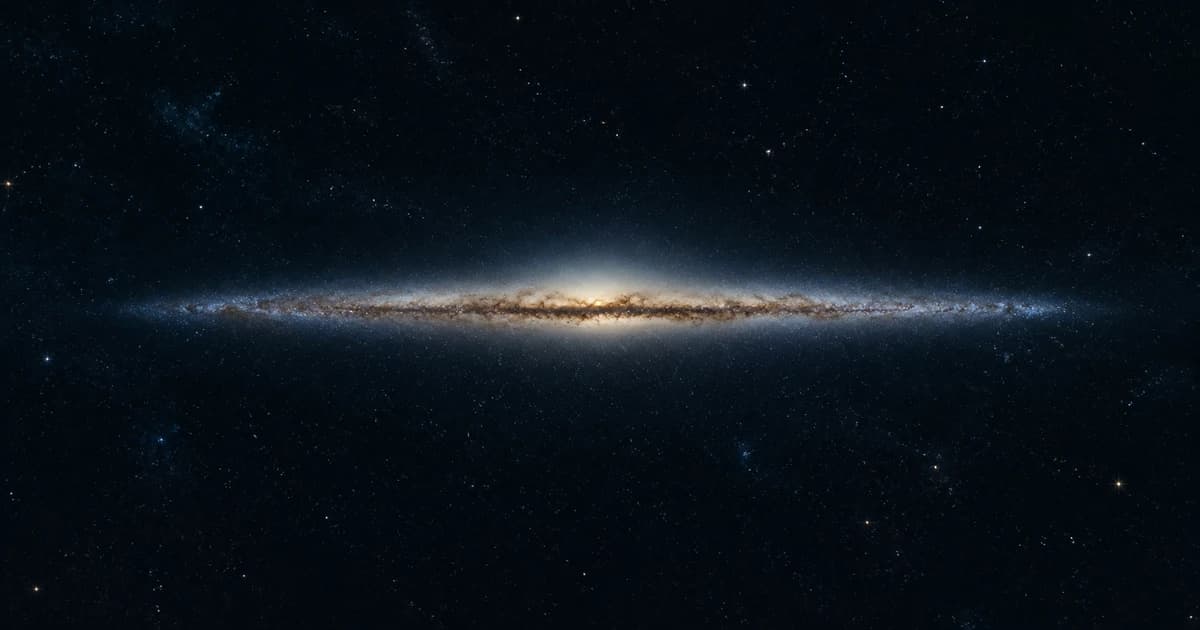
Andromeda is closing on the Milky Way at roughly 110 km/s, and the two are expected to interact in around four billion years, eventually merging into one elliptical galaxy. Essentially no stars will collide. The gaps between stars are so vast relative to their size that direct hits are negligible. Recent analyses have added real uncertainty about whether a merger is certain at all.
Why nothing will hit anything
The Sun is about 1.4 million kilometres across. The nearest star is about 40 trillion kilometres away, roughly 30 million Sun-diameters. If the Sun were a grain of sand, the nearest grain would be tens of kilometres off. Two clouds of sand at those spacings pass through each other with essentially no contacts.
What changes is the orbits, rearranged by the combined gravity.
The likely sequence
- First pass. Tidal streams, disrupted spirals, widespread star formation.
- Separation and return. They move apart, slowed by mutual gravity, then fall back.
- Merger. A single giant elliptical, of the kind in galaxy types, with stars on random orbits.
- The black holes merge, releasing enormous gravitational wave energy.
Nothing will hit anything. That is the more interesting story than the collision headlines.
The recent uncertainty
The approach velocity comes from a Doppler shift and is straightforward. Andromeda's sideways motion must be measured as a tiny angular displacement over years, at 2.5 million light years, and small errors change the outcome.
Depending on that transverse velocity and the pull of other Local Group members, outcomes range from a direct merger to a distant passage. A merger remains likely and is no longer a certainty.
What Earth experiences
Nothing that counts. Night skies would be spectacular during the interaction, and the Sun's orbit might move much further out. But Earth becomes uninhabitable within one to two billion years as solar luminosity rises, and the Sun becomes a red giant in about five billion. The merger is an event our planet will not be habitable for.
The follow-ups
- Will Andromeda collide with the Milky Way?
- It is approaching at roughly 110 km/s and a merger in around four billion years has long been expected. Better measurements of its sideways motion have made that likely instead of certain.
- Will stars collide when the galaxies merge?
- Essentially none. Stars are spaced around 30 million diameters apart, so the galaxies pass through each other with almost no direct contacts.
- Will the collision destroy Earth?
- No, and Earth will not be habitable by then regardless. Rising solar luminosity does that within one to two billion years.
 Natalie Hasselbank