Galaxy types: spiral, elliptical, irregular
Three main shapes, and a classification diagram whose arrow points the wrong way.
4 min read · Published 27 August 2026
In one paragraph
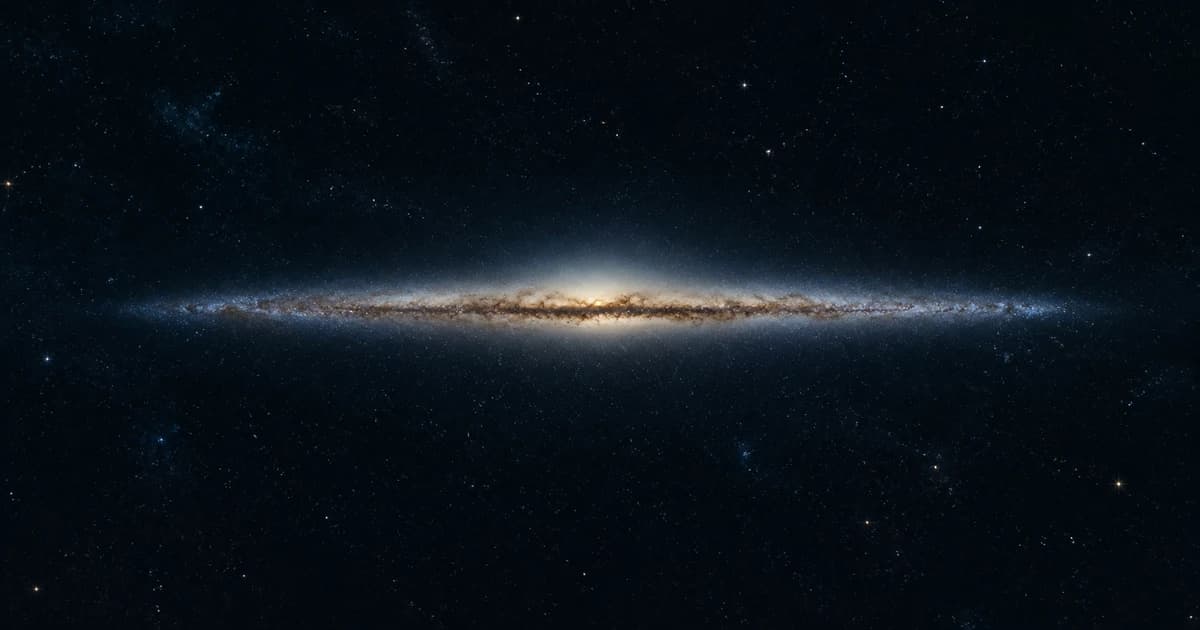
Galaxies come in three broad classes. Spirals have a flat rotating disc with arms and ongoing star formation. Ellipticals are smooth, rounded, and full of old stars with little new formation. Irregulars have no clear structure, often from gravitational disturbance. Hubble laid these out on a tuning fork diagram still used for classification, though the evolution it implies is now known to run backwards.
The three classes
| Type | Shape | Star formation | Contents |
|---|---|---|---|
| Spiral | Flattened rotating disc with arms and a central bulge | Ongoing | Mix of young blue and old red stars; substantial gas and dust |
| Barred spiral | As above with a central bar structure | Ongoing | Similar; the Milky Way is one |
| Elliptical | Smooth ellipsoid, from nearly spherical to elongated | Very little | Predominantly old red stars; little gas or dust |
| Lenticular | A disc without spiral arms: intermediate | Little | Old stars, disc structure, depleted gas |
| Irregular | No regular structure | Often vigorous | Frequently gas-rich; commonly disturbed by interaction |
The Milky Way is a barred spiral. Andromeda is a spiral. The largest galaxies known are giant ellipticals at the centres of galaxy clusters, and the smallest are dwarf irregulars and dwarf spheroidals, which are far more numerous than large galaxies.
The tuning fork, and what it got wrong
Hubble put ellipticals on the handle, splitting into two prongs for normal and barred spirals. Ellipticals got labelled 'early type' and spirals 'late type'.
That wording survives and misleads, because it implies ellipticals turn into spirals. The current understanding is the reverse. Ellipticals form from mergers of spirals.
When two spirals collide, the ordered rotation of their discs is wrecked, stars are flung into random orbits, and a burst of star formation eats the available gas. What's left is a smooth pile of old stars with little gas: an elliptical.
So the sequence runs spiral to elliptical, and 'early' and 'late' are fossils of a wrong idea, kept because the classification itself still works.
Hubble's tuning fork is wrong about evolution and I'd still keep it on the wall. Good map, bad arrow.
Why spirals have arms
Not because they're structures rotating with the galaxy. If they were, the differential rotation of the disc (inner regions orbiting faster than outer) would wind them up tight within a few rotations. They plainly aren't wound up, which is called the winding problem.
The leading explanation is density waves: patterns of compression moving through the disc, rather than fixed collections of stars. Stars pass through an arm and out again, like cars moving through a traffic jam that itself moves slowly.
As gas passes through the compressed region it collapses and forms stars. The most massive of those are hot, blue and short-lived, so they die before leaving the arm, so arms appear bright and blue while the disc between them is redder. The arms hold about the same mass. They're forming luminous stars more actively.
Observing them
Andromeda (M31) is the only large galaxy visible to the naked eye from the northern hemisphere, as a faint elongated smudge under dark skies. It's roughly 2.5 million light years away and is approaching us.
The Magellanic Clouds are irregular satellite galaxies of the Milky Way, prominent to the naked eye from the southern hemisphere.
In amateur telescopes galaxies appear as grey smudges, and the spiral structure so familiar from photographs is generally invisible to the eye. The colour and detail come from long exposures.
The realisation that these are separate galaxies instead of nebulae within the Milky Way came in the 1920s, using Cepheid variables to measure their distances. Before that, whether they were external systems was a genuine open question.
 Natalie Hasselbank