
Antiscia and contra-antiscia in traditional astrology
Points mirrored across the solstice axis, a real traditional technique most software ignores.
2 min read · Published 29 August 2026
In one paragraph
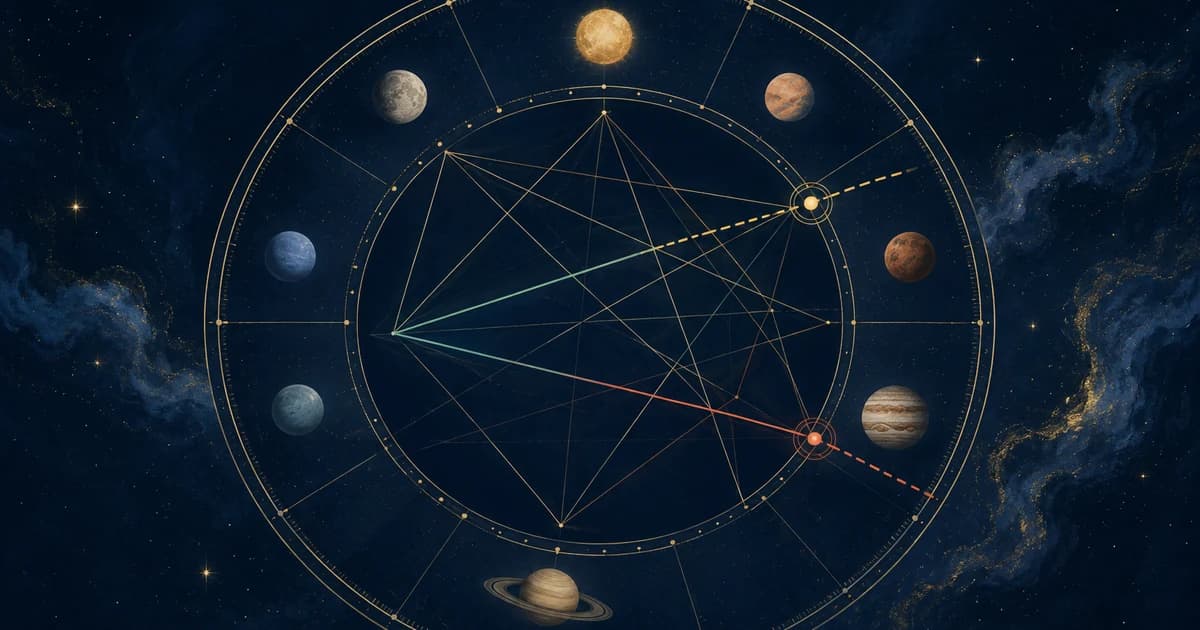
An antiscion is a planet's mirror point reflected across the solstice axis, the line from 0° Cancer to 0° Capricorn. Two positions that are antiscia of each other receive equal daylight. Contra-antiscia mirror across the equinox axis instead. Both are traditional techniques, read as hidden connections between planets that show no ordinary aspect.
How to find one
| Sign | Mirrors to | Example |
|---|---|---|
| Aries | Virgo | 10° Aries → 20° Virgo |
| Taurus | Leo | 5° Taurus → 25° Leo |
| Gemini | Cancer | 15° Gemini → 15° Cancer |
| Libra | Pisces | 10° Libra → 20° Pisces |
| Scorpio | Aquarius | 5° Scorpio → 25° Aquarius |
| Sagittarius | Capricorn | 15° Sagittarius → 15° Capricorn |
The degrees within paired signs always sum to 30, which is the arithmetic check. Contra-antiscia use the equinox axis and take the opposite point.
Why the solstice axis
It is the axis of daylight length. Two degrees that are antiscia correspond to dates with equal day length, one climbing toward midsummer and one coming back. The Sun at 10° Taurus and at 20° Leo give the same daylight, so the link is a real measurable property, not decorative symmetry.
Antiscia are a technique I admire and never use. If your reading needs mirror points to work, the reading has a problem.
How they are used
As hidden aspects, with tight orbs of a degree or two. They run through medieval and Renaissance literature, especially horary, where a hidden link between significators can decide a judgement. Modern astrology dropped them; the traditional revival that restored sect brought them back.
Whether to bother
In a traditional framework they are part of the toolkit. In modern psychological reading they add one more layer to a crowded picture, and more techniques means something always fits. AsterNym doesn't compute them; the table above lets you check your own chart by hand.
What is an antiscion?
A planet's mirror point across the solstice axis from 0° Cancer to 0° Capricorn. Two positions that are antiscia correspond to dates with equal daylight, which is the physical basis of the technique.
How do I calculate my antiscia?
Aries mirrors Virgo, Taurus mirrors Leo, Gemini mirrors Cancer, Libra mirrors Pisces, Scorpio mirrors Aquarius and Sagittarius mirrors Capricorn. The degrees within paired signs always sum to 30.
Are antiscia used in modern astrology?
Largely not. They appear throughout medieval and Renaissance literature and have returned to use among practitioners working from traditional sources.
 Mira Hale