Astrological aspects: conjunctions, squares, trines and oppositions
Placements describe the pieces. Aspects describe the arguments between them, which is where a chart stops being a list.
9 min read · Published 16 August 2026
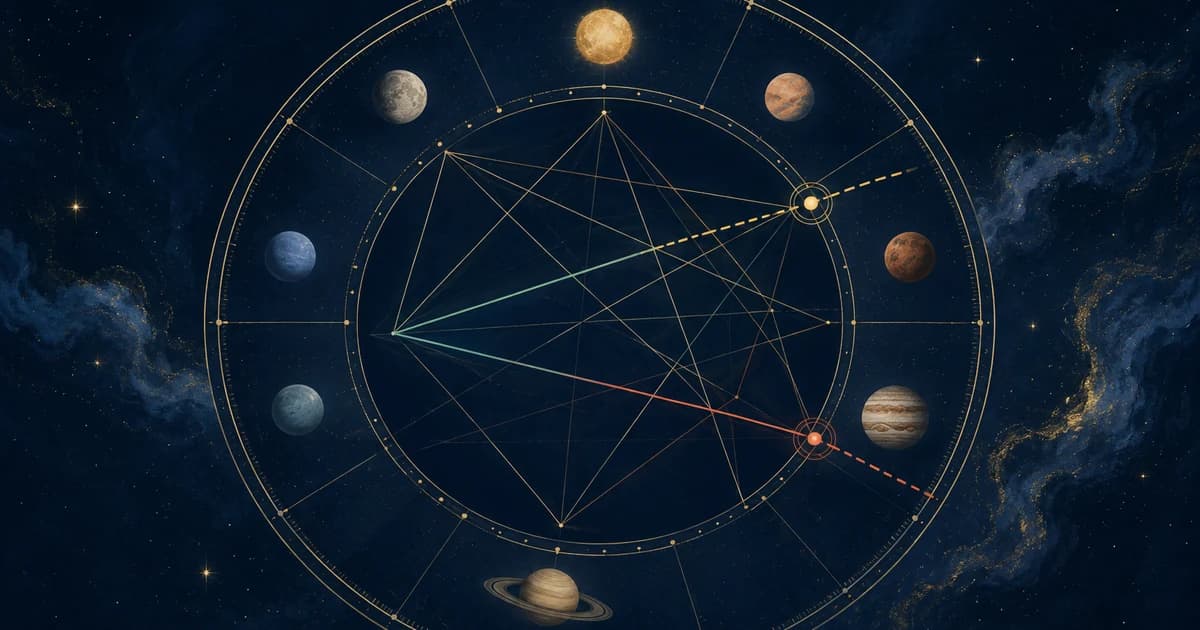
An aspect is the angle between two points in a chart, and only certain angles count, for traditional astrologers, as significant. The five major aspects are the conjunction at 0 degrees, where two bodies merge; the sextile at 60 degrees, read as easy opportunity; the square at 90 degrees, read as friction and drive; the trine at 120 degrees, read as natural flow; and the opposition at 180 degrees, read as tension between two things pulling opposite ways. Aspects don't need to be exact. Each is allowed an orb, a margin of a few degrees, and the tighter the angle the stronger the reading. The division into easy and hard aspects is real in traditional astrologers but frequently misunderstood: squares and oppositions are where most of the energy in a chart comes from, and charts full of trines are traditionally read as comfortable rather than fortunate.
Why only some angles count
The major aspects are the angles you get by dividing a circle by small whole numbers: 360 divided by 1 gives the conjunction, by 2 the opposition, by 3 the trine, by 4 the square, by 6 the sextile.
That isn't a coincidence dressed up afterwards. It's the original reasoning. The scheme is Ptolemaic and explicitly analogous to musical harmony, where simple whole-number ratios of a string produce consonant intervals. Aspects based on divisions by 5 or 7 produce angles the tradition mostly ignored, in the same way that Western music historically ignored intervals that didn't fit its ratios.
So the answer to why 90 degrees counts and 80 doesn't is that 90 divides the circle evenly and 80 does not. Whether that should carry meaning is a separate question, but the system is at least internally coherent rather than arbitrary.
Tight orbs or nothing. A square at nine degrees is an astrologer padding the reading.
The five major aspects
| Aspect | Angle | Division | Reads as |
|---|---|---|---|
| Conjunction | 0° | ÷1 | Fusion, the two act as one, for better or worse |
| Sextile | 60° | ÷6 | Opportunity available if taken; mild, easily missed |
| Square | 90° | ÷4 | Friction, obstruction, and most of the drive |
| Trine | 120° | ÷3 | Natural flow, talent, often unnoticed by its owner |
| Opposition | 180° | ÷2 | Polarity: awareness through tension, often via other people |
The conjunction is the only one whose character depends entirely on what is joined. Venus conjunct Jupiter and Mars conjunct Saturn are both conjunctions and have nothing in common as readings.
Orbs: how close is close enough
Two planets are rarely at exactly 90 degrees, so each aspect is given an orb: a tolerance either side within which it still counts.
There is no universal table. A common modern convention allows around 8 degrees for conjunctions and oppositions, 6 for squares and trines, and 4 for sextiles, with wider orbs for the Sun and Moon and narrower ones for minor aspects. Traditional practice often used orbs attached to the planets rather than to the aspects.
Two ideas do most of the work. Tighter is stronger: most modern astrologers read an aspect within a degree as loud and defining, one at seven degrees as background. And an aspect is applying if the faster planet is still moving towards exactness and separating if it has passed, with applying aspects traditionally read as stronger because the event hasn't finished happening.
Hard and easy is not bad and good
This is the most consistently misread part of the subject, and getting it right changes how a chart feels.
Squares and oppositions are called hard aspects because they describe friction. Two parts of a person that don't sit comfortably together and keep forcing the issue. That friction is where effort comes from. Biographies of people who built something difficult aren't short of squares, and most modern astrologers have always understood the hard aspects as the engine instead of the punishment.
Trines and sextiles describe things that come easily, and the traditional caution about them is real: what is effortless is often undeveloped, because nothing ever demanded that it be worked at. A grand trine (three planets each 120 degrees apart) is popularly read as a gift and traditionally read with some suspicion, as a closed circuit that can make a person self-sufficient in an unhelpful way.
The helpful reframe is that hard aspects describe where a life has friction, and friction is what gets things moving.
Patterns to recognise
The named configurations
- Grand trine, three planets forming a triangle of trines, usually in one element. Read as fluency in that element, and traditionally as a comfort that can become inertia.
- T-square, two planets in opposition, both square a third. The third planet is the pressure point, and this is one of the most common patterns in the charts of people who achieve a great deal.
- Grand cross, two oppositions squaring each other, forming a cross. Read as sustained tension in four directions and, in older texts, as a hard configuration to live with.
- Stellium, three or more planets bunched in one sign or house. Not strictly an aspect pattern, though it concentrates a chart heavily into one area of life.
- Yod, two planets sextile, both quincunx a third. Popularly called the finger of God and given far more weight in modern astrology than the tradition ever gave it.
A note of proportion: pattern-hunting is enjoyable and easy to overdo. A chart with no named configuration is entirely ordinary, and a yod isn't a destiny.
The minor aspects
| Aspect | Angle | Division | Origin | Read as |
|---|---|---|---|---|
| Semi-sextile | 30° | ÷12 | Ptolemaic scheme, later | Mild, adjacent; often ignored |
| Semi-square | 45° | ÷8 | Kepler, 1619 | Minor friction, irritation |
| Quintile | 72° | ÷5 | Kepler, 1619 | Talent, craft, a specific gift |
| Sesquiquadrate | 135° | ÷8 × 3 | Kepler, 1619 | Friction that surfaces late |
| Biquintile | 144° | ÷5 × 2 | Kepler, 1619 | As the quintile, weaker |
| Quincunx | 150° | ÷12 × 5 | Ptolemaic scheme, later | Adjustment, things that do not fit |
Kepler added the aspects based on 5 and 8 in his *Harmonices Mundi* of 1619, reasoning from the same musical analogy Ptolemy had used and extending it to intervals Ptolemy had left out. Most astrologers use the quincunx and ignore the rest, and orbs for all of them are tight, typically two degrees or less. A minor aspect at a wide orb is not there.
Aspects by sign, and aspects by degree
The oldest form of the doctrine counted aspects between signs, not degrees. In Hellenistic practice, any planet in Aries was square any planet in Cancer, whatever their degrees, because the signs themselves stood four apart. Degree-based aspects with orbs came later and are the modern norm.
The two methods disagree at the edges. A planet at 28° Aries and one at 2° Leo are 94 degrees apart, a square by degree within most orbs, and a trine by sign, since Aries and Leo are both fire. Modern astrologers call this an out-of-sign or dissociate aspect and usually read it as weaker. Traditional astrologers would not have called it a square at all. Neither is wrong. They are two definitions, and a chart tool should say which it uses, so AsterNym states its orbs on the natal chart.
A worked example
Take a Sun at 14° Taurus and a Moon at 12° Scorpio. Taurus and Scorpio are opposite signs, so the aspect is an opposition by sign. By degree, 12° Scorpio is 178 degrees from 14° Taurus, so the opposition is two degrees from exact, well inside any orb, and tight enough to be one of the chart's defining features.
Is it applying or separating? The Moon is the faster body. If it had reached 12° Scorpio on its way to 14°, the exact opposition lay ahead and the aspect was applying. If the Moon had already passed 14° and was at 12° on its way back, which cannot happen with the Moon, which never retrogrades, then separating. So the answer depends on the Moon's direction of travel through the sign, which is to say on whether 12° comes before or after 14°. It comes before, so the Moon is applying. Traditional reading treats an applying Sun-Moon opposition as a tension still being worked out, and that is as far as the geometry takes you. What it means for the person is the tradition's claim, not the chart's.
Reading aspects without over-reading them
Start with the tightest few. If an aspect is within two degrees it's doing more in the chart than a dozen loose ones, and the tightest three or four will usually describe the person better than any list of sign placements.
Involve the personal bodies first: Sun, Moon, Mercury, Venus, Mars and the angles. Outer-planet aspects to each other are shared by everyone born in the same span of years and say little about an individual, which is a practical check against interpretations that sound profound but apply to a whole generation.
And keep the same distinction that applies to the rest of a chart. The angle is measurable and will agree across any software. What the angle means is tradition, and the confidence of an interpretation shouldn't exceed the evidence behind it.
Questions people ask
- What are the major aspects in astrology?
- Five: the conjunction at 0 degrees, the sextile at 60, the square at 90, the trine at 120 and the opposition at 180. They come from dividing the circle by small whole numbers, a scheme inherited from Ptolemy and explicitly modelled on musical harmony, where simple ratios produce consonant intervals.
- Are squares and oppositions bad?
- No, though they're called hard aspects. They describe friction between two parts of a chart, and that friction is where drive and effort come from. Astrologers treat them as the engine of a chart, and warn instead that easy trines can leave a talent undeveloped because nothing forced it to be worked at.
- What is an orb in astrology?
- The margin of tolerance around an exact aspect angle. Two planets 87 degrees apart still count as square within a 6 degree orb. Astrologers read tighter aspects as stronger, and there's no universal table of orbs, which means generous orbs can make a chart appear to say almost anything.
- What is a T-square in a birth chart?
- Two planets in opposition that are both square to a third, forming a T shape. The third planet is the focal point where the tension concentrates. It's a common pattern and frequently appears in the charts of people who accomplish a lot, since sustained internal friction tends to produce sustained effort.
- What does applying and separating mean?
- An aspect is applying when the faster planet is still moving towards the exact angle, and separating once it has passed it. Applying aspects are traditionally read as stronger and as describing something still unfolding, while separating aspects count, for traditional astrologers, as having already played out.
- What is an out-of-sign aspect?
- An aspect that is within orb by degree but not by sign, such as 28° Aries and 2° Leo, which are 94 degrees apart and a square by degree but a trine by sign. Modern astrologers usually read it as weaker; traditional astrologers counted aspects by sign and would not call it a square.
- Who added the quintile?
- Johannes Kepler, in his Harmonices Mundi of 1619, extended Ptolemy's musical analogy to include aspects based on dividing the circle by five and eight, giving the quintile, biquintile, semi-square and sesquiquadrate.
- Which aspects should a beginner read first?
- The tightest three or four, whatever they are, and any that involve the Sun, Moon, Mercury, Venus, Mars or the angles. An aspect within two degrees does more in a chart than a dozen loose ones, and outer-planet aspects to each other are shared by a whole generation.
 Mira Hale