

Astrology events 2026: the complete calendar
Computed from the ephemeris, not copied from another list. Times in UT.
6 min read · Published 16 August 2026
The answer
2026 has four eclipses: an annular solar eclipse on 17 February at 28.8° Aquarius, a total lunar eclipse on 3 March at 12.9° Virgo, a total solar eclipse on 12 August at 20.0° Leo, and a partial lunar eclipse on 28 August at 4.9° Pisces. Mercury turns retrograde three times, Venus once in October, and four slow planets change signs: most significantly Neptune into Aries in January, Saturn into Aries in February, Uranus into Gemini in April and Jupiter into Leo in July.
Eclipses
| Date | Event | Peak (UT) | Position |
|---|---|---|---|
| 17 February | Annular solar eclipse | 12:11 | 28.8° Aquarius |
| 3 March | Total lunar eclipse | 11:33 | 12.9° Virgo |
| 12 August | Total solar eclipse | 17:45 | 20.0° Leo |
| 28 August | Partial lunar eclipse | 04:12 | 4.9° Pisces |
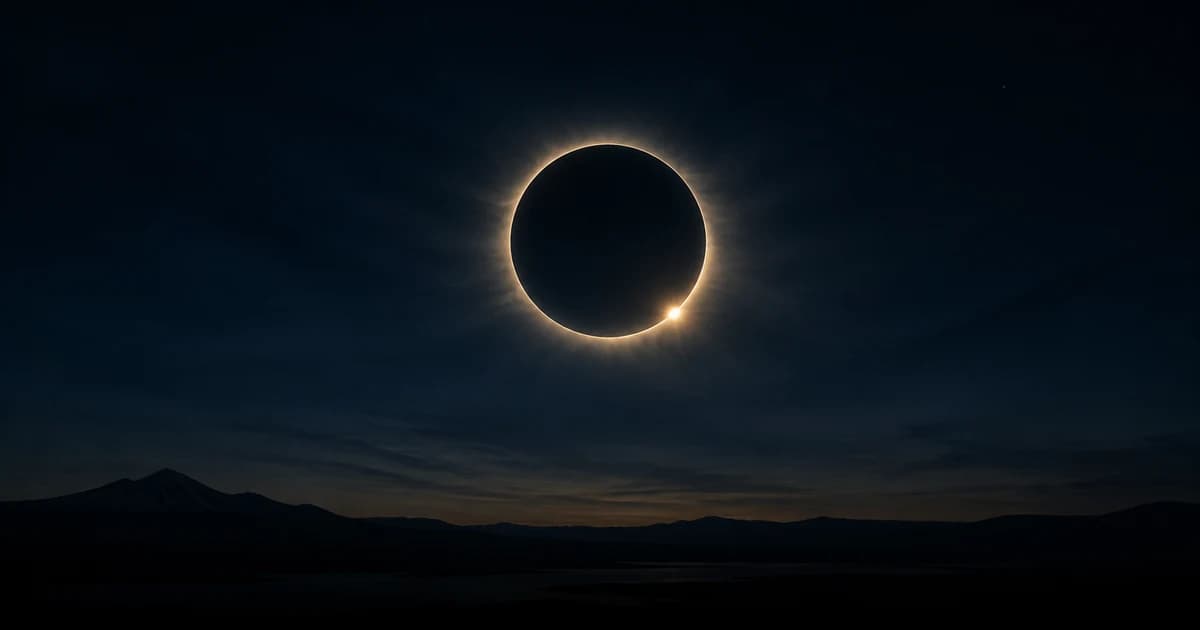
The 12 August total solar eclipse is the one that needs planning around, and not for astrological reasons. Its path of totality crosses Iceland and northern Spain, making it the first total solar eclipse visible from mainland Europe since 1999. If you have never stood in totality, it deserves the trip. It isn't a partial eclipse with more coverage, it is a categorically different experience.
Astrologically, eclipses are traditionally read as intensified new and full Moons that mark turning points, with effects said to run for months. There's no evidence for that claim. What is certain is the astronomy: the geometry, the timing and the path are known to the second, centuries ahead.
Mercury retrograde 2026
| Station | Date | Position |
|---|---|---|
| Retrograde | 26 February | 23° Pisces |
| Direct | 20 March | 8° Pisces |
| Retrograde | 29 June | 26° Cancer |
| Direct | 23 July | 16° Cancer |
| Retrograde | 24 October | 21° Scorpio |
| Direct | 13 November | 5° Scorpio |
Three retrograde periods, which is the normal count. Mercury turns retrograde three or four times a year, every year. That regularity needs holding onto: a phenomenon occurring roughly a fifth of the time isn't a rare event, and anything that goes wrong during one would mostly have gone wrong anyway.
The astronomy is real and rather elegant. Mercury does not reverse. Earth overtakes it on the inside track, and the apparent backwards motion is a perspective effect, the same one you see passing a slower car.
Other retrogrades
- Venus turns retrograde on 3 October at 8° Scorpio and returns direct on 13 November at 23° Libra, retrograding back across a sign boundary. Venus does this only about every eighteen months, making it much rarer than Mercury's.
- Jupiter returns direct on 11 March at 15° Cancer, then stations retrograde again on 13 December at 27° Leo.
- Saturn turns retrograde on 26 July at 15° Aries and returns direct on 10 December at 8° Aries.
- Mars has no retrograde period in 2026. It retrogrades roughly every two years, and its next is in January 2027.
Sign ingresses, the slow, notable ones
| Date | Planet | Moves from | Moves into |
|---|---|---|---|
| 27 January | Neptune | Pisces | Aries |
| 15 February | Saturn | Pisces | Aries |
| 27 April | Uranus | Taurus | Gemini |
| 1 July | Jupiter | Cancer | Leo |
These are the events astrologers treat as era-defining, because the outer planets move so slowly that an ingress happens only once every several years, or, for Neptune, once every fourteen. Neptune completes a full circuit of the zodiac in about 165 years, so its move into Aries in January 2026 is something no living person has seen before.
Whether that means anything is a separate question and the answer is the usual one. What is true is that these are infrequent astronomical events, unlike Mercury retrograde, and if you find the symbolic framing valuable this is where it has the most room to work.
Equinoxes and solstices
| Event | Date and time (UT) |
|---|---|
| March equinox | 20 March, 14:45 |
| June solstice | 21 June, 08:25 |
| September equinox | 23 September, 00:05 |
| December solstice | 21 December, 20:50 |
The March equinox is where the tropical zodiac begins. 0° Aries is defined as the Sun's position at that instant. It's the anchor for the entire Western system, and the reason tropical and sidereal astrology disagree, explained in sidereal vs Western.
How to use a calendar like this
As astronomy, freely. The eclipse dates are exact, the August total eclipse is a remarkable thing to witness, and knowing when the equinox falls is just knowing where you are in the year.
As prediction, carefully. No study supports the claim that eclipses or retrogrades produce measurable effects on individual lives, and the strong version of that claim (that you should avoid signing contracts or travelling) costs people real opportunities for no established reason.
The version to keep is the mild one: if a recurring date gives you a reason to check in on something you have been avoiding, the date has done helpful work, and it didn't need to be causal to do it.
The August eclipse is the one I'd travel for. The rest of the calendar is for people who enjoy calendars.
Still wondering
- When is Mercury retrograde in 2026?
- Three times: 26 February to 20 March in Pisces, 29 June to 23 July in Cancer, and 24 October to 13 November in Scorpio. All dates are Universal Time, so lists computed for other timezones may differ by a day.
- When is the total solar eclipse in 2026?
- 12 August 2026, peaking at 17:45 UT with the Sun at 20.0° Leo. The path of totality crosses Iceland and northern Spain, making it the first total solar eclipse visible from mainland Europe since 1999.
- How many eclipses are there in 2026?
- Four: an annular solar eclipse on 17 February, a total lunar eclipse on 3 March, a total solar eclipse on 12 August, and a partial lunar eclipse on 28 August.
- Which planets change signs in 2026?
- Neptune enters Aries on 27 January, Saturn enters Aries on 15 February, Uranus enters Gemini on 27 April, and Jupiter enters Leo on 1 July. Neptune takes about 165 years to circle the zodiac, so its ingress is an event no living person has seen before.
- Will the 2026 eclipses be visible from the United States?
- Not the total solar eclipse: totality on 12 August crosses Iceland and northern Spain, so the United States is outside the path. The 3 March total lunar eclipse is visible from the Americas where the Moon is up. Check a local eclipse map for your city rather than relying on the date alone.
- What is the biggest astrology story of 2026?
- Many astrologers would point to Neptune entering Aries on 27 January, because Neptune takes about 165 years to complete a circuit and no living person has seen it in Aries. The 12 August total solar eclipse over Iceland and Spain is the other headline. Astrology treats both as symbolic themes, not proven predictors.
- What should I do during the 2026 eclipses?
- Astronomically, use certified eye protection for any solar eclipse and simply watch lunar eclipses if the weather allows. Astrologically, many traditions use eclipse dates for reflection rather than dramatic decisions, but there is no evidence eclipses cause outcomes. Plan travel and viewing around safety and logistics, not omens.
 Mira Hale