

Astrology events 2027: the complete calendar
Including the 2 August eclipse, with over six minutes of totality over Egypt.
6 min read · Published 16 August 2026
2027 has five eclipses: annular solar on 6 February at 17.6° Aquarius, penumbral lunar on 20 February, total solar on 2 August at 9.9° Leo, and penumbral lunar eclipses on 18 July and 17 August. The 2 August total solar eclipse is the headline event of the decade: its path crosses North Africa with more than six minutes of totality, among the longest of the century. Mars retrogrades from January to April, Mercury three times, and Jupiter enters Virgo in July.
The eclipse of the decade
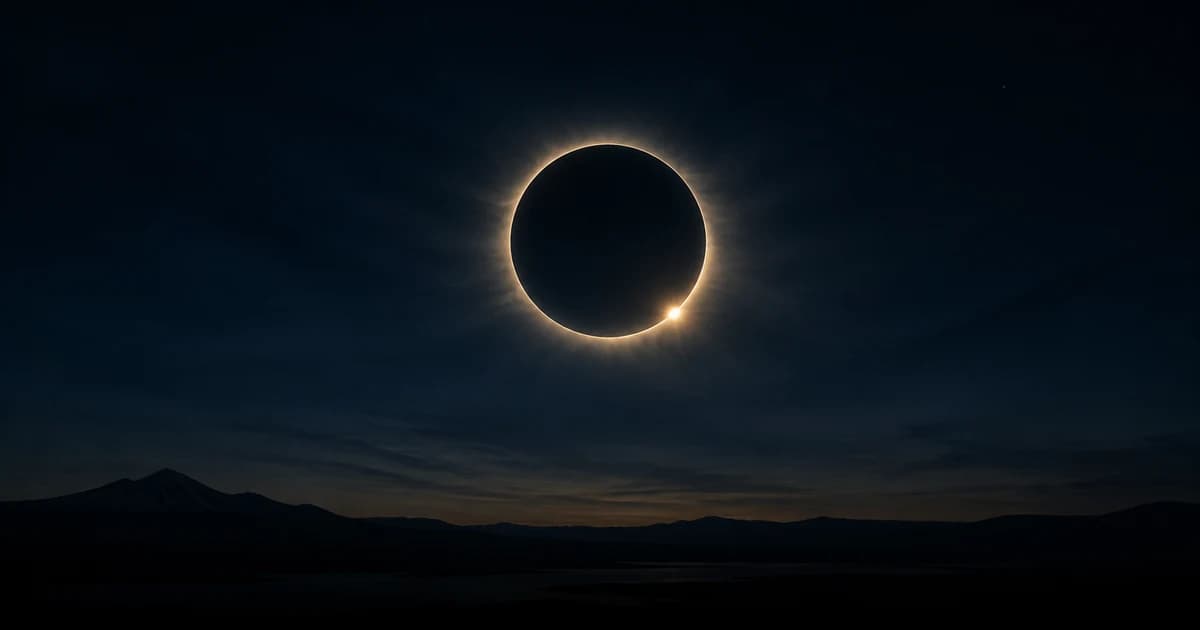
The total solar eclipse of 2 August 2027 deserves its own section. Peak is at 10:06 UT with the Sun at 9.9° Leo, and the path of totality runs across southern Spain, North Africa and the Arabian peninsula, passing close to Luxor in Egypt.
What makes it exceptional is duration. Most total eclipses give you two or three minutes. This one exceeds six minutes near the centre line, among the longest totalities of the twenty-first century over land, and the longest visible from a major landmass until well into the 2100s.
The reason is orbital: the Moon is near perigee, so its disc is large, while Earth is near aphelion, so the Sun's disc is small. A big Moon covering a small Sun, over a path near the equator where the shadow moves slowest, produces an unusually long totality.
If you intend to see it, book early. Eclipse-path accommodation for an event of this profile fills years ahead.
| Date | Event | Peak (UT) | Position |
|---|---|---|---|
| 6 February | Annular solar eclipse | 15:59 | 17.6° Aquarius |
| 20 February | Penumbral lunar eclipse | 23:12 | 2.0° Virgo |
| 18 July | Penumbral lunar eclipse | 16:02 | 26.0° Capricorn |
| 2 August | Total solar eclipse | 10:06 | 9.9° Leo |
| 17 August | Penumbral lunar eclipse | 07:13 | 24.1° Aquarius |
Note that all three lunar eclipses in 2027 are penumbral, the Moon passes only through Earth's outer shadow. These are visually undramatic, often barely perceptible, and astrological writing tends not to distinguish them from total lunar eclipses. Keep the difference in mind when a site tells you a lunar eclipse is significant.
Mars retrograde, January to April
Mars stations retrograde on 10 January at 10° Virgo and returns direct on 1 April at 21° Leo, having retrograded back across a sign boundary.
Mars retrogrades only about every two years, so unlike Mercury this is infrequent, roughly two and a half months once every twenty-six months. Traditional readings associate it with frustrated action and stalled initiative.
The astronomy is the same perspective effect as Mercury's, in reverse: Earth overtakes Mars on the inside, and Mars appears to loop backwards against the stars. Around the middle of a Mars retrograde the planet is close to opposition, meaning it's at its brightest and best-placed for observation all year. The period astrologers treat as difficult is the period astronomers point telescopes at it.
Six minutes of totality in North Africa is the event of the decade, and I'd plan a year around it.
Mercury retrograde 2027
| Station | Date | Position |
|---|---|---|
| Retrograde | 9 February | 6° Pisces |
| Direct | 3 March | 21° Aquarius |
| Retrograde | 10 June | 6° Cancer |
| Direct | 4 July | 27° Gemini |
| Retrograde | 7 October | 5° Scorpio |
| Direct | 28 October | 19° Libra |
All three periods cross back over a sign boundary this year, which astrologers read as revisiting two areas rather than one. It's a consequence of each station falling in the first degrees of a sign, geometry rather than intent.
Slower movements
- Saturn turns retrograde on 9 August at 28° Aries and returns direct on 24 December at 21° Aries, spending the whole year in Aries after its February 2026 ingress.
- Jupiter returns direct on 13 April at 17° Leo and then enters Virgo on 27 July: the only sign ingress by a slow planet in 2027, after four of them in 2026.
- Uranus, Neptune and Pluto all remain in the signs they entered previously. After the unusual cluster of outer-planet ingresses in 2026, 2027 is a settling year by comparison.
Equinoxes and solstices
| Event | Date and time (UT) |
|---|---|
| March equinox | 20 March, 20:24 |
| June solstice | 21 June, 14:10 |
| September equinox | 23 September, 06:01 |
| December solstice | 22 December, 02:42 |
Note the December solstice falling on the 22nd instead of the 21st. Solstice dates drift by a day across the leap-year cycle, which is one reason printed zodiac date ranges are approximations. See is Western astrology outdated.
Where these dates come from
Every figure on this page was computed instead of copied. Eclipse peaks and season points come from the search routines in astronomy-engine, the same library behind every position on this site. Retrograde stations were found by sampling each planet's apparent longitude daily and bisecting the direction change down to the hour. Ingresses were found by scanning for the exact sign-boundary crossing.
That counts because astrology calendars are copied from one another constantly, and errors propagate. If a date here disagrees with another site, check whether they state a timezone. Most don't, and a UT station near midnight will land on a different day almost everywhere.
The same engine produces your own natal chart and the solar return you're currently living through.
Still wondering
- When is the total solar eclipse in 2027?
- 2 August 2027, peaking at 10:06 UT with the Sun at 9.9° Leo. The path of totality crosses southern Spain, North Africa and the Arabian peninsula, and exceeds six minutes near the centre line, among the longest totalities of the century over land.
- When is Mars retrograde in 2027?
- Mars stations retrograde on 10 January at 10° Virgo and returns direct on 1 April at 21° Leo. Mars retrogrades only about once every twenty-six months, making it far less frequent than Mercury's three or four times a year.
- When is Mercury retrograde in 2027?
- Three times: 9 February to 3 March, 10 June to 4 July, and 7 October to 28 October. All three periods retrograde back across a sign boundary. Times are Universal Time.
- Why is the 2027 eclipse so long?
- The Moon is near perigee, making its disc appear larger, while Earth is near aphelion, making the Sun's disc appear smaller. A large Moon covering a small Sun, along a path near the equator where the shadow travels most slowly, produces an unusually long period of totality.
- How many eclipses are there in 2027?
- Five: an annular solar eclipse on 6 February, a penumbral lunar eclipse on 20 February, a penumbral lunar eclipse on 18 July, the total solar eclipse on 2 August, and a penumbral lunar eclipse on 17 August. Penumbral lunar eclipses are subtle and easy to miss by eye. Dates are Universal Time, so local calendars may differ by a day.
- Is the 2027 total solar eclipse visible from the United States?
- Not for totality. The path on 2 August 2027 crosses southern Spain, North Africa and the Arabian peninsula, so viewers in the United States would need to travel to the path to stand in totality.
- What does the 2027 total solar eclipse mean astrologically?
- In astrological tradition an eclipse at 9.9° Leo is read as highlighting visibility, leadership, creativity and self-expression, and eclipses are often treated as turning points. That is symbolic belief, not a verified effect; practical decisions should rest on real-world information, not eclipse lore.
 Mira Hale