

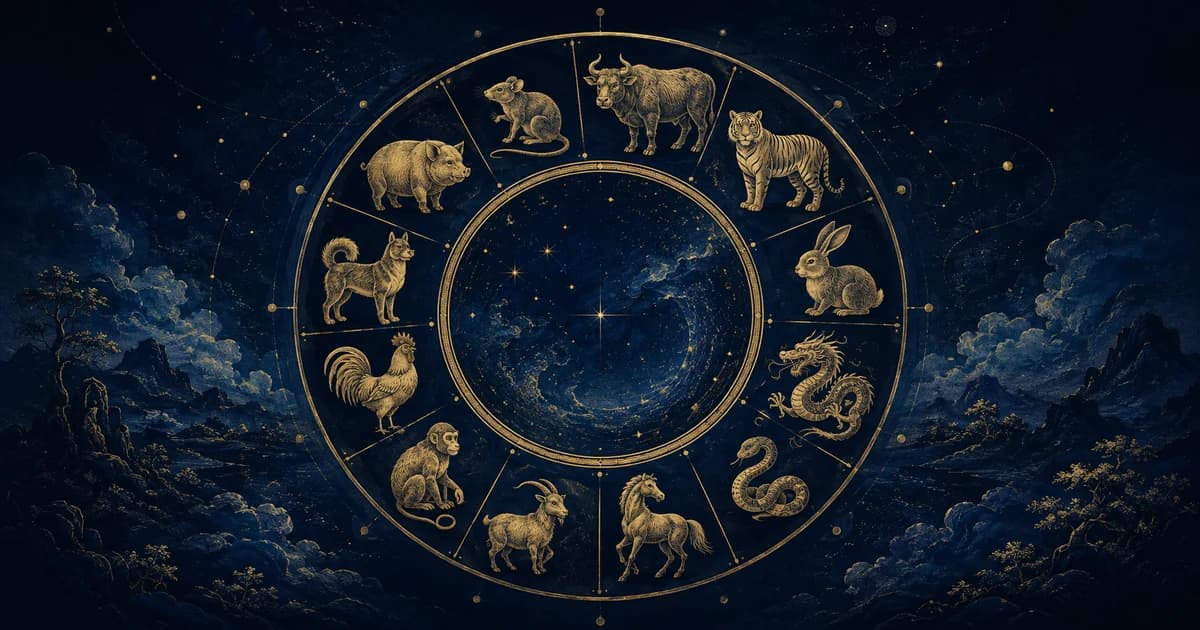
How the Chinese zodiac differs across Vietnam, Korea and Japan
The same twelve branches, adapted by every culture that took them up, and one famous substitution. The animals are labels; the branches are the thing.
4 min read · Published 21 August 2026
First, the answer
The twelve-branch system spread across East and Southeast Asia and was adapted locally. Vietnam replaces the rabbit with a cat and the ox with a buffalo. Japan uses a wild boar instead of a domestic pig and, since the Meiji calendar reform, marks the zodiac year from 1 January rather than Lunar New Year. Korea keeps the same twelve animals but applies the branches most seriously through saju, its four-pillars tradition. Thailand replaces the dragon with the naga.
The substitutions
| Country | Notable differences |
|---|---|
| China | The reference set: Rat, Ox, Tiger, Rabbit, Dragon, Snake, Horse, Goat, Monkey, Rooster, Dog, Pig |
| Vietnam | Cat instead of Rabbit; Buffalo instead of Ox; Goat sometimes read as Goat rather than Sheep |
| Japan | Wild boar (inoshishi) instead of the domestic Pig; Sheep rather than Goat |
| Korea | The same twelve as China; the branches carry most weight through saju rather than the popular zodiac |
| Thailand | Naga, the serpent deity, instead of the Dragon, see Thai astrology |
Each substitution is a local creature or a culturally resonant one taking a slot. The structure (twelve branches in fixed order, paired with ten stems into a sixty-year cycle) survives everywhere intact.
The Vietnamese cat
The best-known difference, and there are competing explanations for it.
The most-cited is linguistic: the Chinese word for the rabbit branch, mão or mǎo (卯), sounds close to the Vietnamese word for cat, mèo. As the system was adopted, the branch name may have been heard and taken as the animal it sounded like.
Others point to ecology and culture, cats being more present in Vietnamese homes than rabbits, or simply to independent local adaptation.
Whichever it is, a Vietnamese person and a Chinese person born in the same year have different animals while sharing the identical branch underneath. That is a clean illustration of what the animals are: labels on a calendar structure, not the structure itself.
The Vietnamese cat is my favourite fact in the whole system, and the strongest argument that the animals are labels.
Japan celebrates on 1 January
The more consequential difference, and one that catches people out.
Japan adopted the Gregorian calendar in the Meiji era, in 1873, and moved its new-year observances with it. So the Japanese zodiac year (the eto) turns on 1 January rather than at Lunar New Year.
That means a person born in late January in Japan is assigned the new year's animal, while a person born on the same date in China is assigned the previous year's. Neither is wrong; they're using different calendars, and this is a third boundary on top of the two covered in why your Chinese sign might be wrong.
Japanese practice also keeps the sexagenary cycle. The sixtieth-birthday celebration, kanreki, marks the return to one's birth stem-branch pairing and is traditionally observed with red clothing, the same colour logic as ben ming nian.
Korea: the branches are used more seriously
Korea keeps the same twelve animals as China, so there's no substitution to note. What differs is emphasis.
The popular year animal exists, but the branches carry their real weight through saju (사주): Korean four-pillars astrology, which uses the identical eight characters as Chinese BaZi with its own interpretive tradition, myeongnihak.
Saju is culturally routine in a way the year animal alone isn't: consulted before marriages, business decisions and job moves, and now widely available through apps and saju cafés. Someone in Korea is much more likely to know their Day Master than someone in the West is to know theirs.
The details are in Korean astrology: what saju is.
What survives everywhere
- Twelve branches in fixed order. The sequence never changes, whatever the animals are called.
- Ten stems and the sixty-year cycle. Every one of these cultures keeps the stem-branch pairing and the sixtieth-year milestone.
- The solar terms. The twenty-four divisions of the solar year underpin the calendar across the region.
- Four pillars practice. BaZi in China, saju in Korea, and related traditions elsewhere, the same eight characters, differently read.
The animals are the most visible layer and the most locally variable. The calendrical structure underneath them is the part that travelled unchanged, which is a reasonable summary of what the system is.
Why does Vietnam have a cat instead of a rabbit?
The most-cited explanation is linguistic: the Chinese name for the rabbit branch, mão, closely resembles the Vietnamese word for cat, mèo, so the branch may have been adopted as the animal it sounded like. Cultural and ecological explanations are also offered.
When does the zodiac year start in Japan?
On 1 January. Japan adopted the Gregorian calendar in 1873 and moved its new-year observances with it, so the Japanese eto year turns at the Gregorian new year rather than at Lunar New Year.
Does Korea use the same zodiac animals as China?
Yes, the same twelve. What differs is emphasis: the branches carry most of their weight in Korea through saju, the four-pillars tradition, which uses the same eight characters as Chinese BaZi with its own interpretive school.
What stays the same across all these countries?
The structure: twelve branches in fixed order, ten heavenly stems, the sixty-year sexagenary cycle, the twenty-four solar terms, and four-pillars practice. Only the animal names and the year boundary vary locally.
 Lily Lau