

How telescopes work
A telescope's primary job is gathering light, not magnifying.
4 min read · Published 28 August 2026
A telescope's primary job is gathering light, not magnifying. A large lens or mirror collects far more photons than your pupil and brings them to a focus, where an eyepiece or sensor examines the image. Aperture determines both how much light is collected (scaling with area) and the finest detail resolvable, which is limited by diffraction. Magnification is set separately by the eyepiece and is the least important specification.
Light gathering
Your dark-adapted pupil is roughly 6mm across. A 150mm telescope has an aperture 25 times wider, and since collecting area scales with the square of diameter, it gathers about 625 times more light.
That's the fundamental function. Faint objects become visible because more photons per second reach your eye, not because the image is bigger.
It is also why aperture dominates every buying decision, as set out in choosing a beginner telescope. Doubling aperture quadruples light collection, and no other specification comes close to that leverage.
Resolution and its limit
Aperture also sets the finest detail resolvable, and there's a hard physical limit: diffraction. Light passing through any aperture spreads slightly, so a point source images as a small disc with faint rings instead of a point.
The disc size is inversely proportional to aperture, larger apertures produce smaller discs and therefore finer detail. This is why a large telescope separates close double stars that a small one shows as one.
In practice, ground-based telescopes rarely reach their diffraction limit because of atmospheric seeing: turbulence in the air blurs and shifts the image. Above roughly 250mm of aperture, seeing usually dominates over diffraction on typical nights.
Two responses exist. Adaptive optics measures the distortion hundreds of times per second and deforms a mirror to cancel it. Or put the telescope above the atmosphere, which is much of the case for space telescopes.
Magnification is the least important number on a telescope box, and I'd ignore any box that leads with it.
Lenses versus mirrors
| Refractor (lens) | Reflector (mirror) | |
|---|---|---|
| How it works | Light bends through a lens to a focus | Light reflects off a curved mirror to a focus |
| Chromatic aberration | Yes: different colours focus differently unless corrected | None. Reflection is colour-independent |
| Support | Only by the edges, since light passes through | The whole back surface can be supported |
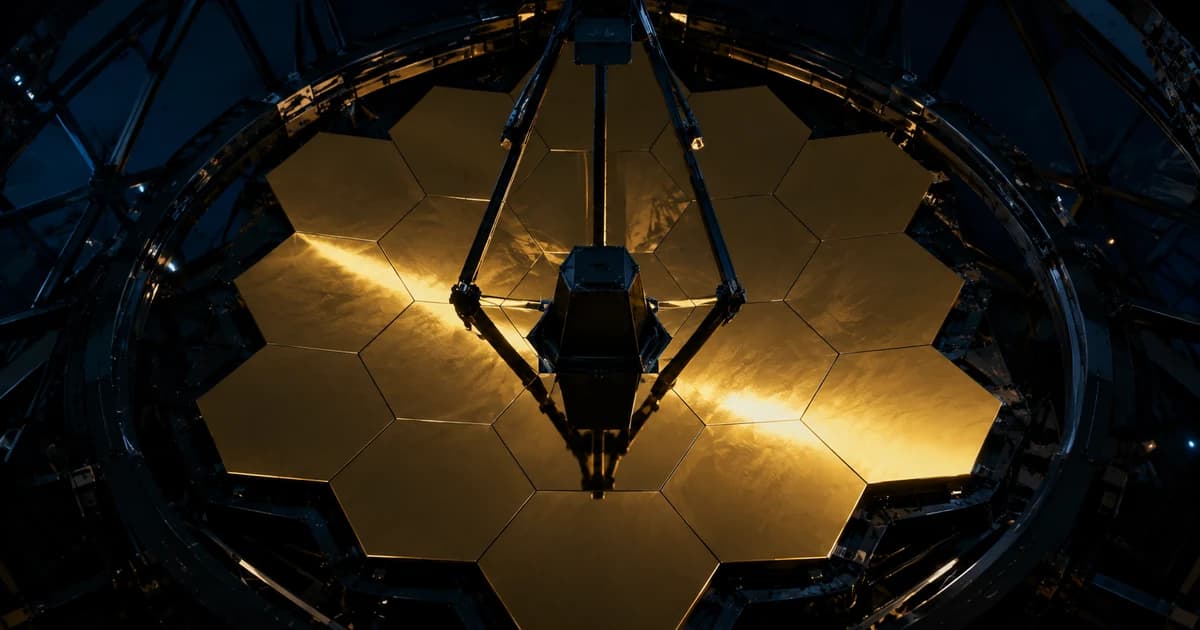
| Practical size limit | About a metre; larger lenses sag under their own weight | Effectively unlimited; segmented mirrors reach tens of metres |
| Cost per aperture | High | Much lower |
Rows three and four explain why every large telescope uses mirrors. A lens can only be held at its rim, so beyond about a metre it deforms under gravity. A mirror can be supported across its entire back, and can be built from segments acting together.
The largest refractor ever built dates from the 1890s and hasn't been exceeded, because the approach hits a physical wall. Mirror telescopes have grown continuously ever since.
Where magnification comes from
Magnification is the telescope's focal length divided by the eyepiece's. Swap the eyepiece and it changes, so it's a property of the combination, not of the telescope.
There is a maximum practical magnification, roughly twice the aperture in millimetres under excellent conditions and often less. Beyond that you enlarge the diffraction disc and atmospheric blur without adding detail. The image gets bigger, dimmer and no sharper.
This is why advertised magnification figures on consumer telescopes are meaningless. A 60mm telescope claiming 500x is claiming roughly four times more than its aperture can support.
Experienced observers often use lower magnification than beginners expect, because a brighter, steadier, wider image usually reveals more than a large dim wobbling one.
Questions people ask
- What does a telescope do?
- It gathers light. A large lens or mirror collects far more photons than your pupil (a 150mm telescope collects about 625 times more than a 6mm dark-adapted pupil) and brings them to a focus where an eyepiece or sensor examines the image.
- Why do large telescopes use mirrors instead of lenses?
- A lens can only be supported at its rim, so beyond about a metre it sags under its own weight. A mirror can be supported across its whole back and built from segments, so mirror telescopes can be made effectively unlimited in size.
- What limits a telescope's resolution?
- Diffraction sets the physical limit, with finer detail resolvable at larger apertures. In practice ground-based telescopes above roughly 250mm are usually limited by atmospheric turbulence instead, which adaptive optics or space-based observing can overcome.
- What is the maximum practical magnification?
- Roughly twice the aperture in millimetres under excellent conditions, and often less. Beyond that you enlarge the diffraction disc and atmospheric blur without revealing more detail: the image becomes larger, dimmer and no sharper.
 Mira Hale