

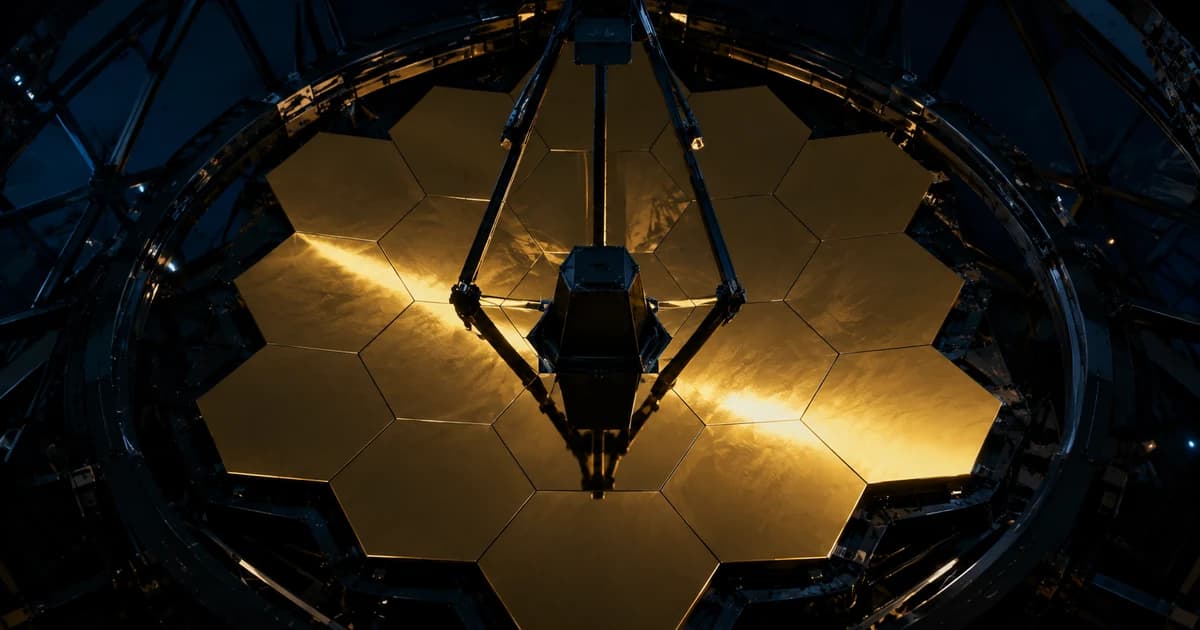
JWST's biggest discoveries so far
Galaxies too big too early, objects nobody can classify, and one claim that got ahead of itself.
4 min read · Published 28 August 2026
Straight to it
Webb has pushed the most distant confirmed galaxy back to roughly 280 million years after the Big Bang, found early galaxies more massive and mature than models predicted, discovered a population of compact 'little red dots' that remain unexplained, and produced detailed exoplanet atmosphere measurements. Its most publicised result (a possible biosignature on K2-18b) is contested and shouldn't be treated as established.
The earliest galaxies
Webb's infrared design was built for this. Light from the earliest galaxies is stretched into the infrared by cosmological redshift, placing it beyond what optical telescopes can reach.
MoM-z14 is currently the most distant confirmed galaxy, at a redshift of about 14.4, seen as it existed roughly 280 million years after the Big Bang. It's small, around fifty times less massive than the Milky Way, and shows emission lines indicating nitrogen and carbon and a rapidly rising star formation rate.
It displaced JADES-GS-z14-0, announced in 2024 at around 300 million years. The record has moved several times, which is itself the result: galaxies exist earlier and are easier to find than pre-launch expectations suggested.
Little red dots
A unexpected discovery: a population of compact, very red objects appearing in early-universe images in numbers nobody predicted.
Their properties are difficult to reconcile. If they're galaxies, they're implausibly compact and massive. If the light comes from accreting black holes, the black holes are implausibly large for the epoch and lack expected X-ray signatures.
One current proposal is a distinct class of object sometimes described as a black hole star: a black hole embedded in and enshrouded by dense gas, producing a spectrum resembling a star instead of a typical quasar.
This is unresolved, and to watch precisely because it's unresolved. A new instrument finding a category of object nobody anticipated is the strongest argument for building new instruments.
The little red dots are the discovery I'd watch. They are the thing Webb wasn't expected to find.
Exoplanet atmospheres
Webb can measure the composition of exoplanet atmospheres by transmission spectroscopy: analysing starlight filtered through a planet's atmosphere as it transits.
It has produced detections of carbon dioxide, water, methane and sulphur dioxide in various exoplanet atmospheres, at a precision that wasn't previously achievable. Sulphur dioxide is notable as evidence of photochemistry, sunlight driving chemical reactions in another planet's air.
The high-profile case is K2-18b, a sub-Neptune where observations were reported as possibly indicating dimethyl sulphide, a molecule produced largely by life on Earth.
That claim is contested. The statistical significance has been questioned, alternative molecules can produce similar features, and independent reanalyses have disagreed. Whether the planet is even a 'hycean' ocean world is disputed.
The appropriate position is interest and patience. A biosignature claim requires far more than a marginal spectral feature, and the history of this field is full of announcements that didn't survive, so the search for life sets its bar so high.
Why infrared, and why L2
Webb observes in the infrared for two reasons: the earliest galaxies are redshifted into it, and infrared penetrates the dust that hides star-forming regions from optical telescopes.
That imposes a hard constraint. An infrared telescope must be extremely cold, or its own thermal emission swamps the signal. Webb therefore sits near the Sun–Earth L2 point, about 1.5 million kilometres out, with a tennis-court-sized sunshield keeping the instruments at around 40 kelvin.
L2 means it's far too distant to service, unlike Hubble in low Earth orbit. The deployment sequence (unfolding the sunshield and mirror segments after launch) had hundreds of single-point failure modes and had to work first time. It did.
Still wondering
- What is the most distant galaxy JWST has found?
- MoM-z14, at a redshift of about 14.4, seen as it existed roughly 280 million years after the Big Bang. It displaced JADES-GS-z14-0 at around 300 million years, and the record has moved several times since launch.
- Did JWST break cosmology?
- No. Some early galaxies appear more massive and mature than models predicted, which constrains galaxy formation models instead of overturning the Big Bang. Mass estimates from limited photometry are uncertain and several early figures were revised downward.
- Did JWST find signs of life on K2-18b?
- The claim of a possible dimethyl sulphide detection is contested. Its statistical significance has been questioned, alternative molecules can produce similar spectral features, and independent reanalyses disagree. It shouldn't be treated as established.
- Why does JWST observe in infrared?
- Because light from the earliest galaxies is redshifted into the infrared, and because infrared penetrates the dust obscuring star-forming regions. This requires the telescope to be extremely cold, so it lies at L2 behind a large sunshield at around 40 kelvin.
 Mira Hale