

How to read your Four Pillars chart
Eight characters in a grid, and the reading order I teach, because the order is most of the skill.
4 min read · Published 18 August 2026
In one paragraph
Read in this order: find your Day Master, judge the season from the month branch, decide whether the Day Master is supported or drained, note which elements dominate and which are missing, then name the Ten God relationships. Only after that look at Luck Pillars. The order is the point. Every later step is read relative to the Day Master, so reading out of sequence gives you eight facts and no conclusion.
How the chart is laid out
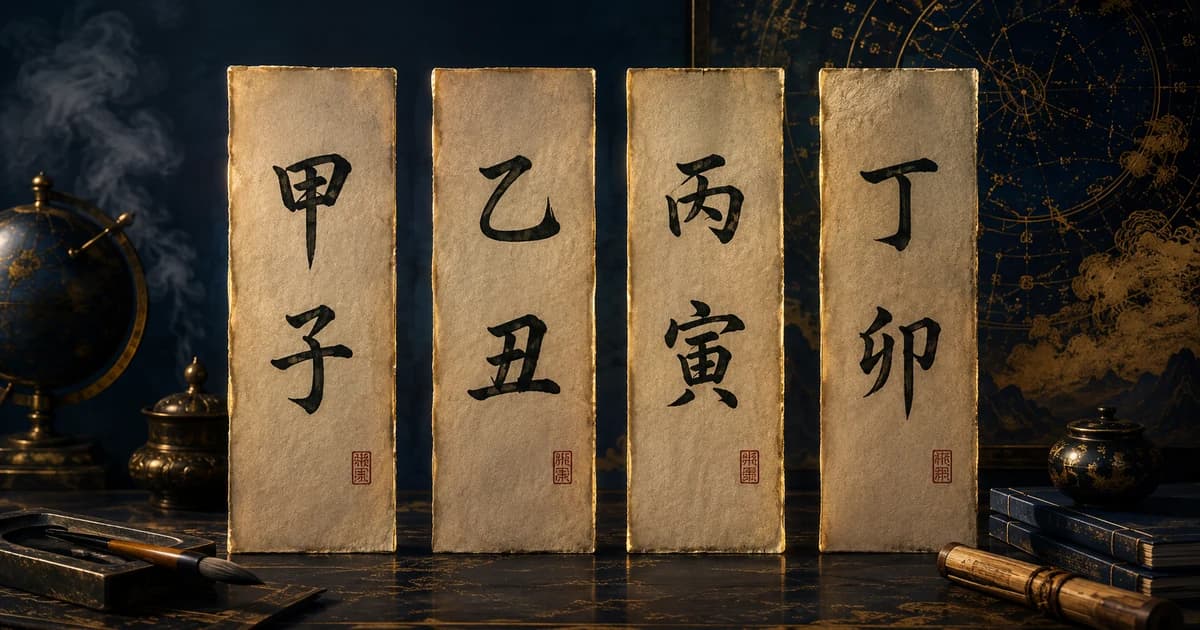
A BaZi chart is a grid, usually with hour, day, month and year across the top, often right to left in Chinese sources, and two rows: heavenly stems above, earthly branches below.
Beneath the branches, a proper chart also shows the hidden stems, the extra stems concealed inside each branch. Most branches hide two or three, and a reading that ignores them is working from about half the chart, the way a pulse taken on one wrist is half a diagnosis. See heavenly stems and earthly branches.
Season first. I would fail any reading that names the Ten Gods before it has judged the month branch.
| Hour | Day | Month | Year | |
|---|---|---|---|---|
| Heavenly stem | One of ten | Your Day Master | One of ten | One of ten |
| Earthly branch | Your birth-hour animal | One of twelve | The season | Your zodiac animal |
| Hidden stems | 1–3 concealed | 1–3 concealed | 1–3 concealed | 1–3 concealed |
The reading order
Six steps, and the order is not optional
- Find the Day Master. The stem of the day pillar. It's you, and everything else is described relative to it. Nothing else can be interpreted until you have it.
- Look at the month branch. This is the season, and in BaZi the season is the heaviest single factor. A Wood Day Master born in spring is in a completely different position from one born in autumn.
- Judge strength. Is the Day Master supported by the chart or drained by it? This determines which elements help you, and it is the question a BaZi reading turns on. See favourable god and element balance.
- Count the elements. What dominates, what is thin, what is missing entirely. Include hidden stems, this is where they change the answer.
- Name the Ten Gods. Every stem, visible and hidden, gets a label describing what it does to your Day Master. This is the interpretive layer.
- Then Luck Pillars. Ten-year periods, read against everything above. They're last because a period only means something once you know what the natal chart wants.
What to look for
An element that's completely absent. BaZi treats absence as informative instead of neutral, which is one of its more distinctive features. A chart with no Water is read very differently from one with a little.
An element that dominates. Four or five characters of one element is a strong signal, and whether it's good news depends entirely on whether that element supports or drains your Day Master.
Branch relationships. Clashes, combinations and harms between the four branches, covered in clashes and combinations.
Whether the hour pillar exists. If you don't know your birth time, say so in your own reading and treat every conclusion as provisional. A quarter of the chart is missing, and the missing quarter may contain the element everything else says you lack.
Reaching a conclusion
A finished reading should compress to two or three sentences: what your Day Master is, whether it's supported, which elements help, and what the dominant Ten God relationship says about how your chart is organised.
If you can't compress it, you have a list of features instead of a reading, the same failure as reading a three-card tarot spread card by card without connecting them.
AsterNym runs all six steps and shows the working at each, including the weights behind the strength judgement, on your BaZi page. The working counts because step three is the one where schools disagree.
Still wondering
- How do I read a BaZi chart?
- In order: identify the Day Master, check the month branch for season, judge whether the Day Master is supported or depleted, count the elements including hidden stems, name the Ten God relationships, and only then look at Luck Pillars. Every step after the first is interpreted relative to the Day Master.
- What is the most important part of a BaZi chart?
- The Day Master, the heavenly stem of the day pillar. It represents you, and every other character in the chart is interpreted by its relationship to it. Nothing else in the chart can be judged without it.
- What are hidden stems in a BaZi chart?
- Additional heavenly stems concealed inside each earthly branch, usually between one and three per branch. They carry real interpretive weight, and a reading that counts only the eight visible characters is working from roughly half the chart.
- Can I read my chart without a birth time?
- Partially. Three of the four pillars are exact from the date alone, but the hour pillar cannot be computed, so a quarter of the chart is missing, including possibly the element the rest of the chart appears to lack. Treat conclusions as provisional.
 Lily Lau