

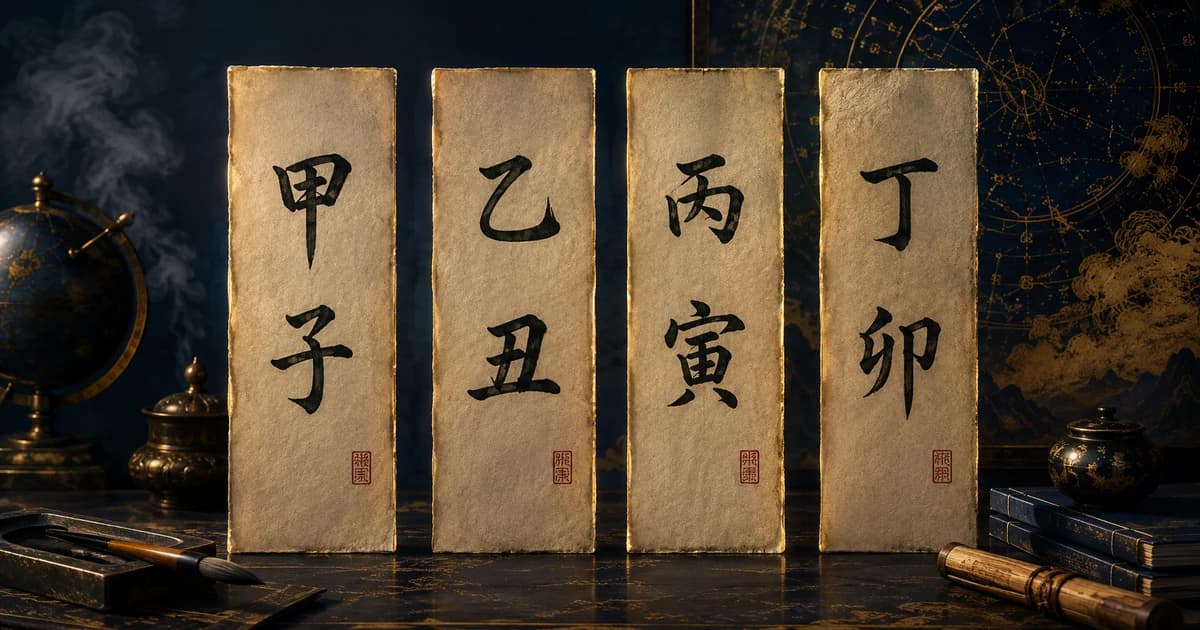
Missing BaZi elements: what an absent element means
When one of the five elements is absent from your Four Pillars: what it means, what it does not, and how a reader supplies it. A missing element is a talking point, not a diagnosis.
5 min read · Published 29 August 2026
Straight to it
In BaZi, the Four Pillars of Destiny, your birth date and time are written as four pillars and eight characters, and every one of those characters carries one of the five elements: Wood, Fire, Earth, Metal and Water. A missing element is one that is absent, or very weak, across those eight characters. A chart can be balanced, missing one element, or missing several, and a missing element is not automatically a problem. What a reader weighs far more heavily is your favourable element, the one your chart most needs, which the tradition suggests bringing in through colours, directions, careers and even favourable numbers and names.
The four pillars and eight characters
A BaZi chart, sometimes called the Four Pillars of Destiny, is built from the year, month, day and hour of your birth. Each of those four pillars is written with two Chinese characters, a Heavenly Stem above and an Earthly Branch below, so BaZi is also called the *eight characters*, since that is what the words mean.
Each of those eight characters carries one of the five elements: Wood, Fire, Earth, Metal and Water. Reading a chart begins with seeing how those elements are spread, which are plentiful, which are scarce, and how they support or control one another, exactly as a Chinese physician begins by asking what is in excess and what is deficient.
What 'missing' really means
A missing element is one that does not appear, or barely appears, among your eight characters. If nowhere in the eight is there any Water, for instance, your chart is often described as missing Water.
The first thing to say is that this is normal and not a verdict. Charts come in every shape: some carry all five elements in reasonable balance, some are missing one, and some are missing two or more while doubling up heavily on others. A missing element is a feature of the chart to understand, not a flaw to fear.
The second thing is subtler and more important: a merely *absent* element isn't the same as a *needed* one. An element can be missing and hardly matter, while an element that's present but out of balance can matter a great deal. Which leads to the idea that does the real work in BaZi.
A missing element is a talking point, not a diagnosis. I'd stop anyone who sells you a remedy for it in the first ten minutes.
The favourable element matters more
BaZi doesn't simply count elements and top up whatever is lowest. It reads the chart as a whole (which element is your Day Master, whether the chart runs strong or weak, and what it needs to come into balance) and from that it identifies a favourable element (and often an unfavourable one).
The favourable element is the one that needs strengthening. Sometimes that's indeed an element the chart is missing; sometimes it's one already present but needing support; and occasionally an absent element is best left absent because bringing it in would unbalance the chart further. This is why a careful reading counts more than a quick headcount, and why "you're missing X, so add X" is too blunt to trust on its own.
How the tradition supplies an element
Once a favourable element is identified, almanac writers suggest inviting more of it into your life through everyday associations. Each element has long-standing links to colours, directions, seasons, careers and more. The table gives the best-known colour and direction associations. These are standard Wu Xing correspondences.
| Element | Colours | Direction |
|---|---|---|
| Wood | Greens | East |
| Fire | Reds, purples, oranges | South |
| Earth | Yellows, browns | Centre |
| Metal | White, grey, metallics | West |
| Water | Black, deep blue | North |
The same logic reaches into choices of career and environment (a Fire-favourable person might be pointed toward warm colours, southern directions and energetic, visible lines of work) and, notably, into favourable numbers and names.
Favourable numbers and names
Numbers and names belong to the same elemental scheme. In this tradition each digit is associated with an element, so once your favourable element is known, almanac practice reads certain digits as supportive and others as neutral or draining. This is the reasoning behind choosing an auspicious phone number, picking digits for a plate or an address, or weighing the elemental balance of a name.
AsterNym's lucky-number tools run on exactly this logic: the favourable digits they suggest come from the same elemental reading that identifies a missing or needed element. You can work out your chart with the BaZi calculator, browse the full set of AsterNym calculators, or go straight to a lucky mobile number reading built on your favourable element.
Questions people ask
- What does a missing element in BaZi mean?
- It means one of the five elements (Wood, Fire, Earth, Metal or Water) is absent or very weak across the eight characters of your Four Pillars chart. Charts can be balanced, missing one element, or missing several, and a missing element is a feature to understand instead of automatically a problem.
- Is it bad to be missing an element in your BaZi chart?
- Not necessarily. Many charts are missing an element and read perfectly well. What counts more is your favourable element, the one the chart most needs, which may or may not be the one that's missing. Sometimes an absent element is best left absent because adding it would unbalance the chart.
- How do you supply a missing or favourable element?
- Almanac writers suggest inviting more of the favourable element through everyday associations: its colours, its compass direction, suitable careers and environments, and its favourable numbers and names. For Fire, for example, that means warm colours and southern directions; other elements have their own standard correspondences.
- How are lucky numbers linked to BaZi elements?
- Tong Shu almanac writers associate each digit with one of the five elements, so once your favourable element is known, some digits read as supportive and others as neutral or draining. This is the basis for choosing auspicious phone numbers or plate numbers, and it uses the same elemental reading that identifies a missing or needed element.
 Lily Lau