

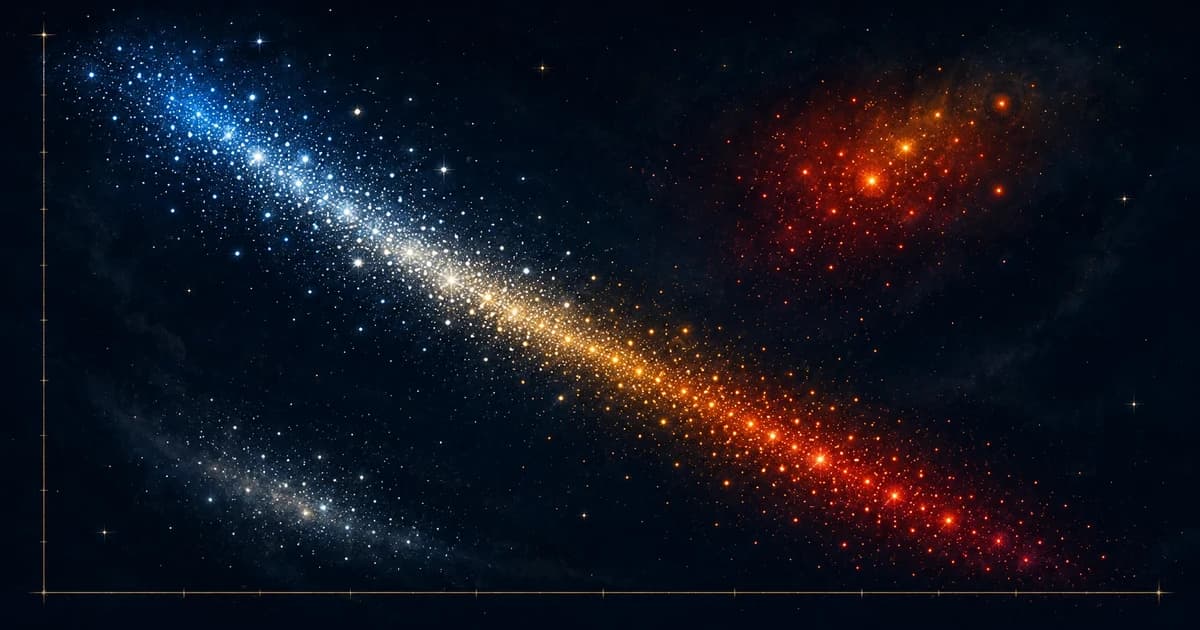
Red dwarfs: the most common stars you've never seen
The overwhelming majority of stars, and you can't see a single one without a telescope. I find that humbling every clear night.
4 min read · Published 26 August 2026
First, the answer
Red dwarfs, M-type main sequence stars, make up roughly three quarters of all stars in the galaxy. Not one is visible to the naked eye. They're small, cool and very faint, burning hydrogen so slowly that they last trillions of years. The universe is about 13.8 billion years old, so no red dwarf has ever reached the end of its life.
Common and invisible
Red dwarfs are the most numerous stars by a wide margin. They're also the faintest, usually giving off a fraction of a percent of the Sun's light, mostly in the infrared.
The nearest star to the Sun, Proxima Centauri, is a red dwarf. At magnitude 11 it needs a telescope, despite being just over four light years away. That one fact says it all. The closest star to us is invisible without equipment.
So the sky you see is deeply unrepresentative. Naked-eye stars are the rare luminous ones, visible because they're bright, not because they're near. The typical star is a red dwarf you'll never see.
Three quarters of the stars in the galaxy are invisible to you. Frankly, that humbles me more than any dark-matter figure.
Why they last so long
Two reasons combine.
They burn slowly. Luminosity scales steeply with mass, so a star at a fraction of the Sun's mass emits a very small fraction of its energy, far less than proportionally.
They are fully convective. Below about a third of a solar mass, a red dwarf circulates its entire interior. Unlike the Sun, which can only fuse hydrogen already in its core, a red dwarf gradually cycles its whole hydrogen supply through the burning region.
The result is lifespans measured in trillions of years, hundreds of times the current age of the universe. Every red dwarf ever formed is still on the main sequence, and their eventual behaviour is known only from models, never observation.
Three quarters of the stars in the galaxy are invisible to you, and I find that more humbling than any dark-matter number.
Planets and the question of life
Red dwarfs are prime exoplanet targets, for practical reasons. A small dim star produces a proportionally larger transit dip and a larger radial velocity wobble, so planets are easier to detect. Their habitable zones are also close in, making orbits short and repeat observations quick.
Consequently many known potentially habitable planets orbit red dwarfs, including Proxima Centauri b.
The complications are significant:
- Tidal locking. Habitable-zone planets orbit so close that they likely keep one face permanently toward the star. Whether that permits habitability depends on atmospheric heat redistribution.
- Flares. Red dwarfs are frequently magnetically active, producing flares far larger relative to their output than the Sun's. Repeated flaring may strip atmospheres from close-in planets.
- Early luminosity. Many spend a long pre-main-sequence phase brighter than their eventual output, potentially desiccating planets before conditions stabilise.
- Time. Against all that, trillions of years is an enormous amount of time for anything to happen in.
The far future belongs to them
Star formation is declining across the universe as gas is consumed. Massive stars are already gone from most galaxies and won't be replaced indefinitely.
In the very long term, red dwarfs will be essentially the only stars remaining, burning steadily for trillions of years after everything more massive has died. The universe's current era of bright hot stars is a brief opening phase.
There is an anthropic observation that needs noting: we exist during the small early window when massive stars still shine and heavy elements are being made. Whether that is coincidence or a requirement for observers to exist at all is a live question, and it's one of the few places where 'why now' is a serious scientific instead of mystical question.
Three more questions
- What is a red dwarf star?
- An M-type main sequence star, small, cool and very faint, typically emitting a fraction of a percent of the Sun's light, mostly in the infrared. They make up roughly three quarters of all stars in the galaxy.
- Can you see red dwarfs with the naked eye?
- No, not one. Even Proxima Centauri, the closest star to the Sun at just over four light years, is magnitude 11 and requires a telescope. Every naked-eye star is one of the rare luminous types.
- How long do red dwarfs live?
- Trillions of years, hundreds of times the current age of the universe. They burn hydrogen very slowly and are fully convective below about a third of a solar mass, so they can cycle their entire hydrogen supply through the burning region.
- Could red dwarf planets support life?
- It is debated. Habitable-zone planets orbit close enough to be tidally locked, and red dwarfs flare frequently in ways that may strip atmospheres. Against that, their enormous lifespans provide vastly more time than Sun-like stars offer.
 Natalie Hasselbank