

Saturn's rings are disappearing | sort of
Two different disappearances, about a hundred million years apart. Neither affects your evening.
4 min read · Published 25 August 2026
Two separate things get muddled. The rings seemed to vanish on 23 March 2025 because Earth passed through their plane, and they're so thin they go invisible edge-on. That's a viewing-angle effect that recurs roughly every 13 to 15 years, next on 15 October 2038. Separately, the rings are slowly falling into Saturn as 'ring rain', but over tens to hundreds of millions of years.
The 2025 disappearance was a viewing angle
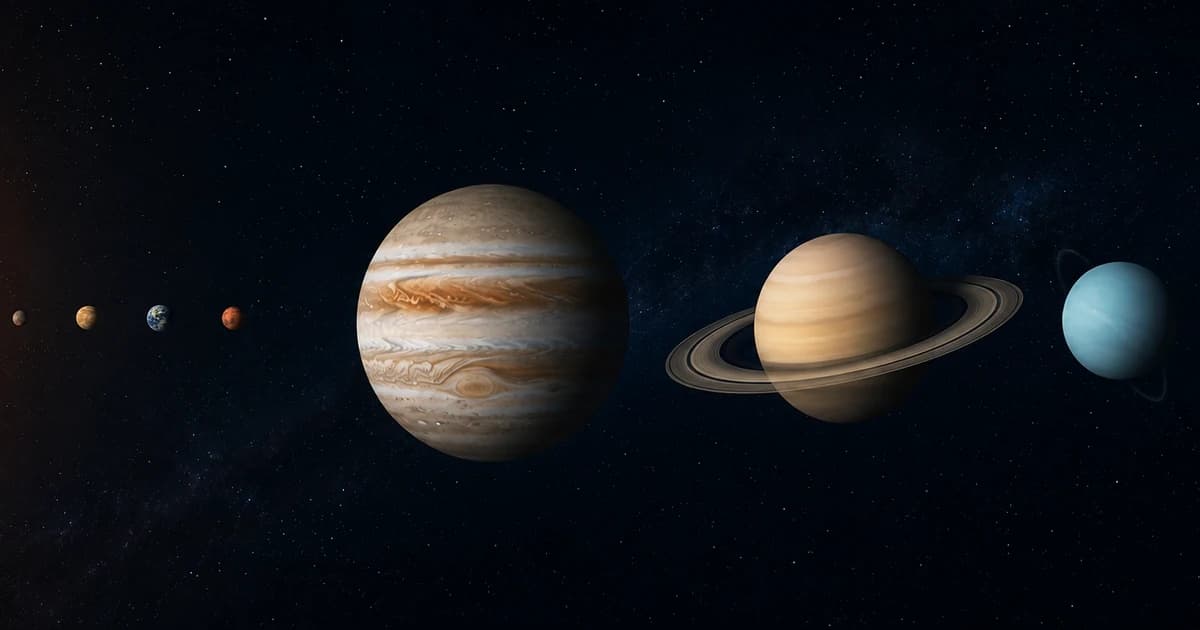
Saturn's axis is tilted about 27 degrees, and the rings sit in its equatorial plane. As Saturn goes round the Sun over roughly 29.5 years, we see the rings from changing angles. Wide open at some points, edge-on at others.
Twice per Saturn orbit, Earth passes exactly through the ring plane. The rings are absurdly thin, tens of metres in places against a span of hundreds of thousands of kilometres, so edge-on they essentially vanish. Thinner, proportionally, than a sheet of paper the width of a football pitch.
That happened on 23 March 2025. The rings have been opening again since. The next crossing is 15 October 2038. The rings aren't disappearing in any sense that affects you, and I'd ignore every headline that says they are.
Ring rain, the real loss
Separately, the rings are being lost. Ring particles are charged by ultraviolet light and by plasma, and Saturn's magnetic field then channels them down into the planet's atmosphere as a steady drizzle of icy material.
Measurements suggest this is depleting the rings on a timescale of tens to hundreds of millions of years: a very long time by human standards and a short one geologically.
That leads to the more surprising conclusion: the rings appear to be young. Evidence including their brightness and low contamination by dust suggests an age well under a hundred million years, and possibly far less. Saturn may have had no rings, or very different ones, when dinosaurs were alive.
So we happen to be observing Saturn during a relatively brief period in which it has spectacular rings. That's a striking piece of luck, and rather similar to the coincidence that makes total solar eclipses possible in our era.
The rings aren't disappearing in any sense that affects you, and I'd ignore every headline that says they are.
What the rings are
| Detail | |
|---|---|
| Composition | Overwhelmingly water ice, with a small fraction of rocky material |
| Particle size | From dust grains to boulders metres across |
| Span | Roughly 280,000 km across the main rings |
| Thickness | As little as tens of metres in places |
| Structure | Named divisions. The Cassini Division is visible in modest telescopes |
| Origin | Debated; a disrupted moon or comet is the leading idea |
The Cassini Division, a gap between the two brightest rings, is visible in a decent amateur telescope when the rings are well open. It's maintained by an orbital resonance with the moon Mimas, which clears particles from that zone.
Every giant planet has rings
This surprises people. Jupiter, Uranus and Neptune all have ring systems. They are simply faint, dark and hard to observe.
Jupiter's are dusty and very tenuous. Uranus has narrow dark rings discovered in 1977 when they briefly blocked a star's light during an occultation. Neptune's include incomplete arcs.
Saturn's are exceptional in being bright, broad and made of clean ice, which is part of why the youth hypothesis is persuasive. An ancient ring system would be expected to have accumulated far more dark contaminating material by now.
Seeing them yourself
Rings are visible in almost any telescope, though not in binoculars, at typical binocular magnifications Saturn appears merely oval. Around 25x is usually enough for the rings to be unmistakable.
Seeing Saturn's rings live, with your own eye rather than in a photograph, is the experience that converts more people to amateur astronomy than anything else. The most common reaction is disbelief that it looks exactly like the pictures.
A beginner telescope will show them clearly, and that alone justifies the purchase for many people.
 Natalie Hasselbank