

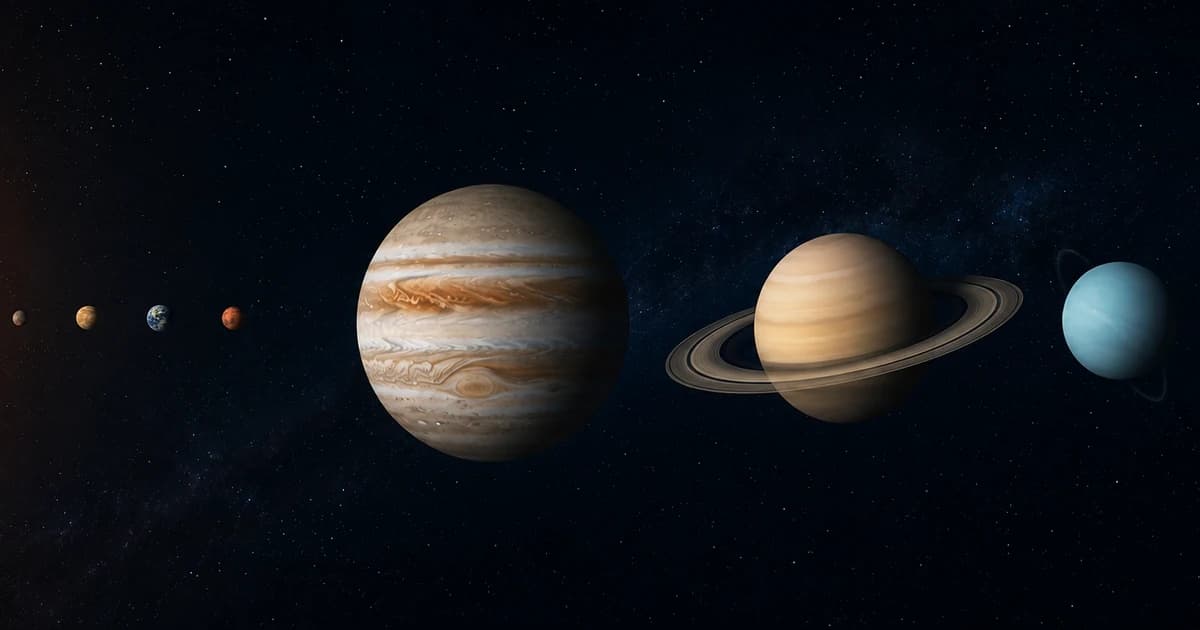
Why Uranus is tipped over
An axial tilt of 98 degrees. It rolls around the Sun instead of spinning upright.
4 min read · Published 25 August 2026
Before the detail
Uranus has an axial tilt of about 98 degrees, so it rotates almost exactly on its side. It rolls along its orbit rather than spinning upright. The leading explanation is one or more giant impacts early on. The result is the most extreme seasons in the solar system: each pole gets 42 years of continuous sunlight, then 42 years of darkness.
What a 98 degree tilt means
Earth's axis tilts about 23.4 degrees. That's what gives us seasons. Most planets are in the same broad range.
Uranus is tilted 98 degrees. Past horizontal. Its rotation axis lies almost in its orbital plane, so at one point in its orbit the north pole points nearly at the Sun, and half an orbit later the south pole does.
Because the tilt passes 90 degrees, Uranus is technically spinning retrograde, like Venus, though for a completely different reason.
Its rings and moons orbit in its equatorial plane, so the whole system is tipped with it. From Earth the rings sometimes look like a vertical circle round the planet rather than the flat ellipse we see at Saturn. Uranus deserves better than jokes about its name. A planet on its side is one of the strangest facts in the solar system.
| Planet | Axial tilt |
|---|---|
| Mercury | About 0.03° · essentially upright |
| Venus | 177° · effectively upside down |
| Earth | 23.4° |
| Mars | 25.2° |
| Jupiter | 3.1° |
| Saturn | 26.7° |
| Uranus | 97.8° |
| Neptune | 28.3° |
The seasons this produces
Uranus takes about 84 Earth years to orbit the Sun. With its axis pointing nearly at the Sun at the solstices, each pole gets 42 years of continuous daylight followed by 42 years of continuous darkness.
During polar summer the Sun circles near the zenith and never sets. During polar winter there is no sunlight at all for four decades.
Counterintuitively, the poles receive more total solar energy over a Uranian year than the equator does: the reverse of Earth. And yet the equator isn't markedly colder than the poles, which suggests atmospheric circulation redistributes heat far more efficiently than expected. This remains incompletely explained.
Uranus deserves better than jokes about its name. A planet on its side is one of the strangest facts in the solar system.
How it got tipped
The standard explanation is a giant impact: a collision with an Earth-sized or larger body during the solar system's chaotic early period, knocking the planet onto its side.
A single impact has a difficulty: it would be expected to disrupt the regular satellite system, and Uranus's major moons orbit neatly in its tilted equatorial plane. Some models suggest multiple smaller impacts better explain both the tilt and the intact moon system, or that the moons re-formed from debris afterwards.
An alternative proposes that a large former moon, since lost, could have driven the tilt gradually through gravitational interaction. There's no settled answer, and the plain position is that this is an open question instead of a solved one.
What else is odd about it
- Its magnetic field is offset and tilted by about 59 degrees from the rotation axis, and it doesn't pass through the planet's centre. Neptune's is similarly irregular, which suggests both are generated in a shallow conducting layer instead of a deep core.
- It's the coldest planet. Uranus records the lowest measured temperature in the solar system, colder than Neptune despite being nearer the Sun: Neptune radiates significant internal heat and Uranus, for unclear reasons, radiates very little.
- It has rings, discovered in 1977 when they briefly dimmed a background star during an occultation. They are narrow and very dark.
- Its moons are named from English literature (Titania, Oberon, Miranda, Ariel, Umbriel) instead of classical mythology, a break from the usual convention.
Seeing it
Uranus sits right at the naked-eye limit, around magnitude 5.7 at best. It's technically visible from a dark site if you know precisely where to look, and it was almost certainly recorded as a star by observers who didn't realise it was moving.
In binoculars it's straightforward once located. In a telescope at moderate magnification it shows as a small pale blue-green disc, distinguishable from a star by being visibly non-pointlike.
It was the first planet discovered with a telescope, in 1781, so it has no ancient astrological tradition attached to it and why its rulership assignment is a modern and contested addition.
The follow-ups
- Why is Uranus tilted on its side?
- The leading explanation is one or more giant impacts early in its history. A single impact struggles to explain why its moon system remains neatly aligned with the tilted equator, so multiple smaller impacts or a lost former moon have also been proposed. It isn't settled.
- What is Uranus's axial tilt?
- About 98 degrees, meaning its rotation axis lies almost in its orbital plane. Because this exceeds 90 degrees, Uranus is also technically rotating retrograde.
- How long are the seasons on Uranus?
- Uranus orbits the Sun in about 84 Earth years, and with its extreme tilt each pole experiences roughly 42 years of continuous daylight followed by 42 years of darkness.
- Is Uranus the coldest planet?
- It records the lowest measured temperature in the solar system, colder than Neptune despite being closer to the Sun. Neptune radiates significant internal heat while Uranus radiates very little, and the reason isn't fully understood.
 Natalie Hasselbank