
Polarities: why each sign has an opposite
Six axes rather than twelve isolated signs, and opposites that need each other more than they fight.
4 min read · Published 19 August 2026
In one paragraph
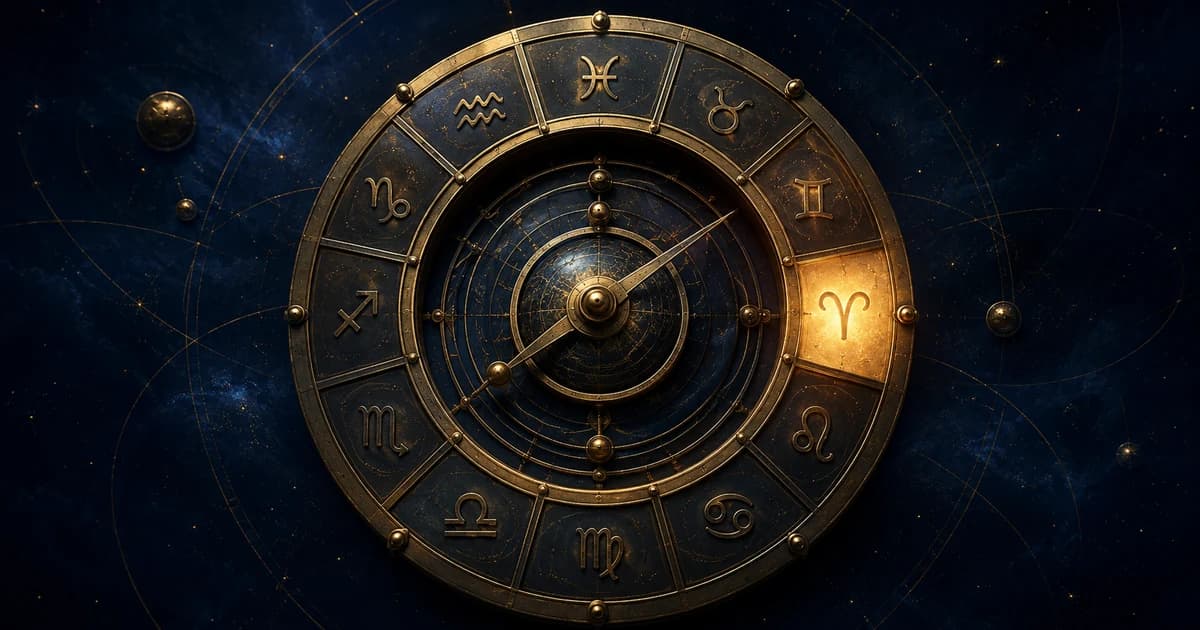
Each sign sits directly opposite another, 180 degrees away, forming six axes: Aries–Libra, Taurus–Scorpio, Gemini–Sagittarius, Cancer–Capricorn, Leo–Aquarius and Virgo–Pisces. Opposite signs always share a polarity (both positive or both negative) and always have compatible elements, fire with air or earth with water. Western astrologers read that's why opposition in astrology as tension between complements rather than outright conflict.
The six axes
| Axis | Elements | The tension |
|---|---|---|
| Aries – Libra | Fire – Air | Self against other; asserting against relating |
| Taurus – Scorpio | Earth – Water | What is mine against what is shared |
| Gemini – Sagittarius | Air – Fire | Information against meaning; the local against the distant |
| Cancer – Capricorn | Water – Earth | Private life against public role |
| Leo – Aquarius | Fire – Air | The individual against the collective |
| Virgo – Pisces | Earth – Water | Precision against dissolution; the part against the whole |
Each pair names a genuine dilemma, not a good option and a bad one. Cancer–Capricorn isn't home versus work with a right answer; it's the permanent negotiation between them, which nobody resolves once.
Why opposites are compatible
There are two structural facts here that most sign-compatibility content ignores.
First, opposite signs always share the same polarity: the alternating positive/negative or masculine/feminine division running around the zodiac. Aries is positive and so is Libra. Taurus is negative and so is Scorpio. Since polarity alternates and twelve is even, a sign 180 degrees away necessarily matches.
Second, they always have compatible elements: fire opposes air, and earth opposes water. Those are precisely the element pairings traditionally read as harmonious.
So the opposition aspect (often described as the most difficult after the square) connects two signs that share a fundamental orientation and get along elementally. That's why it reads as tension instead of incompatibility, and why the traditional advice is integration, not choosing a side.
I read opposite signs as one axis, not two enemies, and I think the 'incompatible opposites' idea should have died decades ago.
The axis idea changes how you read houses
The same logic applies to houses, and it's arguably more handy there.
Houses sit in opposite pairs too (first and seventh, second and eighth, and so on) and reading them as axes instead of isolated compartments tends to produce better readings. The second house of your own resources and the eighth of shared resources are one question about ownership, not two unrelated topics.
So a planet in your seventh house is also saying something about your first, because the axis is one thing. Practitioners who read houses in pairs generally find charts hang together better than those who read twelve separate boxes.
Full-moon logic
Every full Moon is an opposition: the Sun in one sign and the Moon in the opposite one. That's the definition · 180 degrees of separation.
So a full Moon in Scorpio has the Sun in Taurus, and the traditional reading of that lunation is exactly the Taurus–Scorpio axis: what I hold against what we share. The axis structure is doing the work.
It is also why your natal Moon phase describes a relationship between two placements instead of one. AsterNym computes your natal lunar phase on your natal chart, and the phase is a statement about the angle between your Sun and Moon.
Reading your own axes
Look at which axes your chart is loaded on. Several planets across the Cancer–Capricorn axis means the private-versus-public question is a live one for you in a way it isn't for everybody.
Then look at where an axis is empty. An axis with nothing on either end isn't absent from your life, but most modern astrologers read it as less thematically prominent.
Every sign page names the opposite sign and what the axis is about, which is a more practical frame than reading a sign alone.
 Mira Hale