I Ching · King Wen 14
Hexagram 14: Great Possession
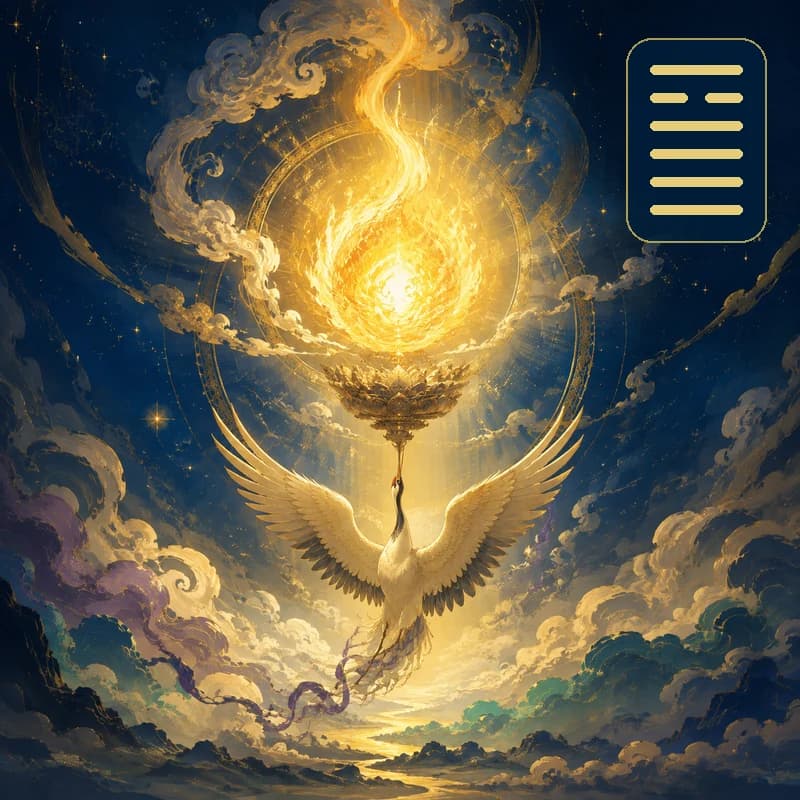
䷍ 大有 Dà Yǒu · also called Possession in Great Measure, Great Having, Abundance · The Clinging above The Creative
Great possession held with modesty: abundance that lasts because its owner does not cling to it.
abundanceclaritymodestystewardshipsupreme success
The meaning of Hexagram 14
Heaven below, fire above: the sun at its height, illuminating everything. Great Possession is a hexagram of abundance, and its subject is not how to get wealth but how to hold it. One yielding line in the fifth place is the centre of the figure: a modest, receptive ruler whom the strong lines all support. The tradition's point is that possession in great measure is kept by humility and clarity, by seeing clearly what you have and giving evil no place in it. The reading is favourable, and it makes the good fortune conditional on how it is carried.
The image. Fire high in heaven; the wise person curbs evil and furthers good.
- Advice
- Hold what you have with clarity and modesty, and be generous with it.
- Warning
- Pride in possession draws envy and loses support; abundance is kept by the humble.
 over
over
Structure: ☰ The Creative (Heaven) below, ☲ The Clinging (Fire) above. Nuclear hexagram 43, Breakthrough. Every line reversed: 8, Holding Together.
Hexagram 14 for love and relationships
You have something valuable. The reading is about keeping it: with modesty, openness and generosity rather than possessiveness. Do not cling; what is held lightly stays.
Hexagram 14 for career
Success and resources are at hand. Lead by clarity and by giving credit, not by dominance. The strong people around you support a modest centre; they leave a proud one.
Hexagram 14 for money
Real abundance, and the responsibility that goes with it. Manage it in the light: transparent accounts, sound stewardship, generosity where it is due. Wealth hoarded in the dark spoils.
Hexagram 14 for decisions
Decide from a position of strength, and decide generously. The reading supports the option that shares the possession and clarifies things, and warns against the one that grasps.
The six changing lines
Read from the bottom. A changing line flips, and the hexagram it changes into is named with each.
Blessed by heaven. Good fortune; nothing that does not further.
The highest line, and one of the most fortunate in the book: possession so lightly held that it is blessed. Someone at the top who honours what is above and remains modest is helped by everything.
Changing, it becomes Hexagram 34, Great Power. Read line 6 →
Whose truth is accessible, yet dignified. Good fortune.
The modest centre of the hexagram: someone whose sincerity draws everyone in and whose dignity keeps the relationship from becoming familiar. Both are needed. Sincerity without dignity is exploited.
Changing, it becomes Hexagram 1, The Creative. Read line 5 →
One makes a distinction between oneself and one's neighbour. No blame.
Close to power and wealth, and refusing to compete with it or be inflated by it. The line describes the discretion of someone who knows exactly what is theirs and does not reach past it.
Changing, it becomes Hexagram 26, Great Taming. Read line 4 →
A prince offers it to the Son of Heaven. A petty person cannot.
Possession used in service of something higher, offered up rather than hoarded. The line contrasts the generous and the petty: the same wealth in petty hands becomes a burden and a harm.
Changing, it becomes Hexagram 38, Opposition. Read line 3 →
A big wagon for loading. One may undertake something. No blame.
The means are adequate to the task: capable helpers, sufficient resources, a load that can be carried. The line encourages undertaking something substantial now.
Changing, it becomes Hexagram 30, The Clinging. Read line 2 →
No contact with what is harmful. No blame. If one recognises the difficulty, there is no blame.
At the beginning of possession, the danger is contamination: attachments, habits or people that will spoil it. Keeping clear of them, and being aware how hard that is, keeps the line blameless.
Changing, it becomes Hexagram 50, The Cauldron. Read line 1 →
Related hexagrams
Cast your own reading
Ask a question and toss six lines. The oracle does not choose the hexagram for you; the coins do.
Ask the I Ching →Common questions
- What does I Ching Hexagram 14 mean?
- Great possession held with modesty: abundance that lasts because its owner does not cling to it. Heaven below, fire above: the sun at its height, illuminating everything. Great Possession is a hexagram of abundance, and its subject is not how to get wealth but how to hold it. One yielding line in the fifth place is the centre of the figure: a modest, receptive ruler whom the strong lines all support. The tradition's point is that possession in great measure is kept by humility and clarity, by seeing clearly what you have and giving evil no place in it. The reading is favourable, and it makes the good fortune conditional on how it is carried.
- What does Hexagram 14 mean for love?
- You have something valuable. The reading is about keeping it: with modesty, openness and generosity rather than possessiveness. Do not cling; what is held lightly stays.
- Which hexagram does Hexagram 14 change into?
- It depends on which lines change. With one changing line: line 1 gives Hexagram 50, The Cauldron; line 2 gives Hexagram 30, The Clinging; line 3 gives Hexagram 38, Opposition; line 4 gives Hexagram 26, Great Taming; line 5 gives Hexagram 1, The Creative; line 6 gives Hexagram 34, Great Power. With every line changing it becomes Hexagram 8, Holding Together.