
Nine Star Ki calculator
Nine Star Ki (九星気学) is the Japanese art of nine stars, drawn from Chinese feng shui and the ancient magic square.
How Nine Star Ki works
What you get
Traditional interpretation
The structure is calculated. What it means comes from the system's own texts and practice, offered for reflection. These meanings have not been shown to predict personality or events.
Also: Calculated.
How we work it out →- Your birth date.
- Your Principal and Emotional stars from the Japanese nine-star feng-shui numerology.
Working out your two stars
It starts with the year, and the year doesn’t begin on 1 January. Nine Star Ki years turn at risshun (立春), the moment the Sun reaches 315° along its path, which lands on 3, 4 or 5 February. Born before that moment? You belong to the previous year. The calculator looks up the exact instant in Japan time for your birth year. In 2026 it came at 05:02 on 4 February.
Next comes some arithmetic. Add the digits of that year until one digit is left, take it away from 11, and pull anything above 9 back into range. For 1990 that’s 1 + 9 + 9 + 0 = 19, then 1, and 11 minus 1 is 10, which wraps round to 1: One White Water. Someone born on 20 January 1990 still counts as 1989, so they get Two Black Earth. Because of the subtraction, the star drops by one each year. 2026 is a One White Water year and 2027 is Nine Purple Fire.
Your Emotional star runs on solar months, each one opening on a solar term somewhere between the 3rd and the 9th of the calendar month. Your year star decides where February starts counting: 8 if your year star is 1, 4 or 7; 2 if it’s 2, 5 or 8; 5 if it’s 3, 6 or 9. From there it falls by one a month. A birth on 20 March 1990 falls in the second solar month of a One White Water year, so the count goes 8, then 7, and the Emotional star is Seven Red Metal.
No birth time is needed for most dates. Risshun is not always 4 February: between 1900 and 2030 it falls on the 3rd in three years and the 5th in thirty-eight, and it has a time of day, so the calculator reads the real instant in Japan time rather than assuming a date.
What is Nine Star Ki?
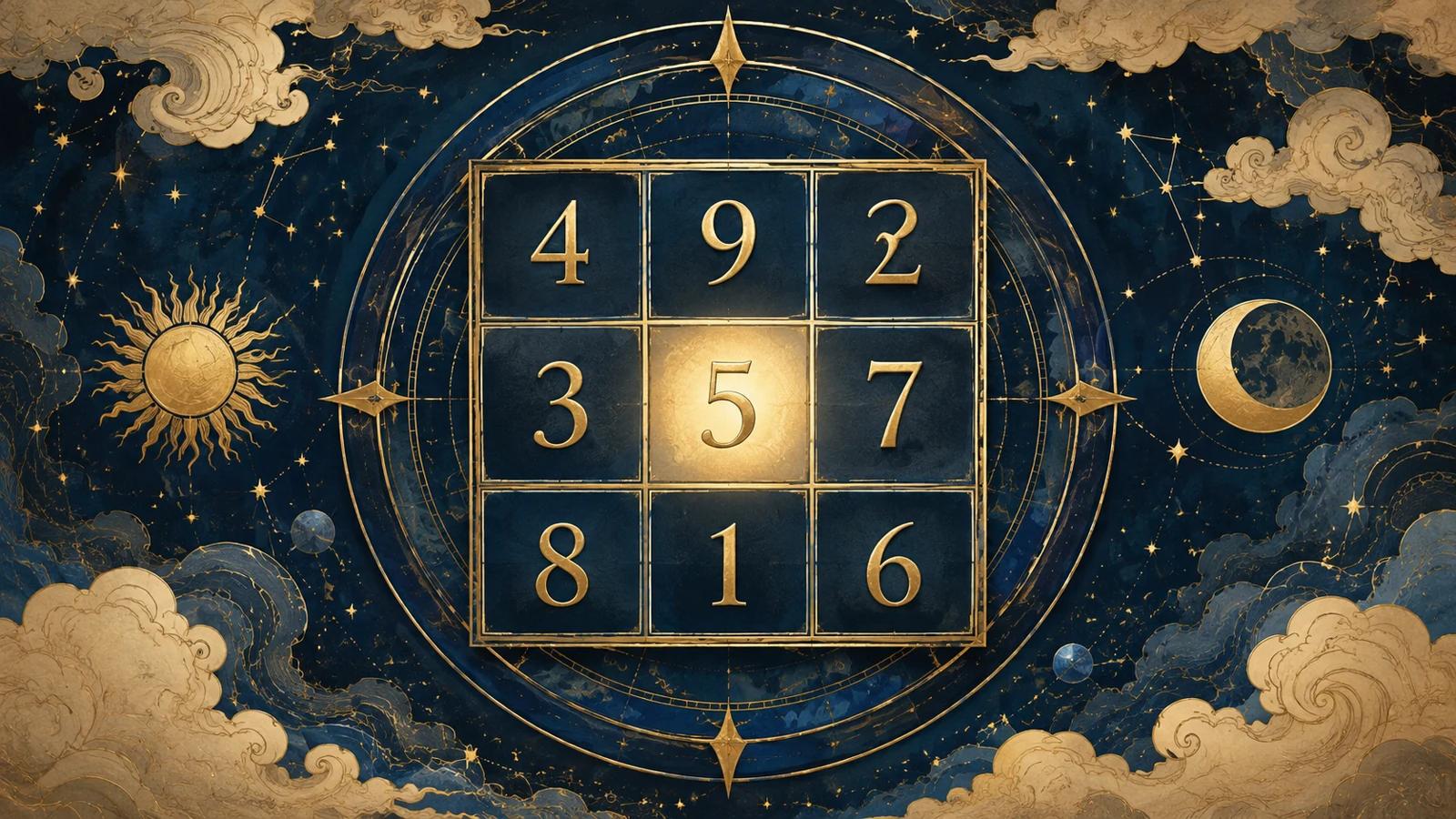
Nine Star Ki (九星気学, Kyusei Kigaku) sorts everyone into one of nine stars, numbered one to nine, each carrying a colour, one of the five elements, and a bagua trigram. The nine numbers come from the magic square, the grid where every row, column and diagonal sums to fifteen: that also underlies feng shui and the Lo Shu.
You carry three stars. Your Principal (year) star describes the core self, read across a lifetime. Your Emotional (month) star describes how you feel and react, especially under pressure. An inner star, from the birth time, adds a third layer. AsterNym computes the two that need only your date.
Nine Star Ki also gives an inner (hour) star from your birth time, and reads yearly and monthly “movements” through the nine houses. AsterNym computes your two main stars and presents them as a metaphysical tradition, one way of reading a birthday, not a forecast.
Is Nine Star Ki astrology?
Not quite. Nine Star Ki does not calculate planets or stars in the sky. It belongs to the feng-shui family, a numerology of nine numbers and five elements, closer in method to BaZi or numerology than to Western astrology. But it asks the familiar questions: what am I like, who suits me, and when is the right time to act?
AsterNym explores these as cultural and metaphysical traditions, not scientific predictions.
Reading your result
Lead with the Principal star. Japanese books call it your honmeisei (本命星), and the character sketch under your result comes from it. The Emotional star is about how you react, so two people who share a Principal star can still come across quite differently on a bad day.
For compatibility, Nine Star Ki readers compare elements using the five-element cycle: Water feeds Wood, Wood feeds Fire, Fire makes Earth, Earth yields Metal and Metal yields Water. Two stars next to each other in that cycle tend to support each other. Two with one element between them, like Water and Fire, tend to pull against each other.
The trigram ties each star to the bagua, the eight-sided map feng shui lays over a home. There are nine stars and eight trigrams, so one star goes without. Five Yellow Earth takes the middle of the square, and the calculator labels it Chūgū (中宮), the centre palace.
Older than its name, and one gap here
The nine stars are older than their Japanese name. The same numbers travel round the Lo Shu square in Chinese Flying Star feng shui, and Japanese almanacs print the ruling star of each year and month. Kyusei Kigaku breaks down as nine stars, ki and study.
One thing to check before you trust your result. If your birthday is the day of risshun itself, your year star depends on whether you were born before or after that day’s exact moment. The calculator only asks for a date, so it puts you in the new year. Compare your birth time with that year’s risshun in Japan time, and if you came first, your Principal star is one number higher, with Nine wrapping round to One.
Questions about your star
- What is Nine Star Ki?
- Nine Star Ki (九星気学, Kyusei Kigaku) is a Japanese system of nine stars derived from Chinese feng shui and the magic square of nine numbers. Everyone carries three stars, a Principal (year) star for the core self, an Emotional (month) star, and an inner (hour) star, each linked to one of the five elements and a bagua trigram. Practitioners use it to describe character and to choose timing.
- How is my Nine Star Ki number calculated?
- Your Principal star comes from your birth year: add the year's digits down to a single number and subtract from eleven, wrapping into the range one to nine. Because the Japanese astrological year begins at risshun, the moment the Sun reaches 315 degrees, a birthday in January or early February is read from the previous year. Risshun is not a fixed date: it falls on 3, 4 or 5 February depending on the year, and it has a time of day, so AsterNym reads the real instant in Japan time instead of assuming the 4th. The calculator takes only a date, so if you were born on the risshun day itself it counts you in the new year; if you were born before that day's risshun moment, your Principal star is one number higher. The month star follows from the year star's group and your birth month.
- Do I need my birth time for Nine Star Ki?
- No, for the two main stars. Your Principal (year) and Emotional (month) stars need only your birth date. A birth time adds a third, inner star, which AsterNym does not currently compute.
- What are the five elements in Nine Star Ki?
- Each of the nine stars is tied to one of the five elements: 1 is Water; 3 and 4 are Wood; 9 is Fire; 2, 5 and 8 are Earth; 6 and 7 are Metal. Practitioners use the elements and their relationships to interpret and combine the stars.
- Is Nine Star Ki the same as astrology?
- Not quite. Nine Star Ki does not read the positions of planets or stars in the sky. It is a feng-shui-derived numerology of nine numbers and five elements, closer in method to BaZi or numerology than to Western astrology, though it asks similar questions about character and compatibility.
- Why does another calculator give me a different Nine Star Ki?
- Almost always because of early February. Some calculators change the year on 4 February every year, and some on 1 January. This one changes it on the day of risshun in Japan time, which can fall on 3, 4 or 5 February, so a birth in the first days of February can land in a different year and get a different Principal star. It takes only a date, so a birth on the risshun day itself is counted in the new year even if it came before that day's exact moment.