
Chart body
Pluto
What refuses to stay buried.
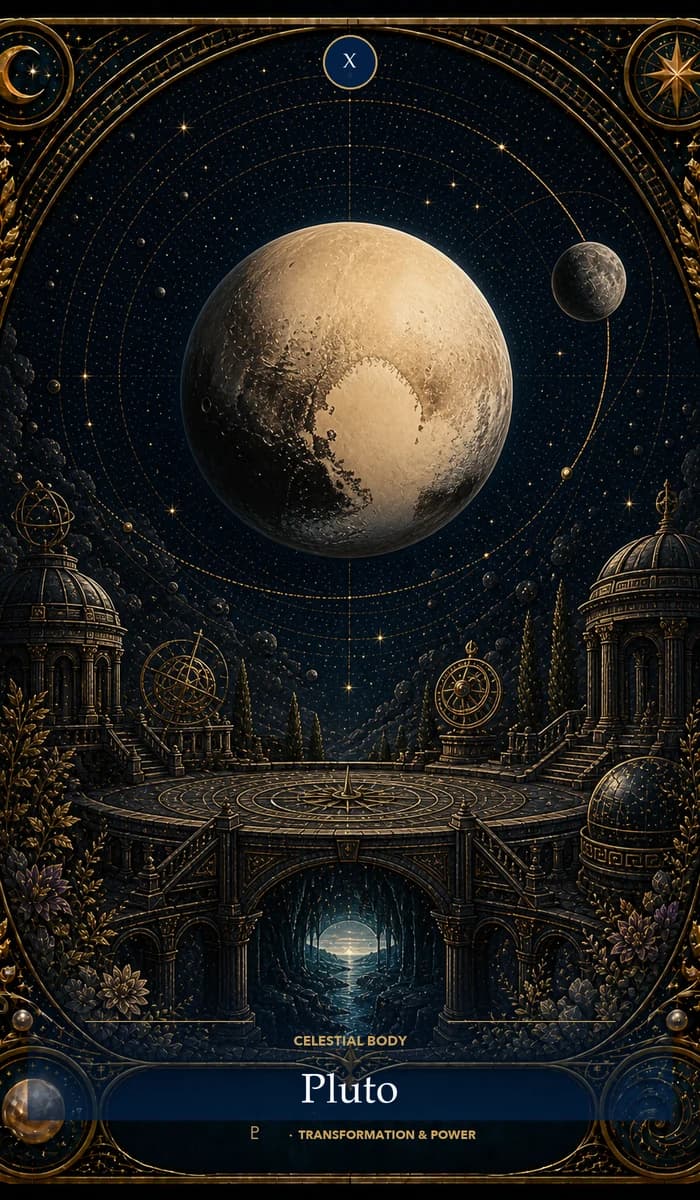
In a birth chart, Pluto describes your depths: power, transformation, what refuses to stay buried.
What it is
Discovered in 1930 and reclassified as a dwarf planet in 2006, it is smaller than Earth's Moon. Its 248-year orbit is tilted and eccentric enough that it was closer to the Sun than Neptune from 1979 to 1999.
In a chart: Twelve to thirty years in each sign, depending where it is in that eccentric orbit. Its sign is generational; house, angularity and tight aspects are what astrologers read as personal.
How astrologers have read Pluto
- Traditional significations
- None in traditional astrology; a modern planet
- Modern natal shorthand
- Power, transformation, compulsion, what refuses to stay buried
AsterNym’s interpretation
At its best
Real depth and real endurance. The capacity to go through something that ends a version of you and come out the other side.
The difficult end
Control, secrecy, and treating intensity as proof of importance.
What to do with it
Let the thing end. Pluto's placements describe what you cannot keep by gripping.
What Pluto rules
Pluto has no traditional domicile: it was not known before the telescope. Common modern ruler or association: Scorpio. AsterNym uses the traditional ruler for chart-ruler and dignity calculations and displays this modern association separately. No classical dignities are assigned to Pluto; modern astrologers disagree on them.
The other chart bodies
Where is Pluto in your chart?
Its zodiac position comes from the body's calculated astronomical longitude. Its house is derived from your local birth horizon using AsterNym's declared Whole Sign house system.