

Chart body
Uranus
Where you break the pattern.
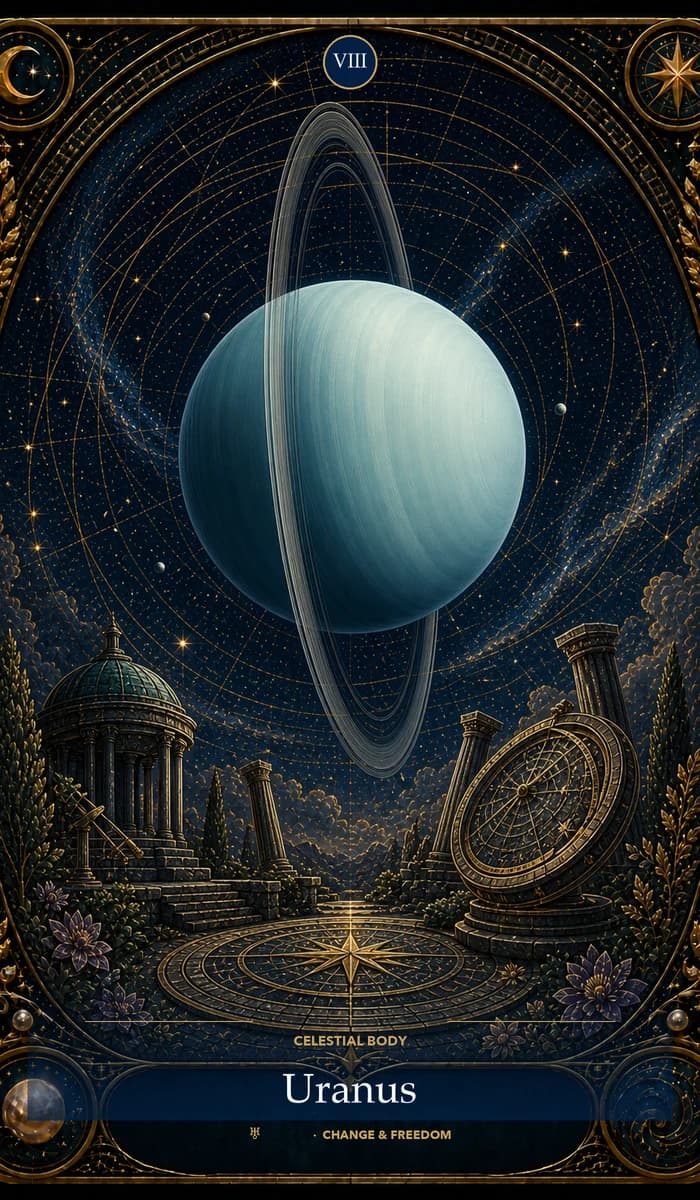
In a birth chart, Uranus describes your rebellion: where you break patterns and need freedom.
What it is
Discovered by William Herschel in 1781, the first planet found with a telescope. It rotates on its side at 98°, so its poles take turns facing the Sun through an 84-year orbit.
In a chart: About seven years in each sign. Its sign is largely generational; astrologers usually treat it as more personally distinctive through its house, angularity and tight aspects to faster-moving planets.
How astrologers have read Uranus
- Traditional significations
- None in traditional astrology; a modern planet
- Modern natal shorthand
- Disruption, independence, sudden change, where you break patterns
AsterNym’s interpretation
At its best
Originality that is not performed. Seeing the arrangement everyone accepts and asking who decided that.
The difficult end
Difference for its own sake. Blowing up something workable because staying would mean being ordinary.
What to do with it
Change the thing that needs changing, not the thing that is merely settled.
What Uranus rules
Uranus has no traditional domicile: it was not known before the telescope. Common modern ruler or association: Aquarius. AsterNym uses the traditional ruler for chart-ruler and dignity calculations and displays this modern association separately. No classical dignities are assigned to Uranus; modern astrologers disagree on them.
The other chart bodies
Where is Uranus in your chart?
Its zodiac position comes from the body's calculated astronomical longitude. Its house is derived from your local birth horizon using AsterNym's declared Whole Sign house system.