

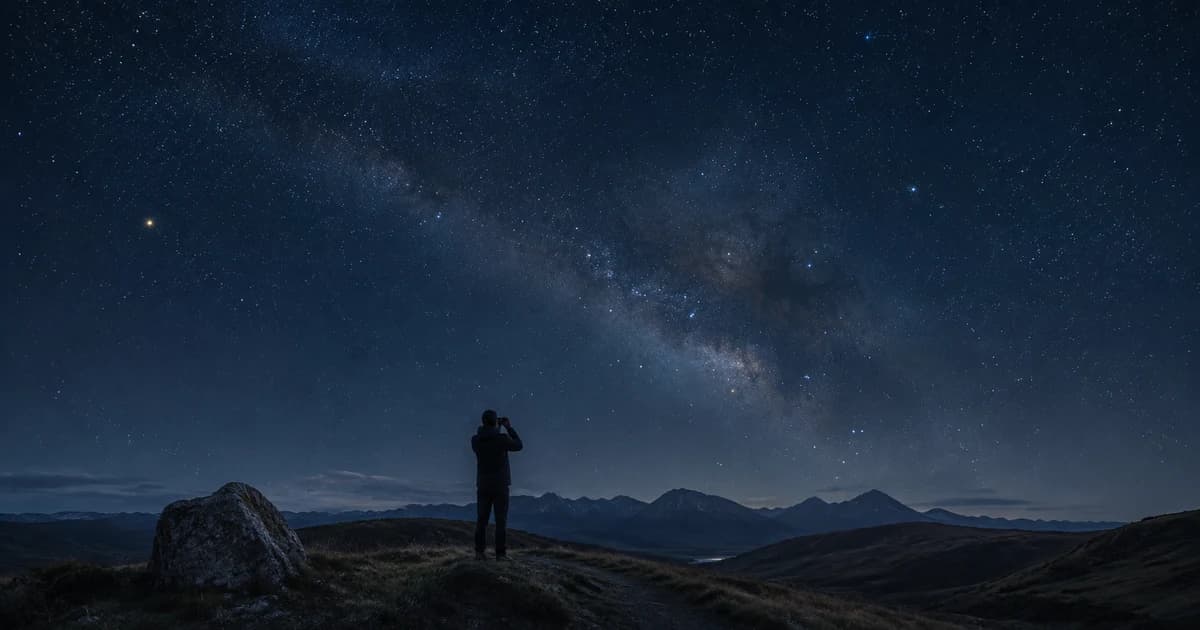
What you can see with the naked eye
Five planets, two other galaxies, about 4,500 stars. No equipment involved.
4 min read · Published 23 August 2026
Before the detail
Under a dark sky the unaided eye sees roughly 4,500 stars at once, five planets, the Milky Way, several star clusters, the Andromeda Galaxy at 2.5 million light years, and satellites every few minutes. Under a city sky that list collapses to the Moon, the planets and a few dozen stars. The difference is location, not equipment.
The planets
| Planet | Typical brightness | How to recognise it |
|---|---|---|
| Venus | Brightest object after the Moon | Unmistakable; only visible near sunrise or sunset |
| Jupiter | Very bright, steady white | Second brightest planet; visible much of the night |
| Mars | Varies enormously | Distinctly orange-red; brightest near opposition every ~26 months |
| Mercury | Bright but elusive | Never far from the Sun; needs a clear low horizon at twilight |
| Saturn | Moderately bright, yellowish | Steady and unremarkable to the eye, its rings need magnification |
| Uranus | At the naked-eye limit | Technically visible from very dark sites if you know exactly where to look |
Planets usually twinkle much less than stars. That's the quickest identification method and it works because a star is effectively a point source scintillating in atmospheric turbulence, while a planet shows a tiny disc that averages the effect out.
The deep sky objects
- The Andromeda Galaxy (M31), at roughly 2.5 million light years, the most distant object visible to the unaided eye. It appears as a faint elongated smudge, and it's another galaxy.
- The Milky Way: our own galaxy seen edge-on from inside it. Needs Bortle 4 or better.
- The Pleiades (M45): a bright star cluster. Most people see six stars; keen eyes under dark skies see more.
- The Orion Nebula (M42): visible as a fuzzy patch in Orion's sword, and it's a star-forming region 1,300 light years away.
- The Beehive Cluster (M44): a faint patch in Cancer under decent skies.
- The Magellanic Clouds: two satellite galaxies of the Milky Way, visible only from the southern hemisphere, and unmistakable once seen.
- The Double Cluster in Perseus, two clusters side by side, a faint patch to the eye.
How many stars, fairly
About 9,000 stars are bright enough to see without equipment across the whole sky. You only see half the sky at once, and objects near the horizon are dimmed by atmosphere, so the practical figure at any moment under an excellent sky is around 4,500.
That's far fewer than most people assume. It's also dramatically more than most people have seen. Under Bortle 8 city skies the figure drops to maybe 20 to 50.
The naked-eye limit is around magnitude 6 for typical eyes under dark skies. Exceptional observers reach 7 or beyond. Each step down the magnitude scale roughly triples the number of stars on offer.
Andromeda with the naked eye is the moment I'd chase first. Two and a half million light years, no equipment.
Things that move
- Satellites. Several visible per hour after dusk and before dawn, moving steadily and not blinking. Aircraft blink; satellites don't.
- The ISS, which is bright enough to outshine every star and takes a few minutes to cross, see when to see the ISS.
- Meteors. A handful per hour on any night, far more during a shower.
- Iridium-style flares and satellite trains, which appear as sudden brightenings or lines of moving points.
The rarer sights
Zodiacal light: a faint cone of light along the ecliptic before dawn or after dusk, caused by sunlight scattering off interplanetary dust. Needs Bortle 3 or better and is often mistaken for light pollution.
Aurora, at high latitudes and occasionally much further south during strong geomagnetic storms: see aurora forecasting.
Comets, which appear every few years bright enough for the naked eye, see comet watching.
Bright novae and, very rarely, supernovae. No naked-eye supernova has occurred in our galaxy since 1604, which is a long wait and part of why Betelgeuse attracts so much attention.
How many stars can you see with the naked eye?
About 9,000 are bright enough across the whole celestial sphere, but since only half the sky is visible at once and horizon objects are dimmed, the practical figure under an excellent dark sky is around 4,500. Under city skies it may be as few as 20 to 50.
What is the most distant object visible to the naked eye?
The Andromeda Galaxy, at roughly 2.5 million light years. It appears as a faint elongated smudge and is another galaxy, not an object within our own.
Which planets can be seen without a telescope?
Five easily: Venus, Jupiter, Mars, Mercury and Saturn. Uranus is technically at the naked-eye limit from very dark sites if you know exactly where to look. Planets usually twinkle much less than stars, because their tiny apparent discs average out atmospheric turbulence,.
Can you see the Milky Way with the naked eye?
Yes, under Bortle 4 skies or darker. It appears as a faint structured band across the sky. Most urban and suburban residents can't see it at all, which is a matter of light pollution instead of eyesight.
 Natalie Hasselbank