

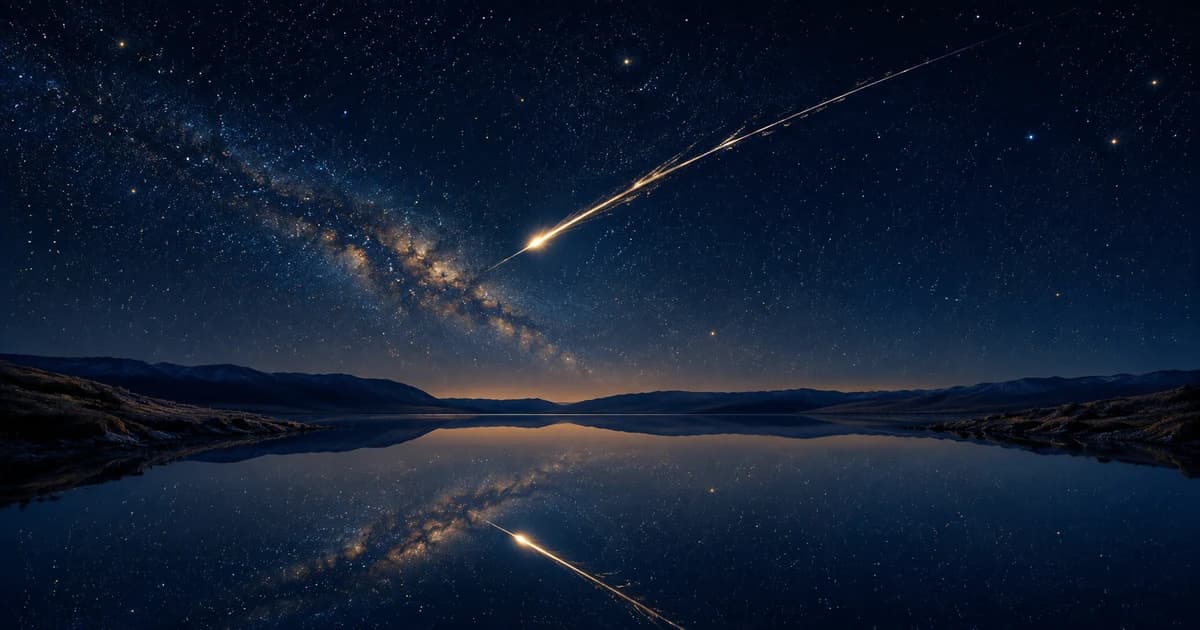
When and where to see the ISS pass overhead
Brighter than every star, across the sky in four minutes, and there are people on board.
4 min read · Published 24 August 2026
The answer
The International Space Station is visible from almost anywhere on Earth as a bright, steady point of light crossing the sky in two to six minutes. It only shows shortly after sunset or before sunrise, when it's in sunlight while you're in the dark. Pass times depend on where you are and change constantly, so you need a live prediction. NASA's Spot the Station and Heavens-Above are the standard free tools.
Why you need a live prediction
This is the one thing in this section we can't compute for you. Here's why.
The ISS orbits at roughly 400 km, going round about every 90 minutes, and its orbit decays measurably from atmospheric drag. It gets reboosted now and then to compensate, which changes the orbit each time. Predictions depend on current orbital data, published as two-line element sets and updated often.
A pass time worked out from old data will be wrong. So there's no static table anyone can publish. Use a service that fetches current elements. Spot the Station from NASA and Heavens-Above are free and reliable, and several phone apps do the same with notifications. The ISS is the best two minutes of astronomy available to anyone with a phone. I'd put it ahead of any planet.
Why it only appears at dawn and dusk
You need two conditions at once: the station must be in sunlight, and you must be in darkness.
At 400 km altitude the ISS emerges from Earth's shadow well before your local sunrise and stays lit well after your sunset, the same reason high-altitude aircraft catch the sun after it has set for you.
In the middle of the night the station is in Earth's shadow when it passes over you, so there's nothing to see. In daylight it's above you but lost in the bright sky.
That leaves a window of roughly one to two hours after sunset and before sunrise. Passes cluster in those periods, and around midsummer at high latitudes you can sometimes catch several in one night because the station stays sunlit longer.
The ISS is the best two minutes of astronomy available to anyone with a phone, and I'd put it ahead of any planet.
What it looks like
- Very bright. At a good pass it outshines every star and rivals Venus, reaching around magnitude −3 to −4.
- Steady, not blinking. Aircraft have flashing navigation lights; the ISS doesn't. This is the quickest way to tell them apart.
- Moving noticeably. It crosses the sky in two to six minutes, fast enough that motion is obvious but slow enough to follow comfortably.
- Usually west to east, because that is the direction it orbits.
- Sometimes it fades out mid-sky. That is the station entering Earth's shadow, and it happens over several seconds instead of instantly. Watching it disappear that way is oddly affecting.
Seeing detail
Through binoculars the ISS is a moving point of light with perhaps a hint of elongation. Tracking it by hand is difficult but possible on a high pass.
Through a telescope, experienced observers can resolve the solar array structure, but this requires tracking a fast-moving object manually at high magnification, which is hard. Some amateurs manage remarkable images.
A phone will record it as a streak on a long exposure, which is an easy and satisfying result, see phone astrophotography.
The other things crossing your sky
Satellites are visible constantly after dusk, and there are now a great many. Most are faint points moving steadily; the ISS is simply the brightest.
Satellite trains (lines of moving points, visible shortly after a batch launch) are a recent addition and a disorienting sight if you don't know what they are.
The growth in satellite numbers is a real problem for astronomy. Large constellations produce trails across long-exposure images and have prompted formal concern from observatories and the astronomical community. It's a version of the light pollution problem operating in orbit, and far harder to fix locally.
The Chinese space station Tiangong is also visible and reasonably bright, and prediction services list it alongside the ISS.
How can I see the ISS?
Use a live prediction service such as NASA's Spot the Station or Heavens-Above to get pass times for your exact location. The station appears as a bright, steadily moving point crossing the sky in two to six minutes, usually west to east.
Why is the ISS only visible at dawn and dusk?
Two conditions must coincide: the station must be in sunlight while you're in darkness. In the middle of the night it passes through Earth's shadow, and in daylight it's lost in the bright sky. That leaves roughly one to two hours after sunset and before sunrise.
How do I tell the ISS from an aircraft?
The ISS shines with a steady light and doesn't blink. Aircraft have flashing navigation lights. The station is also usually brighter than anything else in the sky and moves at a distinctive, easily followed pace.
Why can't ISS pass times be published in advance?
Because the station's orbit decays from atmospheric drag and is periodically reboosted, changing the orbit each time. Predictions require current orbital data, so any static table quickly becomes wrong.
 Natalie Hasselbank