
What is BaZi? The Chinese system that isn't the zodiac
Eight characters, four pillars, and a good deal more than the animal year most of us start from. This is the system I read in Hong Kong every week.
5 min read · Published 18 August 2026 · Updated 1 November 2026
Before the detail
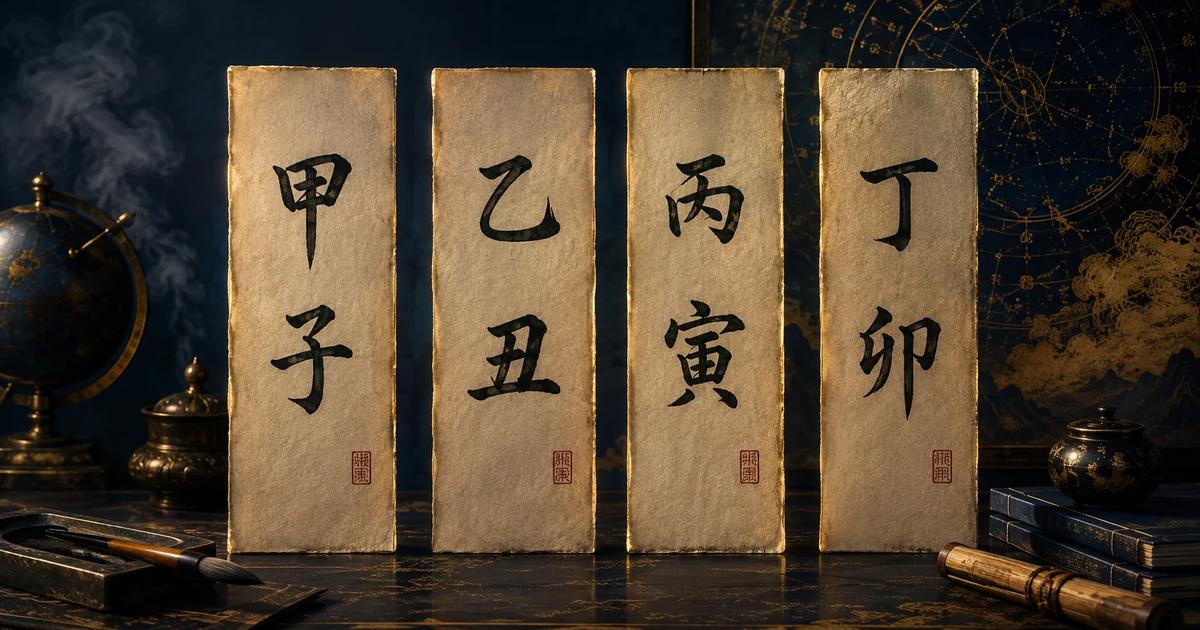
BaZi means 'eight characters'. Your birth year, month, day and hour each become a pair, a heavenly stem and an earthly branch, giving four pillars and eight characters in all, read through the five elements of Chinese metaphysics. The twelve-animal zodiac most people know is half of one of those four pillars. BaZi is the complete system. The hour pillar comes from one of twelve two-hour branches, so it needs a reliable birth time, and near the edge of a branch the result can depend on time correction and on how the late-night hour is handled.
The animal is one eighth of it
Your Chinese zodiac animal is the earthly branch of your year pillar, one character out of eight, and when a client tells me they are a Tiger I know where our conversation starts, not where it ends.
A full BaZi chart has four pillars, each with a heavenly stem above and an earthly branch below. Eight characters. The animal you have known since childhood is one of them, and in my experience it rarely decides the reading.
Since Xu Ziping in the Song dynasty, practitioners have taken the stem of the day pillar as the Day Master, the character that stands for you and the reference point every other character is measured against. Most people who can name their animal have never been told their Day Master, which is like knowing your star sign and never having seen a birth chart.
The animal year is how most people come to Chinese astrology, and it is a good way in. If you go one step further, make it BaZi.
The four pillars and what each covers
| Pillar | Built from | Traditionally read for |
|---|---|---|
| Year | The year of birth, turning at lichun | Ancestry, wider environment, the era you arrived into |
| Month | The solar term you were born in | The season, the heaviest factor in judging elemental balance |
| Day | The day of birth | You. Its stem is your Day Master |
| Hour | The two-hour branch of your birth time | Later life, output, children in traditional readings |
Note the month pillar row. Most practitioners give the season you were born into more weight than anything else when judging whether your chart is supported or depleted, so a chart computed without solar terms isn't a BaZi chart in any classical sense.
The hour row needs a reliable birth time, though not to the minute: each branch covers two hours. The trouble comes near the edges. Many practitioners correct the clock to true solar time (where the Sun stood at your birthplace) before choosing the branch, and schools differ on births between 23:00 and midnight, the late Zi hour, where one convention moves the day pillar to the next day. In the convention AsterNym uses, the chart runs on recorded civil time and civil midnight, and the page shows the alternative whenever either correction would change a pillar. More in the Chinese zodiac hours.
The five elements, and why they are not four
Western astrology has four elements (fire, earth, air, water) that describe temperament. Chinese metaphysics has five (Wood, Fire, Earth, Metal, Water) and they work differently.
The five sit in two cycles. In the generating cycle each element produces the next: Wood generates Fire, Fire generates Earth, Earth generates Metal, Metal generates Water, Water generates Wood. In the controlling cycle each restrains another: Wood breaks Earth, Earth dams Water, Water quenches Fire, Fire melts Metal, Metal cuts Wood.
The order of both cycles is standard. The explanations attached to them are not. Texts and teachers explain Metal generating Water as dew forming on cold metal, as metal melting into liquid, or as springs rising from rock, and you will meet more than one image for most steps.
That structure is what makes BaZi analytical instead of descriptive. The question isn't 'what element are you' but 'what does your chart have too much of, what is missing, and what would balance it', which is a different kind of question from anything Western sun-sign astrology asks.
What a BaZi reading tells you
- Your Day Master and its strength, whether the chart supports you or depletes you, which decides which elements help. Schools differ on how to weigh strength. Covered in Day Master.
- Your elemental balance: what dominates, what is absent, what BaZi practitioners say would steady you.
- The Ten Gods: every other character named by its relationship to your Day Master: support, output, wealth, authority or competition. See the Ten Gods explained.
- Your Luck Pillars: ten-year periods that give BaZi a timing structure Western astrology has no direct equivalent for. See Luck Pillars.
What it does not tell you
Classical BaZi literature contains material on lifespan, illness, and marriage timing. None of it has any evidential basis, and a practitioner willing to give you a date for any of them is telling you about themselves, not about your chart.
AsterNym's own choice is to compute the structure and decline the predictions. The full list is at what we won't tell you. What remains is an interesting analytical frame, and it's more than enough.
Still wondering
- What does BaZi mean?
- BaZi is the Mandarin reading of 八字, literally eight characters. English sources also call it the Four Pillars of Destiny, Japanese practitioners call it shichu suimei, and in Korea the same system goes by saju, meaning four pillars.
- Who developed BaZi?
- Li Xuzhong, a Tang-dynasty scholar, gets the credit for a three-pillar method built from the year, month and day. Xu Ziping in the Song dynasty added the hour and centred the chart on the day stem, which is why the method is often called Ziping.
- What if I do not know my birth time?
- You can still compute the year, month and day pillars, six of the eight characters. Those three are exact for most dates, but a birth on the day of a solar-term change or in the late-night hour may still need a time to settle the month or day pillar.
- Can a time zone or daylight saving change my BaZi chart?
- It can change the hour pillar. Clock time in a wide time zone, or under daylight saving, can sit an hour or more from local solar time, enough to cross a two-hour branch. Practitioners differ on whether to correct for it, so a good chart states which time it used.
 Lily Lau