The I Ching: a philosophy of change, not just an oracle
A philosophy of change with an oracle attached, not the other way round. Read the Wings before you throw the coins.
10 min read · Published 16 August 2026
First, the answer
The I Ching (易經, the 'Book of Changes') is the oldest of the Chinese classics and two things at once: a divination method and a philosophy. As a method, you generate one of 64 hexagrams, six stacked lines, each yin or yang, usually with three coins, and read its text plus the hexagram it changes into. As a philosophy, its single claim is that reality is process rather than substance: nothing is fixed, every situation is already turning into its opposite, and wisdom is reading where you are in that turning and acting in time. The word 易 (yì) itself means change.
The whole philosophy is in the title
易 means change, and that is not incidental. It is the thesis. Where much of Western metaphysics starts by asking what things fundamentally *are*, the I Ching starts by assuming there are no fixed things to find, only situations in motion. A hexagram is never a state you are in; it is a moment in a transition, with a direction of travel built in.
That is why the book is built around 64 configurations rather than a list of fixed types. Each one is a snapshot of a process, the way a river is the same river and never the same water. Reading it well means locating not just where you are but which way the current runs, which is also how a good pulse-taker thinks.
Read the Wings before you throw the coins. The oracle without the philosophy is a fortune cookie with better prose.
How a hexagram is built
From two lines to sixty-four situations
- Two lines. A solid line is yang, a broken line is yin. That's the entire alphabet.
- Eight trigrams (八卦). Stack the lines three deep and there are eight combinations (the bagua) each tied to an image: heaven, earth, water, fire, thunder, wind, mountain, lake.
- Sixty-four hexagrams. Stack two trigrams and there are 64 pairs, each a six-line figure with its own name, image and judgement.
- Changing lines. When you cast, some lines are 'moving', yin about to become yang, or the reverse. They transform, producing a second hexagram, and the pair counts, for Chinese metaphysicians, as *now* and *where this is heading*.
That structure is binary in the literal sense, so Leibniz (who was developing binary arithmetic) was so struck by it that he read the hexagrams as the numbers 0 to 63. The tradition didn't build a number system; it built a system of images. But the correspondence is real, and it's the reason the I Ching keeps turning up in histories of computing.
It reads a moment, not a person
This is the distinction people most often miss. BaZi and Zi Wei Dou Shu are birth systems: they read the fixed shape of a life from the moment it began. The I Ching does the opposite. It's generated fresh each time, from the moment a question is sincerely asked, and it describes *that situation* rather than *you*.
In Western terms it's far closer to horary astrology than to a natal chart. And it inherits horary's discipline: the question has to be real, idle or repeated questions are held to produce unreadable answers, and the reading is of the matter at hand, not the querent's whole character.
So the clear one-line comparison is: BaZi tells you what kind of life you're built for; the I Ching tells you the shape of the situation in front of you and where it's tending. Different questions, not competing answers.
The Ten Wings: where the philosophy lives
The oldest layer of the book is terse and strange, bare oracle phrases about fording rivers and seeing great men. What turned it from an oracle into a classic is the commentary layer, the Ten Wings (十翼), traditionally associated with the Confucian school and added centuries later.
The Wings are the philosophy proper. They read the hexagrams as a moral and cosmological order: the exemplary person (君子, the junzi) studies the changes to know when to act and when to wait, treats a favourable position as temporary, and reads a peak as the moment decline begins. Timing, 時, becomes the central virtue. Doing the right thing at the wrong moment is, in this framework, simply doing the wrong thing.
Change contains the seed of its opposite
The engine underneath is the same yin and yang that runs through every Chinese system, and its least intuitive rule is the load-bearing one here: each pole generates the other, and at its extreme becomes it. Maximum yang is the summer solstice, which is exactly when yin begins.
In the I Ching this becomes a theory of timing and humility. Hexagram 11, Peace, is followed immediately by hexagram 12, Standstill. Prosperity is drawn as the condition from which decline sets in. The changing lines encode the same idea mechanically: the fullest yang line is the one about to break. The practical counsel that falls out of this is consistent and slightly austere. Don't mistake a good position for a permanent one, and act before the turn, not after it.
How it travelled west
The book reached the West seriously through Richard Wilhelm's 1923 German translation, and then the 1950 English edition carrying a foreword by Carl Jung, who used it as his central example of what he called synchronicity, meaningful coincidence in place of cause. That framing shaped how a generation of Western readers understood it.
From there its fingerprints spread well beyond divination. John Cage composed music by casting the hexagrams, letting chance replace the composer's choices. Philip K. Dick wrote *The Man in the High Castle* by consulting it at decision points and following what it said. It became a fixture of the 1960s counterculture and the New Age bookshelf.
None of this is evidence that it works. It's evidence that a 3,000-year-old book about the structure of change turned out to be strikingly good to think with, which is a different, and more defensible, kind of claim.
Casting: coins and stalks
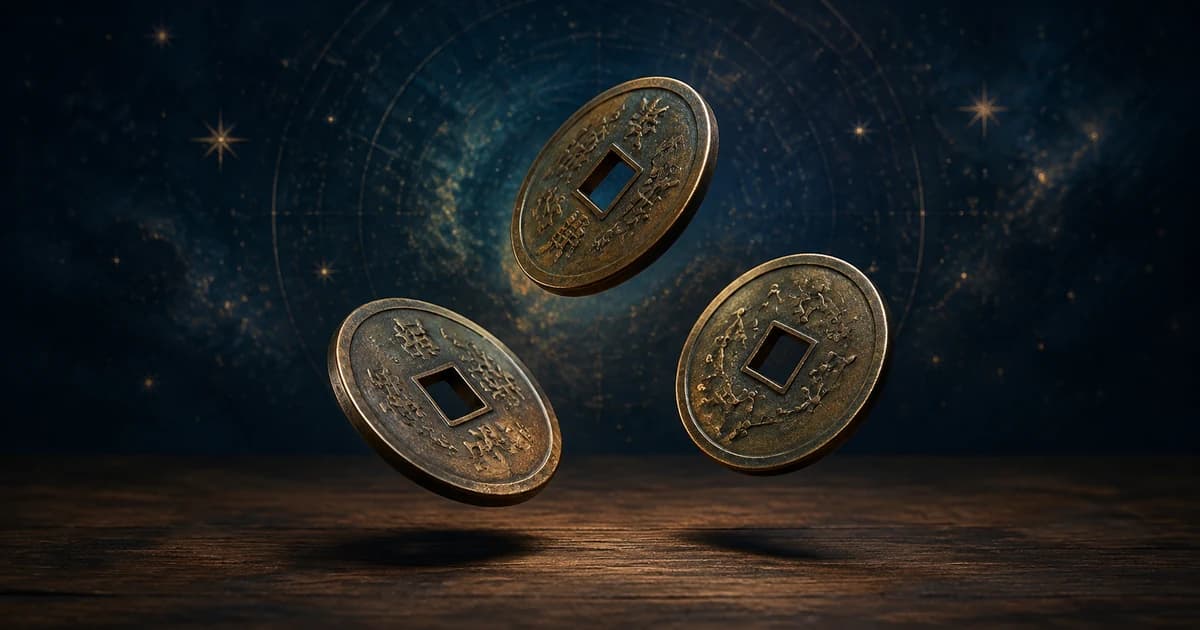
The three-coin method is the one nearly everyone uses. Assign heads 3 and tails 2, throw three coins six times, and total each throw. A total of 7 is a young yang line, 8 a young yin line, 9 an old yang line that is about to change, 6 an old yin line about to change. Build the hexagram from the bottom up: the first throw is the lowest line.
The older yarrow-stalk method divides and counts fifty stalks in a procedure that takes twenty minutes and produces the same four outcomes with different odds. Coins give each moving line a one-in-eight chance. Stalks give old yin one chance in sixteen and old yang three in sixteen, so a stalk reading changes more often through yang than yin. Practitioners argue about which is correct. Neither is; they are two conventions, and the book is silent on probability.
| Coin total | Line | Moving? | Coins | Stalks |
|---|---|---|---|---|
| 6 | Old yin | Yes, becomes yang | 1 in 8 | 1 in 16 |
| 7 | Young yang | No | 3 in 8 | 5 in 16 |
| 8 | Young yin | No | 3 in 8 | 7 in 16 |
| 9 | Old yang | Yes, becomes yin | 1 in 8 | 3 in 16 |
A worked reading
Suppose the six throws, bottom to top, come out 7, 8, 9, 7, 8, 8. That gives yang, yin, yang, yang, yin, yin. The lower three lines, yang over yin over yang, are the trigram Li, fire. The upper three, yang at the base under two yin lines, are Zhen, thunder. Fire below thunder is hexagram 21, Biting Through, whose image is a jaw closing on an obstacle.
The third line was a 9, so it moves. Old yang becomes yin, the lower trigram turns into Zhen, and thunder over thunder is hexagram 51, The Arousing. The reading is 21 turning into 51: an obstruction that has to be bitten through, tending towards a shock that clears the air.
You read three things in order. The judgement of hexagram 21 for the situation as it stands. The text of the moving third line for the specific point of pressure, which in Wilhelm's rendering warns of biting on old dried meat and meeting something poisonous, with slight humiliation and no blame. Then the judgement of 51 for where it is heading. What you do not do is read all six line texts, or every line of the second hexagram. Lines that did not move are not speaking.
The order of the sixty-four
The received order, called the King Wen sequence, arranges the hexagrams in thirty-two pairs. In most pairs the second hexagram is the first turned upside down. Peace and Standstill are one pair, and so are Biting Through and Grace. Where a hexagram looks the same upside down, as the all-yang Creative does, its partner is its complement with every line reversed, which gives the Receptive. Only eight hexagrams are their own inversion, and those four pairs are joined by complement.
Nobody has recovered the principle behind which pair follows which. A silk manuscript excavated at Mawangdui in 1973 and dated to around 168 BCE carries the same hexagrams in a completely different order, built mechanically from the trigrams, which suggests the received sequence was one arrangement among several before it became canon.
Which translation
- Wilhelm and Baynes (1950). The one most people own, with Jung's foreword. Rich, Confucian in temper, and it folds the Wings into the main text so smoothly that readers cannot tell the layers apart.
- Legge (1882). Public domain, stiff, and candid about the seams between oracle and commentary.
- Lynn (1994). Translates the Wang Bi commentary of the third century, the reading that shaped Chinese interpretation for a thousand years.
- Rutt (1996). Strips the Wings away and reads the Zhouyi as a Bronze Age oracle text about hunting, sacrifice and war. Bracing, and the right corrective if Wilhelm has made the book seem too serene.
- Minford (2014). Two complete translations in one volume, the Confucian book and the Bronze Age oracle, which is the most direct way to see that there are two books.
Does the I Ching answer?
As prediction, there is no evidence that it does, and its structure makes it very hard to test. The text is deliberately ambiguous, changing lines multiply the possible readings, and interpretation is done in context after the fact, which is exactly the shape that lets any outcome be reconciled with the reading.
What is defensible is narrower and more interesting. Forcing a vague situation through a fixed, strange, image-rich frame is a genuine method for surfacing what you already half-know, the same reason a good question from a stranger can unstick you. That's a fact about attention and reflection, not about the coins. The philosophy of change stands on its own; the oracle is a way of applying it to a Tuesday.
Three more questions
- What is the I Ching?
- The 'Book of Changes', the oldest Chinese classic. It's both a divination method (generating one of 64 six-line hexagrams, usually with three coins, and reading it plus the hexagram it changes into) and a philosophy whose central claim is that reality is continuous change, not fixed states.
- How is the I Ching different from BaZi?
- BaZi reads a person's whole life from their birth moment and is fixed for that person. The I Ching is generated fresh from the moment a question is asked and describes that specific situation, not the person. One is a birth chart; the other is closer to horary astrology.
- What are the Ten Wings?
- The commentary layer added to the ancient hexagram text centuries later, traditionally linked to the Confucian school. They turned the oracle into a philosophy, reading the hexagrams as a moral and cosmological order in which timing is the central virtue.
- Does the I Ching work?
- There is no evidence that it predicts events better than chance, and its ambiguity makes it very hard to test. What it does reliably do is provide a structured frame for reflecting on a situation, which can surface what you already sense, a fact about attention, not about the coins.
- How do you cast the I Ching with coins?
- Throw three coins six times, scoring heads 3 and tails 2. A total of 7 or 8 is a fixed line, 9 or 6 a moving line. Build the hexagram from the bottom up, then change the moving lines to find the second hexagram.
- What is the King Wen sequence?
- The received order of the sixty-four hexagrams, arranged in thirty-two pairs where each is usually the other turned upside down. A silk manuscript from Mawangdui carries a different, mechanical order, so the received sequence was not the only one.
 Lily Lau