

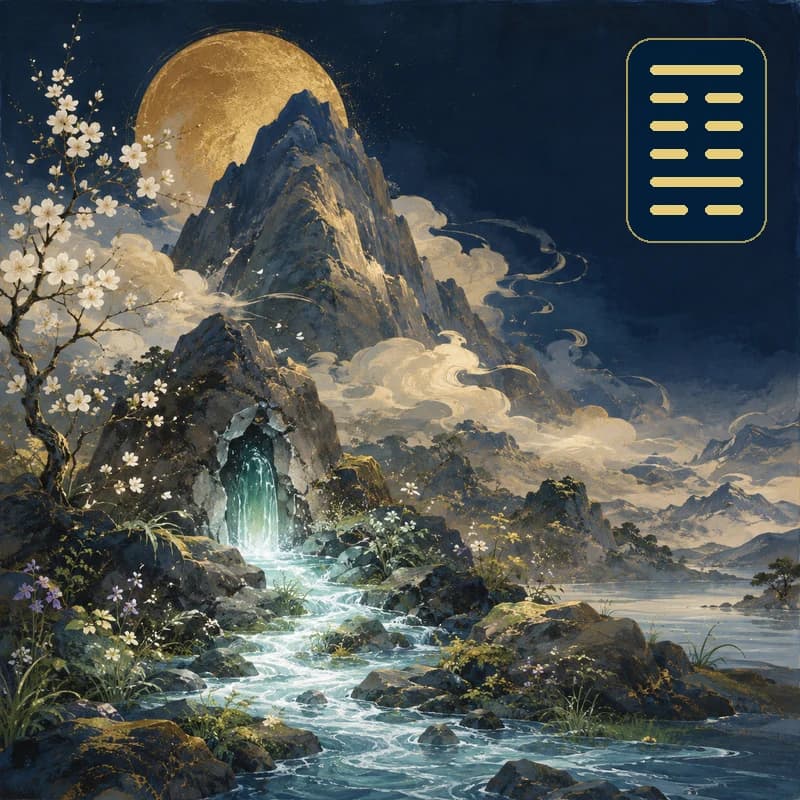
I Ching · King Wen 4
Hexagram 4: Youthful Folly
䷃ 蒙 Méng · also called Inexperience, Enveloping · Keeping Still above The Abysmal
Inexperience seeking guidance: the learner must ask, and the teacher must not be asked twice for the same answer.
inexperiencelearningguidancesinceritydiscipline
The meaning of Hexagram 4
A spring at the foot of a mountain: water that does not yet know where it is going. Youthful Folly is about not knowing, and about the proper relationship between the one who does not know and the one who does. The tradition's rule is famous: the student seeks the teacher, not the other way round, and a question asked over and over out of doubt is not answered. The reading is not an insult. It says the situation is one of inexperience, that guidance is available, and that the way to receive it is with sincerity and without pestering.
The image. A spring rises at the mountain's foot; the wise person acts with resolve and cultivates character.
- Advice
- Admit what you do not know, seek one good teacher, and take the answer you are given.
- Warning
- Asking the same question repeatedly, hoping for a different answer, shuts the source of guidance.
 over
over
Structure: ☵ The Abysmal (Water) below, ☶ Keeping Still (Mountain) above. Nuclear hexagram 24, Return. Every line reversed: 49, Revolution.
Hexagram 4 for love and relationships
Someone in the situation is inexperienced, and pretending otherwise is the problem. Be honest about what you do not know. If you are the one being asked for the same reassurance repeatedly, the reading supports a kind, firm answer given once.
Hexagram 4 for career
A learning position. Find the person who knows and ask properly; do not ask everyone, and do not keep asking the same thing. The reading rewards the humble learner and the teacher who sets clear limits.
Hexagram 4 for money
Do not act on money matters you do not understand. Take advice from someone qualified, once, and follow it. The folly the hexagram names is repeating a question because you dislike the answer.
Hexagram 4 for decisions
You do not yet know enough to decide well. Get guidance, sincerely, from one good source, and then act on it rather than shopping for a second opinion that agrees with you.
The six changing lines
Read from the bottom. A changing line flips, and the hexagram it changes into is named with each.
Punishing folly. It does not further to commit transgressions; it furthers to prevent them.
At the top, discipline becomes punishment. The line permits it only to prevent harm, never as retaliation; the aim is to stop a fault, not to make someone pay for it.
Changing, it becomes Hexagram 7, The Army. Read line 6 →
Childlike folly brings good fortune.
Not knowing, held with openness and trust: the beginner's mind the tradition admires. Someone who admits ignorance without shame and follows guidance sincerely is in the best possible position to learn.
Changing, it becomes Hexagram 59, Dispersion. Read line 5 →
Entangled folly brings humiliation.
Inexperience that has wrapped itself in fantasy. The person will not learn because they will not face what is real, and the tradition says the teacher should leave them to the consequences for a while. If this is you, the way out is contact with reality.
Changing, it becomes Hexagram 64, Before Completion. Read line 4 →
Do not take the girl who throws herself at a man of bronze. Nothing furthers.
A warning against grasping at someone or something purely because it looks strong or successful. Losing yourself in imitation or infatuation leads nowhere. The line asks for self-possession.
Changing, it becomes Hexagram 18, Work on What Has Been Spoiled. Read line 3 →
Bearing with fools kindly is fortunate. Knowing how to take a wife is fortunate. The son can run the household.
The line of the patient teacher: someone who tolerates inexperience gently and is trusted with real responsibility because of it. Kindness toward those who know less is rewarded with authority.
Changing, it becomes Hexagram 23, Splitting Apart. Read line 2 →
Discipline makes the fool learn. Fetters help; continuing that way brings shame.
At the start, rules and limits are useful; a beginner needs structure. The line adds that structure imposed for too long becomes humiliation. Use discipline to open the mind, not to close it.
Changing, it becomes Hexagram 41, Decrease. Read line 1 →
Related hexagrams
Cast your own reading
Ask a question and toss six lines. The oracle does not choose the hexagram for you; the coins do.
Ask the I Ching →Common questions
- What does I Ching Hexagram 4 mean?
- Inexperience seeking guidance: the learner must ask, and the teacher must not be asked twice for the same answer. A spring at the foot of a mountain: water that does not yet know where it is going. Youthful Folly is about not knowing, and about the proper relationship between the one who does not know and the one who does. The tradition's rule is famous: the student seeks the teacher, not the other way round, and a question asked over and over out of doubt is not answered. The reading is not an insult. It says the situation is one of inexperience, that guidance is available, and that the way to receive it is with sincerity and without pestering.
- What does Hexagram 4 mean for love?
- Someone in the situation is inexperienced, and pretending otherwise is the problem. Be honest about what you do not know. If you are the one being asked for the same reassurance repeatedly, the reading supports a kind, firm answer given once.
- Which hexagram does Hexagram 4 change into?
- It depends on which lines change. With one changing line: line 1 gives Hexagram 41, Decrease; line 2 gives Hexagram 23, Splitting Apart; line 3 gives Hexagram 18, Work on What Has Been Spoiled; line 4 gives Hexagram 64, Before Completion; line 5 gives Hexagram 59, Dispersion; line 6 gives Hexagram 7, The Army. With every line changing it becomes Hexagram 49, Revolution.