Western zodiac
Capricorn
 Capricorn
 Dec 22 – Jan 19 (approximate) · Earth · Cardinal
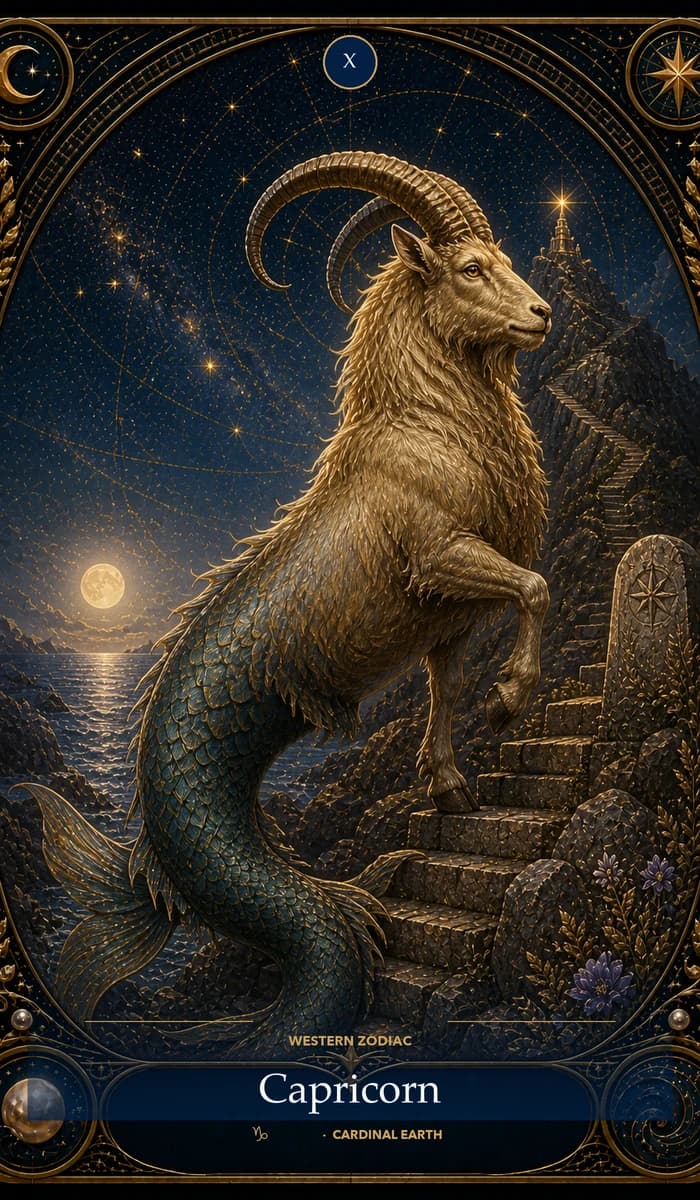
You climb, quietly, until you're at the top.
Dates are approximate: sign transitions vary slightly by year and time; your exact sign is calculated astronomically.
Why Capricorn is Capricorn
Earth + Cardinal + Saturn
Earth concerns results and resources; Cardinal signs initiate; Saturn is the classical planet of limit, structure and time. Together they produce the Capricorn emphasis on ambition, discipline and the long climb: a sign that starts things it intends to still be standing in thirty years. The severity follows from the same recipe.
Capricorn at a glance
- Element
- Earth
- Earth concerns what is tangible and usable: resources, bodies, results.
- Modality
- Cardinal
- Cardinal signs open a season and initiate; they start things.
- Degrees
- 270°–300° tropical zodiac
- Thirty degrees of the ecliptic, measured from the March equinox. Every sign is exactly thirty; the constellations behind them are not.
- Seasonal position
- Early winter, from the December solstice, Northern Hemisphere
- The tropical zodiac follows the seasons of the Northern Hemisphere. South of the equator the calendar dates are the same and the season is the opposite.
Capricorn in detail
Strengths
Discipline and earned authority: the tradition's summary of what the combination above is for.
Shadow / growth edge
Letting worth exist outside achievement.
Relationships
Capricorn is traditionally read as loving with commitment and provision. The classical caution is presence over performance.
Work and ambition
The tradition suits Capricorn to the long game: institutions, mastery, leadership that outlasts trends.
Capricorn as Sun, Moon and Rising
In modern Western astrology the Sun, Moon and Rising are often called the “Big Three”: the Sun is read through identity and direction, the Moon through emotional needs and instinct, and the Rising through how you enter the world. The same sign plays a different role in each.
- ☉ Capricorn Sun
- What it describes: The sign the Sun occupied on your birth date. In modern Western astrology it is read through identity, vitality and direction; traditional astrology read it for the life's honour and the father, and by sect.
- How Capricorn tends to express here: A Capricorn Sun is traditionally read as identity built on responsibility: the person who felt like the adult in the room early, and who measures a life by what it built.
- What it does not mean: It does not mean your whole personality is this sign. Nine other bodies and the houses have a say.
- ☽ Capricorn Moon
- What it describes: The sign the Moon occupied at your birth. Modern astrology reads it through emotional needs and instinct; traditional astrology read it for the body, the mother, and the fluctuating conditions of a life.
- How Capricorn tends to express here: A Capricorn Moon is traditionally read as needing respect and reliability to feel safe. Feelings are said to be managed like commitments, and shown late.
- What it does not mean: It does not mean your feelings are fixed. It describes what tends to settle you, not what will happen to you.
- ↗ Capricorn Rising
- What it describes: The sign rising on the eastern horizon at your birth, from the exact time and place. Traditionally the sign of the body and of how life meets you; in modern shorthand, presentation and approach.
- How Capricorn tends to express here: Capricorn Rising is traditionally read as a serious, dependable manner: people tend to hand it responsibility early, and to be surprised by the dry humour underneath.
- What it does not mean: It does not mean your entire personality is this sign. It is the door, not the house.
Capricorn’s opposite: Cancer
Capricorn and Cancer sit 180° apart, and both are Cardinal: both build. Capricorn builds the public position; Cancer builds the private home. The axis is about security in its two forms, and each sign can mistake the other's for weakness.
Explore Cancer →The three decans of Capricorn
A sign is thirty degrees wide, and the tradition has never treated all thirty as identical. Each splits into three ten-degree decans, roughly the first, middle and last ten days the Sun spends here. Two systems assign a planet to each decan and they disagree, so both are shown and named. Your decan is decided by your degree of Capricorn, not your birthday; your natal chart gives it exactly.
Capricorn I
0°–10° Capricorn
Modern triplicity decan: Capricorn · ruled by Saturn. In the triplicity system the first third of Capricorn emphasises the sign's own qualities, under its own ruler.
Traditional Chaldean face ruler: Jupiter. In the older Chaldean face system these same ten degrees are assigned to Jupiter.
Capricorn II
10°–20° Capricorn
Modern triplicity decan: Taurus · ruled by Venus. In the triplicity system these degrees take a Taurus colouring, the next sign of Earth, and Venus joins Saturn in the reading.
Traditional Chaldean face ruler: Mars. In the older Chaldean face system these same ten degrees are assigned to Mars.
Capricorn III
20°–30° Capricorn
Modern triplicity decan: Virgo · ruled by Mercury. In the triplicity system these degrees take a Virgo colouring, the third sign of Earth, and Mercury joins Saturn in the reading.
Traditional Chaldean face ruler: Sun. In the older Chaldean face system these same ten degrees are assigned to Sun.
The first is a common modern triplicity scheme: the three signs of the element in order, starting from this one. The second is the Chaldean face system, older and still standard in traditional and tarot work, which runs the seven visible planets in order of apparent speed through all thirty-six faces without regard to sign. Two books can give different decan rulers for the same degree without either being wrong; they are using different systems. AsterNym shows both rather than picking one quietly.
Famous Capricorn charts
Public figures whose published birth date puts the Sun in Capricorn:
Where does Capricorn appear in your chart?
You may carry Capricorn as your Sun, your Moon, your Rising, or in none of the three and somewhere else entirely.