Western zodiac
Leo
 Leo
Leo Jul 23 – Aug 22 (approximate) · Fire · Fixed
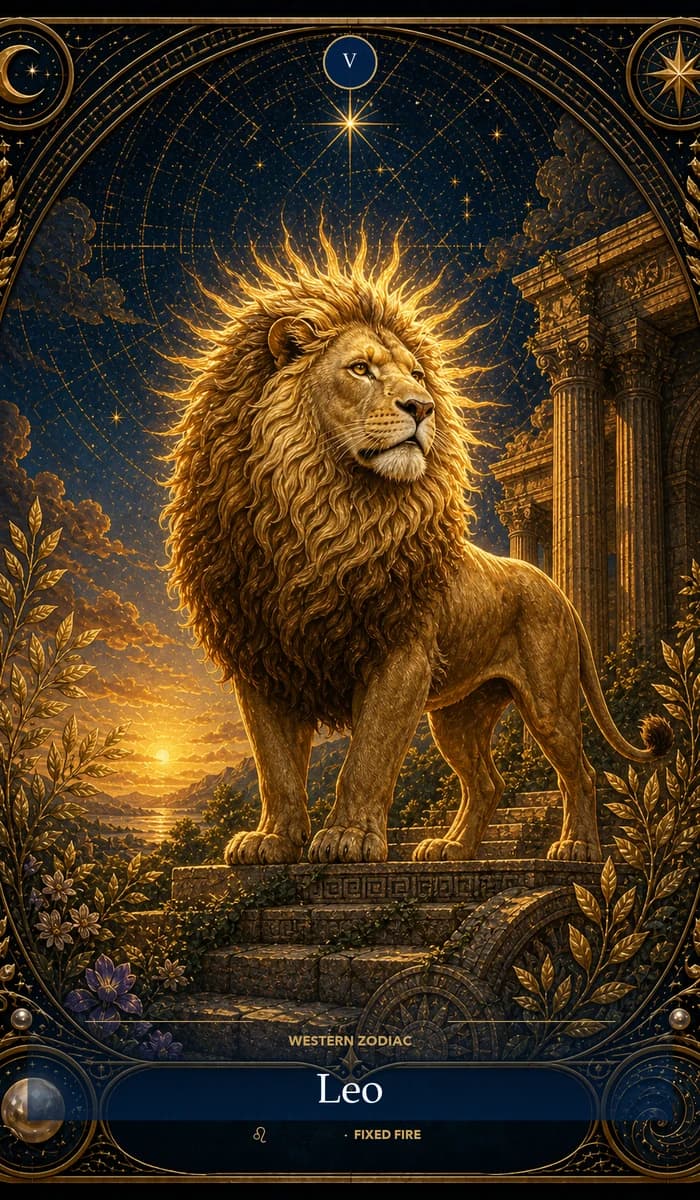
You warm the room and mean it.
Dates are approximate: sign transitions vary slightly by year and time; your exact sign is calculated astronomically.
Why Leo is Leo
Fire + Fixed + Sun
Fire concerns expression; Fixed signs sustain and consolidate; the Sun is the visible centre of the classical planetary system. Together they produce the Leo emphasis on sustained creative expression, warmth, pride and visibility. The need for an audience is not an addition to the recipe; it is what a fixed fire looks like.
Leo at a glance
- Element
- Fire
- Fire concerns action and expression: the drive to do, show and begin.
- Modality
- Fixed
- Fixed signs hold the middle of a season and consolidate; they sustain things.
- Degrees
- 120°–150° tropical zodiac
- Thirty degrees of the ecliptic, measured from the March equinox. Every sign is exactly thirty; the constellations behind them are not.
- Seasonal position
- Mid-summer, Northern Hemisphere
- The tropical zodiac follows the seasons of the Northern Hemisphere. South of the equator the calendar dates are the same and the season is the opposite.
Leo in detail
Strengths
Generous confidence and heart: the tradition's summary of what the combination above is for.
Shadow / growth edge
Shining without needing the mirror.
Relationships
Leo is traditionally read as loving loudly and loyally. The classical caution is applauding as readily as being applauded.
Work and ambition
The tradition suits Leo to visible work: creative direction, performance, leading from the front, anything where the effort can be seen.
Leo as Sun, Moon and Rising
In modern Western astrology the Sun, Moon and Rising are often called the “Big Three”: the Sun is read through identity and direction, the Moon through emotional needs and instinct, and the Rising through how you enter the world. The same sign plays a different role in each.
- ☉ Leo Sun
- What it describes: The sign the Sun occupied on your birth date. In modern Western astrology it is read through identity, vitality and direction; traditional astrology read it for the life's honour and the father, and by sect.
- How Leo tends to express here: A Leo Sun is traditionally read as identity built on radiance: the person at their best when creating and seen creating, and generous with attention once they have it.
- What it does not mean: It does not mean your whole personality is this sign. Nine other bodies and the houses have a say.
- ☽ Leo Moon
- What it describes: The sign the Moon occupied at your birth. Modern astrology reads it through emotional needs and instinct; traditional astrology read it for the body, the mother, and the fluctuating conditions of a life.
- How Leo tends to express here: A Leo Moon is traditionally read as needing warmth, recognition and wholehearted affection from the people closest. Quiet appreciation may not always feel like enough.
- What it does not mean: It does not mean your feelings are fixed. It describes what tends to settle you, not what will happen to you.
- ↗ Leo Rising
- What it describes: The sign rising on the eastern horizon at your birth, from the exact time and place. Traditionally the sign of the body and of how life meets you; in modern shorthand, presentation and approach.
- How Leo tends to express here: Leo Rising is traditionally read as a warm, self-assured presentation: rooms tend to arrange themselves around it, and the person is often assumed to be more confident than they feel.
- What it does not mean: It does not mean your entire personality is this sign. It is the door, not the house.
Leo’s opposite: Aquarius
Leo and Aquarius sit 180° apart, and both are Fixed: both hold their position. Leo personalises, this is what I made. Aquarius abstracts, this is what the group needs. The axis is about visibility and collective purpose, and the opposition is less a quarrel than two answers to the same question about where the light should fall.
Explore Aquarius →The three decans of Leo
A sign is thirty degrees wide, and the tradition has never treated all thirty as identical. Each splits into three ten-degree decans, roughly the first, middle and last ten days the Sun spends here. Two systems assign a planet to each decan and they disagree, so both are shown and named. Your decan is decided by your degree of Leo, not your birthday; your natal chart gives it exactly.
Leo I
0°–10° Leo
Modern triplicity decan: Leo · ruled by Sun. In the triplicity system the first third of Leo emphasises the sign's own qualities, under its own ruler.
Traditional Chaldean face ruler: Saturn. In the older Chaldean face system these same ten degrees are assigned to Saturn.
Leo II
10°–20° Leo
Modern triplicity decan: Sagittarius · ruled by Jupiter. In the triplicity system these degrees take a Sagittarius colouring, the next sign of Fire, and Jupiter joins Sun in the reading.
Traditional Chaldean face ruler: Jupiter. In the older Chaldean face system these same ten degrees are assigned to Jupiter.
Leo III
20°–30° Leo
Modern triplicity decan: Aries · ruled by Mars. In the triplicity system these degrees take a Aries colouring, the third sign of Fire, and Mars joins Sun in the reading.
Traditional Chaldean face ruler: Mars. In the older Chaldean face system these same ten degrees are assigned to Mars.
The first is a common modern triplicity scheme: the three signs of the element in order, starting from this one. The second is the Chaldean face system, older and still standard in traditional and tarot work, which runs the seven visible planets in order of apparent speed through all thirty-six faces without regard to sign. Two books can give different decan rulers for the same degree without either being wrong; they are using different systems. AsterNym shows both rather than picking one quietly.
Famous Leo charts
Public figures whose published birth date puts the Sun in Leo:
Where does Leo appear in your chart?
You may carry Leo as your Sun, your Moon, your Rising, or in none of the three and somewhere else entirely.