

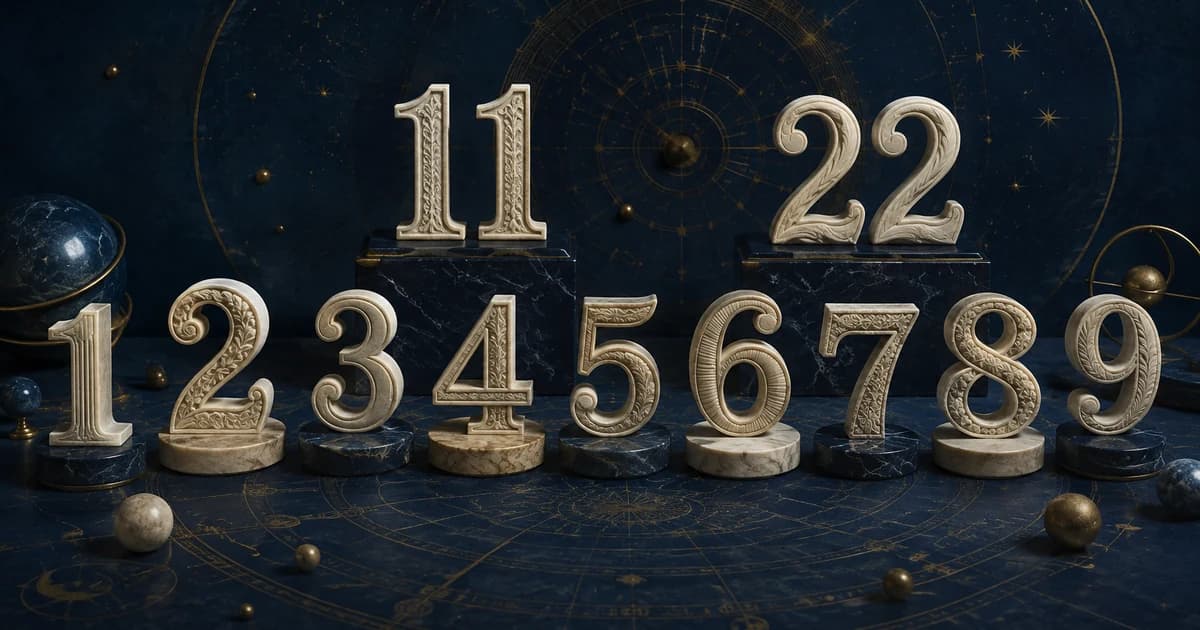
Master numbers 11, 22, 33: what makes them different
Three numbers that break the reduction rule, and one that half the field doesn't accept.
4 min read · Published 20 August 2026
In one paragraph
Master numbers are 11, 22 and 33, totals that numerology leaves unreduced instead of collapsing to 2, 4 and 6. They're described as carrying greater potential and greater difficulty than the single digit beneath them: 11 as intuition and nervous intensity, 22 as the master builder, 33 as the master teacher. Schools disagree over whether 33 qualifies as a Life Path at all, which is a helpful reminder that the rules were decided instead of discovered.
What makes them 'master'
Numerology's basic rule is reduction: every total collapses to a single digit. Master numbers are the stated exception, kept whole because each is a doubling of a single digit. 11 is two ones, 22 is two twos, 33 is two threes.
The reasoning offered is that a doubled number brings the qualities of its root at higher intensity, with correspondingly higher difficulty. An 11 is said to carry the 2's sensitivity amplified to the point of strain; a 22 the 4's structural capability at a scale that's hard to sustain.
Each also retains its reduced number underneath. An 11 is described as 11/2: the master expression on top of the ordinary 2, which is what it falls back to when the higher expression isn't being lived.
| Number | Reduces to | Traditional description | The strain attached |
|---|---|---|---|
| 11 | 2 | Intuition, vision, spiritual sensitivity | Nervous tension; overwhelm; a sensitivity that costs |
| 22 | 4 | The master builder, large structures made real | Pressure of scale; paralysis in the face of the vision |
| 33 | 6 | The master teacher · service without self-interest | Self-sacrifice past the point of usefulness |
The 33 problem
Not every school accepts 33 as a Life Path number, and the disagreement is instructive.
The stricter position holds that 33 only counts as a master number if it appears as a total of the reduced month, day and year components, and depending on the calculation method, that combination is extremely restrictive. Some practitioners argue that a Life Path 33 is effectively impossible under a correct calculation and that anyone reporting one has used a loose method.
Others accept it freely. The result is that whether you 'have' a 33 depends entirely on whose rules your calculator implemented.
That deserves sitting with, because it isn't a subtle disagreement about interpretation. Two practitioners will tell you that you do and don't possess the rarest configuration in the system.
33 is a master number because someone wanted a third one. I'd stop at 22.
The candid problem
A category defined as *more significant* has an obvious pull, and numerology has no mechanism to resist it.
There is no test that could show whether someone has master-number qualities. The descriptions include both an elevated expression and a fallback to the reduced number, which means any observed behaviour fits: living up to it confirms the master number, and not living up to it confirms the fallback. Nothing could count against it.
That's textbook unfalsifiability. The same structure examined in is astrology a science, and it's more acute here than elsewhere in numerology, because the category is explicitly flattering.
If you calculate an 11 or 22, the handy response is interest instead of identity. If it produces a sense of being marked out, that feeling is the thing to be sceptical of.
Where they show up
Master numbers can appear in any of the core positions: Life Path, Expression, Soul Urge or Personality, and in personal year cycles, though most practitioners reduce personal years to single digits.
AsterNym's policy is per position, not global. The Life Path, Expression, Soul Urge and Personality keep 11, 22 and 33 and label them; the Birthday Number keeps 11 and 22; Personal Year, Month and Day reduce to 1 to 9, so the nine-year cycle stays a nine-year cycle. The numerology page prints the policy for each position.
What are master numbers in numerology?
The numbers 11, 22 and 33, which are left unreduced instead of collapsing to 2, 4 and 6. Each is a doubling of a single digit and is described as carrying that digit's qualities at higher intensity, with correspondingly greater difficulty.
Is 33 a real master number?
It is disputed. Some practitioners hold that a Life Path 33 is effectively impossible under a strict calculation and that anyone reporting one has used a loose method; others accept it freely. Whether you have one depends on whose rules your calculator implemented.
What does 11/2 mean?
It indicates a master number 11 that reduces to 2. The notation shows both the master expression and the ordinary number underneath it, which most numerology guides describe as what the person falls back to when the higher expression isn't being lived.
Are master numbers better than single digits?
Numerologists describe them as carrying greater potential and greater difficulty instead of being better. There's also no way to test the claim: living up to a master number confirms it and not doing so confirms the fallback, so nothing could count against it.
 Santiago Garcias