

The planets in astrology: what each one represents
In astrology the planets are the active agents of a chart.
9 min read · Published 16 August 2026
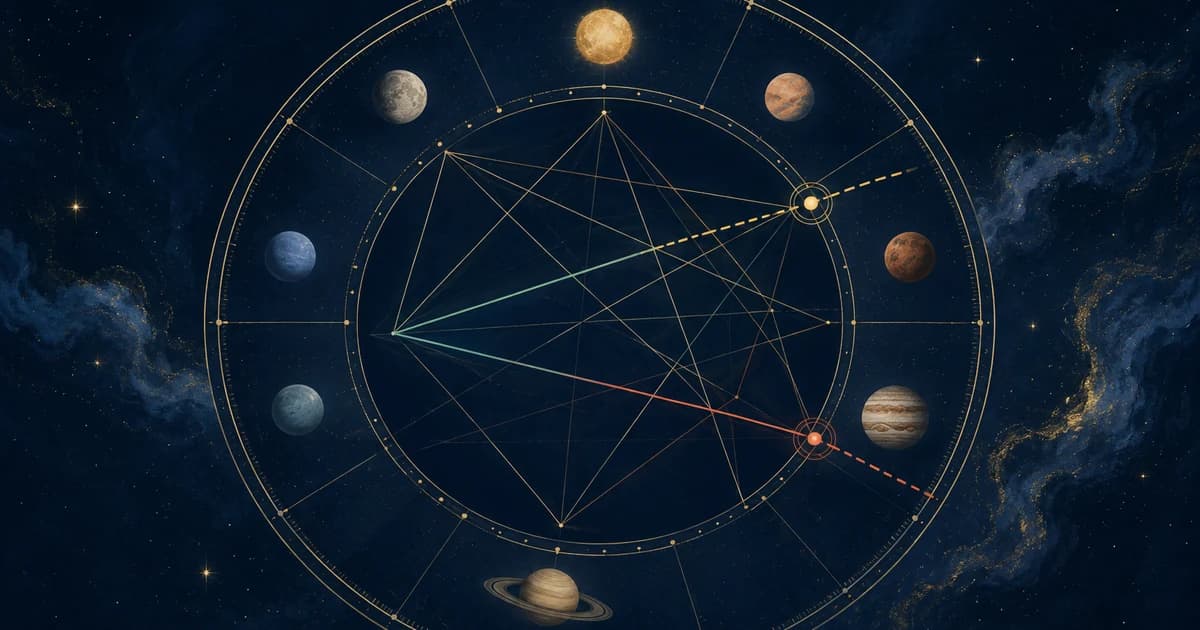
In astrology the planets are the active agents of a chart. The parts that do something, where signs describe manner and houses describe area of life. The traditional seven, visible to the naked eye, are the Sun for vitality and identity, the Moon for emotion and instinct, Mercury for thought and communication, Venus for attraction and values, Mars for drive and conflict, Jupiter for expansion and belief, and Saturn for limit, structure and time. Three modern additions follow: Uranus for disruption, Neptune for dissolution and imagination, and Pluto for power and transformation. The most handy division is by speed. Sun through Mars move quickly and describe an individual; Jupiter and Saturn are social and generational-adjacent; Uranus, Neptune and Pluto move so slowly that they are shared by everyone born within years of you, which limits what they can say about a person.
The traditional seven
| Body | Governs | Rules | Cycle |
|---|---|---|---|
| Sun | Vitality, identity, direction, the father | Leo | 1 year |
| Moon | Emotion, instinct, habit, the mother | Cancer | 27.3 days |
| Mercury | Thought, speech, learning, trade, travel | Gemini, Virgo | 88 days |
| Venus | Attraction, values, art, harmony, money | Taurus, Libra | 225 days |
| Mars | Drive, anger, courage, conflict, desire | Aries, Scorpio | 687 days |
| Jupiter | Expansion, belief, luck, excess, teaching | Sagittarius, Pisces | 11.9 years |
| Saturn | Limit, structure, time, discipline, loss | Capricorn, Aquarius | 29.5 years |
These are the seven classical planets, and the word planet is used loosely here. It comes from the Greek for wanderer, and originally meant anything that moved against the fixed stars, which included the Sun and Moon. The rulerships in the third column are the traditional scheme, expanded on in every sign's ruling planet.
The three modern planets
Uranus was discovered in 1781, Neptune in 1846 and Pluto in 1930, and astrology absorbed each of them within a few decades. They were assigned rulership of Aquarius, Pisces and Scorpio respectively, displacing Saturn, Jupiter and Mars: a change traditional astrologers largely reject.
Uranus counts, for traditional astrologers, as disruption, sudden change, independence and everything that breaks a pattern. Neptune as dissolution, imagination, compassion, illusion and the loss of boundaries. Pluto as power, compulsion, destruction and transformation.
There is an argument to notice here, and it cuts both ways. The meanings assigned were shaped by what was happening when each was found: Uranus by the age of revolutions, Neptune by Romanticism and the discovery of anaesthesia, Pluto by the atomic era and the rise of mass ideology. Defenders read that as the sky and the age corresponding. Critics read it as astrologers naming planets after their own historical moment, and note that Pluto's 2006 reclassification as a dwarf planet changed nothing in astrological practice, which suggests the category was never doing the work.
I'd rank a planet's condition above its sign. A weak Venus in Libra does less than a strong Venus in Aries, whatever the books say.
What makes a planet strong
Astrologers have a well-developed and often-skipped machinery for deciding how much weight a placement carries, and it's more interesting than the sign meanings.
Dignity: a planet in the sign it rules is at full strength; in the opposite sign, called detriment, it is weakened; exalted in a particular sign it is amplified, and in the sign opposite that, its fall, it struggles. Mars in Aries is strong; Mars in Libra is in detriment.
Angularity: a planet in the 1st, 4th, 7th or 10th house is more prominent in a life than the same planet in a cadent house. This is set out in angular, succedent and cadent.
Condition: whether it is retrograde, combust from being too near the Sun, or tightly aspected by benefics or malefics.
Modern popular astrology dropped most of this, which is part of why sign-based readings feel flat: without dignity, every placement has the same weight, and a chart becomes a list instead of a hierarchy.
Why the week is in that order
The seven classical planets gave the days of the week their names, and the order of the days is a piece of astrology hiding in plain sight. Arrange the planets by apparent speed, slowest first: Saturn, Jupiter, Mars, Sun, Venus, Mercury, Moon. This is the Chaldean order, and late antiquity assigned the hours of the day to the planets in that sequence, cycling round. Twenty-four hours later the cycle has advanced by three places, so the planet ruling the first hour of the next day is three steps on: Saturn's day is followed by the Sun's, then the Moon's, then Mars's, Mercury's, Jupiter's and Venus's.
Saturday, Sunday, Monday. Then, in the Romance languages, mardi, mercredi, jeudi, vendredi for Mars, Mercury, Jupiter and Venus, which English replaced with the Germanic gods Tiw, Woden, Thor and Frigg standing in for the same planets. Every calendar on your phone runs on a planetary-hour system from the second century, and almost nobody who uses it knows.
Benefics, malefics and sect
Traditional astrology sorted the planets by temperament before it sorted them by meaning. Jupiter and Venus are the benefics, held to bring ease; Mars and Saturn the malefics, held to bring difficulty; the Sun and Moon the lights, and Mercury neutral, taking its character from what it touches. Modern astrology softened this into 'challenging' and 'flowing', but the older scheme is what the aspect readings and the dignity tables assume.
The refinement is sect. In a day chart the Sun, Jupiter and Saturn are 'of the sect' and behave better; in a night chart the Moon, Venus and Mars do. So Saturn in a day chart is a stern but constructive planet and in a night chart the harsher one, while Mars is worse by day and more usable by night. This one idea explains a great deal of what a traditional reading says about the same planet in two charts, and it is covered in sect: day and night charts.
How long each spends in a sign
| Body | Time in one sign | Shared by |
|---|---|---|
| Moon | About 2.5 days | People born the same two or three days |
| Mercury | Two to nine weeks, depending on retrograde | People born within a few weeks |
| Venus | About four weeks, longer when retrograde | People born within about a month |
| Sun | About a month | Everyone with the same Sun sign |
| Mars | About six to seven weeks | People born within a couple of months |
| Jupiter | About a year | A school year |
| Saturn | About two and a half years | A few school years |
| Uranus | About seven years | A generation's younger half |
| Neptune | About fourteen years | A generation |
| Pluto | Twelve to thirty-one years, by its elliptical orbit | Up to two generations |
The right-hand column is the practical guide to how much a placement can say about you. A Moon sign separates you from most people born that month. A Neptune sign does not separate you from anyone you went to school with.
The bodies astrologers argue about
Beyond the ten, practitioners disagree about what else belongs. Chiron, a small body between Saturn and Uranus found in 1977, has been widely adopted as 'the wounded healer'. The four largest asteroids have their followers, discussed in asteroids in astrology. The lunar nodes, which are points and not bodies, are used by almost everyone. Lilith, in its most common form, is a point too, the empty focus of the Moon's orbit.
AsterNym computes the ten planets and the nodes, and states the reason for stopping there on the minor bodies page: a smaller set computed properly is preferable to a larger one computed through a route it has not verified. Where a planet is missing from a chart on this site, that is why.
Reading a planet in three parts
Every placement is a sentence with three components, and the order stops the interpretations blurring.
The planet is what is acting. The sign is how it acts. The house is where in life it acts. Saturn in Gemini in the third house reads as limitation and structure, expressed through communication and thinking, in the arena of speech, learning and siblings. Change only the planet and something entirely different is happening in that same arena.
Then read the aspects to see which planets are arguing with which. That's the point where a chart stops being ten separate statements and becomes something with internal structure, and it is also the point where over-interpretation gets easy, so the discipline of starting with the tightest aspects counts.
Still wondering
- What do the planets represent in astrology?
- They're the active agents of a chart. The Sun is vitality and identity, the Moon emotion and instinct, Mercury thought and communication, Venus attraction and values, Mars drive and conflict, Jupiter expansion and belief, Saturn limit and structure, with Uranus, Neptune and Pluto read as disruption, dissolution and transformation.
- Why are the Sun and Moon called planets?
- The word comes from the Greek for wanderer and originally meant any body that moved against the fixed stars, which included the Sun and Moon. Astrology kept the older usage, so the traditional seven planets include both. In astronomy the term was narrowed long after astrological practice had settled.
- What is the difference between personal and outer planets?
- Speed, and therefore how personal they can be. The Sun, Moon, Mercury, Venus and Mars move fast enough to differ between people born weeks apart. Uranus, Neptune and Pluto spend seven to twenty years in a sign, so everyone born within several years shares the placement, which makes their sign generational instead of individual.
- Does Pluto still count in astrology?
- Astrologers kept it after the 2006 reclassification as a dwarf planet, on the reasoning that astrological significance was never a function of astronomical category. Critics point out that if the category can change with no effect on the practice, the category was probably not doing the work the practice claimed.
- What does planetary dignity mean?
- A traditional system for how strongly a planet operates given its sign. A planet in the sign it rules is at full strength, in the opposite sign it's in detriment and weakened, and each has a sign of exaltation where it's amplified and a fall opposite that. Most modern popular astrology drops this scheme.
- Why are the days of the week in that order?
- The hours of the day were assigned to the seven planets in order of speed, Saturn to the Moon, cycling round. Each day advances the cycle by three places, giving Saturn, Sun, Moon, Mars, Mercury, Jupiter, Venus: Saturday through Friday, with English swapping in Germanic gods for the last four.
- What are the benefics and malefics?
- Jupiter and Venus are the benefics, held to bring ease; Mars and Saturn the malefics, held to bring difficulty. Sect refines this: in a day chart Saturn behaves better and Mars worse, and in a night chart the reverse.
- Why does AsterNym leave out Chiron?
- Its ephemeris library covers the Sun, Moon and eight planets and has no data for Chiron or any asteroid. The site computes the ten planets and the nodes and states the reason on its minor bodies page: a smaller set computed properly beats a larger one computed through an unverified route.
 Mira Hale