Angel numbers decoded: 111, 222, 333 and beyond
Popular, recent, and explained rather well by a documented feature of attention.
4 min read · Published 20 August 2026
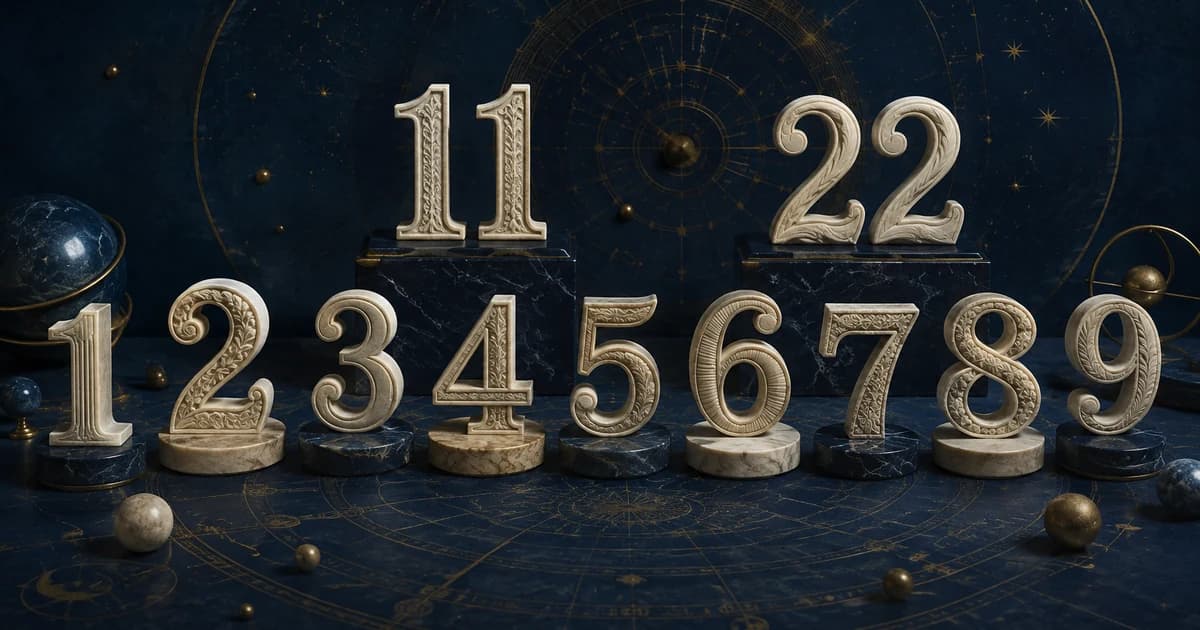
Angel numbers are repeating digit sequences (111, 222, 333) said to be messages. The concept is recent, popularised largely by Doreen Virtue from the late 1990s and spread massively by social media; it isn't an ancient tradition and has no basis in classical numerology. The reason you started seeing them everywhere after learning about them is a documented attentional effect, and knowing that doesn't have to spoil them.
What each sequence is said to mean
| Number | The common reading |
|---|---|
| 111 | New beginnings; thoughts manifesting; pay attention to what you were thinking |
| 222 | Balance, partnership, trust the process; things aligning |
| 333 | Support present; creative expression; encouragement to speak |
| 444 | Protection and stability; foundations are sound |
| 555 | Significant change arriving |
| 666 | Rebalance the material and the spiritual, not the horror-film reading |
| 777 | Alignment, good fortune, spiritual progress |
| 888 | Abundance and material return |
| 999 | Completion; a cycle closing |
| 1111 | The most-cited of all: a portal, a moment of alignment, make a wish |
These meanings are broadly consistent across sources, which is notable, but consistency here reflects everyone copying the same recent origin, not convergent tradition.
Where the idea came from
Not from classical numerology, which works with reduced single digits and the master numbers instead of repeating sequences on clocks and receipts.
The modern concept was popularised principally by Doreen Virtue, whose books from the late 1990s onwards assigned meanings to repeating number sequences as angelic communication. It spread from there through the New Age market and then, enormously, through social media, where a short video about 111 performs extremely well.
Virtue herself later publicly renounced her angel-related work after a religious conversion, which is a unusual epilogue for the founder of a popular spiritual practice and one that most content on the subject omits.
Angel numbers are a 1990s invention with a phone-clock delivery system, and I'd say so to anyone who sees 11:11.
Why you started seeing them everywhere
The experience is striking and the explanation is well documented.
It is called the frequency illusion: often the Baader-Meinhof phenomenon. Once something is brought to your attention, you notice it far more often, and the increase in noticing feels like an increase in occurrence. Two mechanisms combine: selective attention, which makes you register instances you previously filtered out, and confirmation bias, which makes those instances feel significant.
There is a second factor specific to numbers. Repeating sequences are visually distinctive, so they're more memorable than 11:38. You see 11:11 and 11:38 about equally often; you remember one of them.
And a third: most people check the time many times a day, glance at receipts, notice licence plates. The number of opportunities is enormous, so encountering repeating sequences regularly is expected instead of remarkable.
Does knowing this ruin it?
Not necessarily, and be fair here rather than merely debunking.
If seeing 111 prompts you to notice what you were thinking about, that prompt is real and the mechanism behind it doesn't matter to whether the reflection is handy. It functions like a randomly timed reminder to check in with yourself, and there's nothing wrong with that.
What needs avoiding is the stronger version: treating a sequence as confirmation that a decision is correct, or as a message about another person, or as a reason to act. A number on a clock can't know your situation, and using it as evidence is where a harmless habit turns into a bad decision-making input.
That's the same line this journal draws around Magic 8 Balls and fortune cookies: fine as a prompt, not fine as evidence.
What classical numerology does instead
Works with numbers derived from facts about you: your birth date and your name, rather than from what you happened to glance at.
That's still not evidence of anything, but it is at least reproducible: your Life Path is the same number every time anyone calculates it, whereas the numbers you notice depend on when you looked up. AsterNym computes the derived kind on your numerology page and does not do angel numbers, because there's nothing to compute.
What are angel numbers?
Repeating digit sequences such as 111, 222 and 333, interpreted as messages. The concept was popularised largely by Doreen Virtue from the late 1990s and spread through social media. It isn't part of classical numerology.
What does 1111 mean?
It is the most-cited angel number, commonly described as a moment of alignment or a prompt to notice what you were thinking. There's no traditional basis for the meaning: it derives from popular publishing of the last few decades.
Why do I keep seeing the same numbers?
The frequency illusion, also called the Baader-Meinhof phenomenon: once something is brought to your attention you notice it far more often, and that increase in noticing feels like an increase in occurrence. Repeating sequences are also visually distinctive and therefore more memorable than ordinary times.
Are angel numbers part of traditional numerology?
No. Classical numerology works with numbers derived from a birth date or name and reduced to single digits or master numbers. Assigning specific messages to repeating sequences seen on clocks and receipts is a development of roughly the last thirty years.
 Santiago Garcias